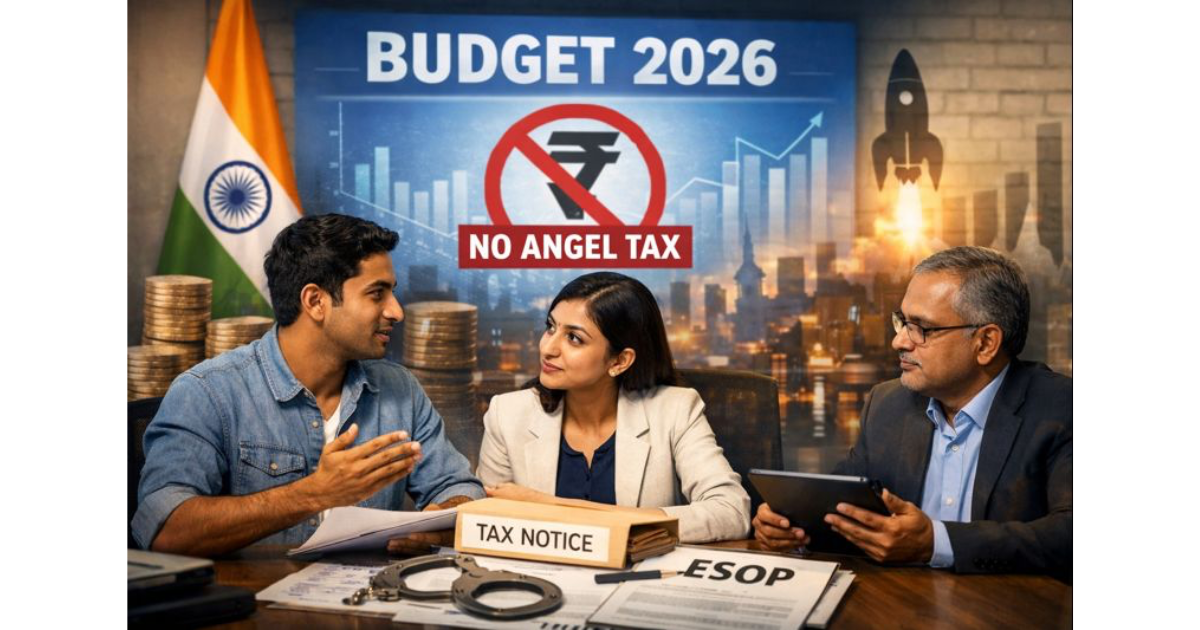
New Delhi — As India’s Union Budget 2026-27 approaches on February 1, 2026, expectations are running high across industry circles. From calls for consumer-driven growth to targeted incentives for manufacturing and deep tech, various sectors are pitching their priorities. Among these voices, one message from the startup ecosystem has been remarkably consistent: don’t just abolish the angel tax — ensure it never comes back in any disguised form and address the lingering consequences of its past.
What Was Angel Tax — And Why It Mattered
For over a decade, Indian startups grappled with a provision in Section 56(2)(viib) of the Income-Tax Act that classified equity funding received at a premium over “fair market value” as taxable income. This levy came to be dubbed the angel tax, because it most directly affected angel investors — high-net-worth individuals and early-stage backers whose capital fuels young enterprises.
Although originally introduced in 2012 to crack down on unaccounted money and curb potential money-laundering through share transactions, in practice the tax created regulatory ambiguity and investor unease. Startups argued that innovative early-stage ventures do not conform easily to traditional valuation methods such as net asset value or discounted cash-flow, leading to frequent disputes with tax authorities, protracted litigation, and even deterrence of capital inflows.
Abolition in Budget 2024 — A Milestone, Not the Finish Line
In July 2024, Finance Minister Nirmala Sitharaman announced the abolition of the angel tax for all classes of investors, a long-sought reform hailed as a major relief for the startup economy. The move took effect from April 1, 2025, under Budget 2024-25 provisions and was widely expected to unlock more early-stage funding and improve India’s investment climate.
Yet even that landmark decision has not fully quelled the ecosystem’s concerns. A significant segment of startups — particularly those that received funding prior to the abolition — are still entangled in legacy tax disputes and outstanding demands issued under the old regime. These unresolved cases are a substantial drag on both fundraising prospects and investor confidence.
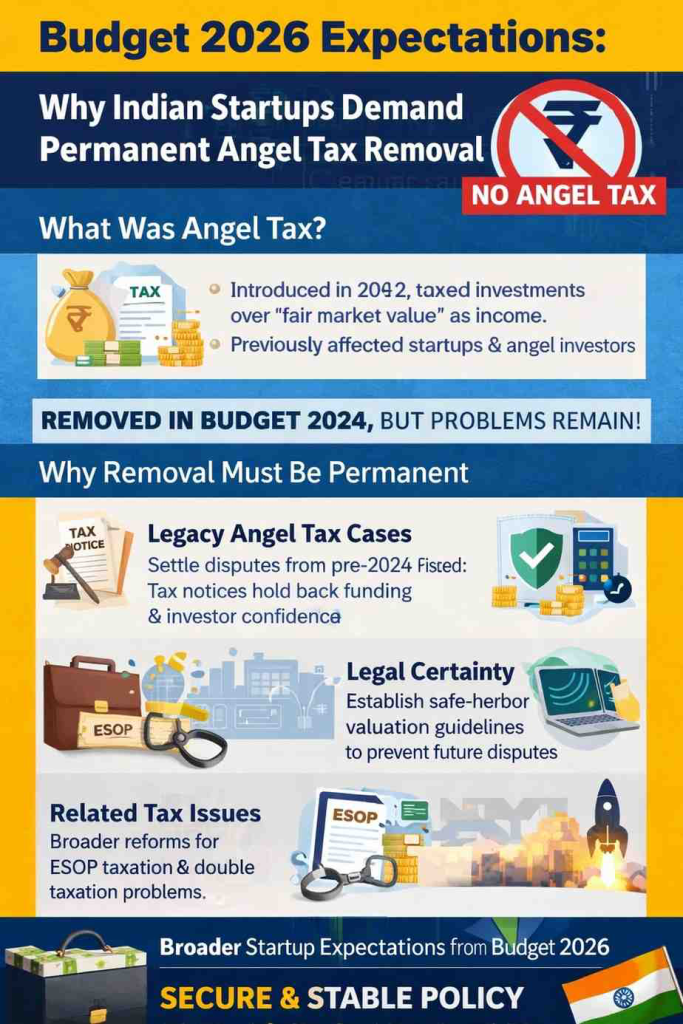
Why Startups Are Now Pushing for Permanent Angel-Tax Closure
Startups’ demands now go beyond the mere abolition of a tax line item. Their expectations from the upcoming Budget are shaped by three deep-seated concerns:
Settlement of Legacy Angel Tax Cases
Thousands of startups still face unresolved tax notices and penalties arising from pre-abolition years. Founders and investors say these old liabilities are routinely flagged during due diligence, souring deals or even scuttling capital raises. They want the government to wipe the slate clean — not just repeal the law on paper, but ensure all past disputes are conclusively settled in their favor, with clear guidelines for refunds, waivers, and withdrawal of notices.
Legacy tax demands have sometimes been severe. In reported scenarios elsewhere in the ecosystem, founders have faced multi-crore rupee demands, and even seizures of corporate bank balances, leaving businesses unable to operate normally.
Legal Certainty & Safe-Harbor Protections
Startup valuations, especially at early stages, are inherently subjective. Without a safe-harbor valuation framework, companies risk retrospective challenges from authorities. Stakeholders want clear statutory rules that compensate for this reality — a system that gives founders and investors confidence in their valuations and prevents future retroactive disputes. This is the permanent removal they seek: not just scrapping the tax, but neutralizing the conditions that could recreate similar headaches in another form.
Addressing Related Tax Issues (ESOPs & Double Taxation)
Angel tax isn’t the only tax issue in the startup playbook. Employee Stock Option Plans (ESOPs) — a critical tool to attract and retain talent — still face double taxation: taxed as a perquisite when exercised and again on capital gains when sold. Many founders want broader reform in how ESOPs are treated, including deferred or outcome-based tax triggers. These reforms, while not strictly part of the angel tax story, are closely tied to investor and employee incentives and are top of mind in Budget discussions.
Broader Startup Expectations and the Policy Landscape
The startup community expects a broader set of tax and regulatory tweaks from Budget 2026:
- Clarified tax treatment for international cloud services and foreign partnerships, ensuring clarity on permanent establishment rules.
- Expanded ESOP tax deferment rules to cover more startups and stages.
- Targeted incentives for deep-tech and research-intensive ventures, where capital intensity and longer gestation periods pose unique challenges.
Industry bodies like NASSCOM are actively advocating for these and other startup-friendly measures, signaling that tax reforms will be an important theme in Budget 2026 even beyond angel tax itself.
Why This Matters to the Economy
The startup sector today is foundational to India’s innovation ecosystem. With more than 100 unicorns and tens of thousands of emerging ventures, it contributes to employment creation, technological advancement, and global competitiveness. However, in a more disciplined funding environment — shaped by global capital tightening and domestic macro uncertainties — regulatory certainty and streamlined tax policy are now as vital as capital itself.
By addressing legacy angel tax issues comprehensively and embedding protections that prevent recurrence of similar disputes, Budget 2026 can send a powerful signal: that India is not only a land of entrepreneurial dreams, but also a jurisdiction where policy stability and certainty of outcomes are taken seriously.
Conclusion: A Budget With a Legacy to Shape
For the startup ecosystem, Budget 2026 isn’t just another fiscal event — it’s an opportunity to lock in reforms that will define India’s innovation trajectory for years to come. While the abolition of the angel tax was a welcome first step, the call now is for a permanent end to related disputes and systemic uncertainty. In the eyes of founders, investors, and global capital, that’s the real litmus test of whether India’s policy compass truly points toward startup-friendly growth.
Add digitalherald.in as a preferred source on google – click here
Last Updated on: Tuesday, January 27, 2026 10:07 am by Digital Herald Team | Published by: Digital Herald Team on Tuesday, January 27, 2026 10:07 am | News Categories: Finance