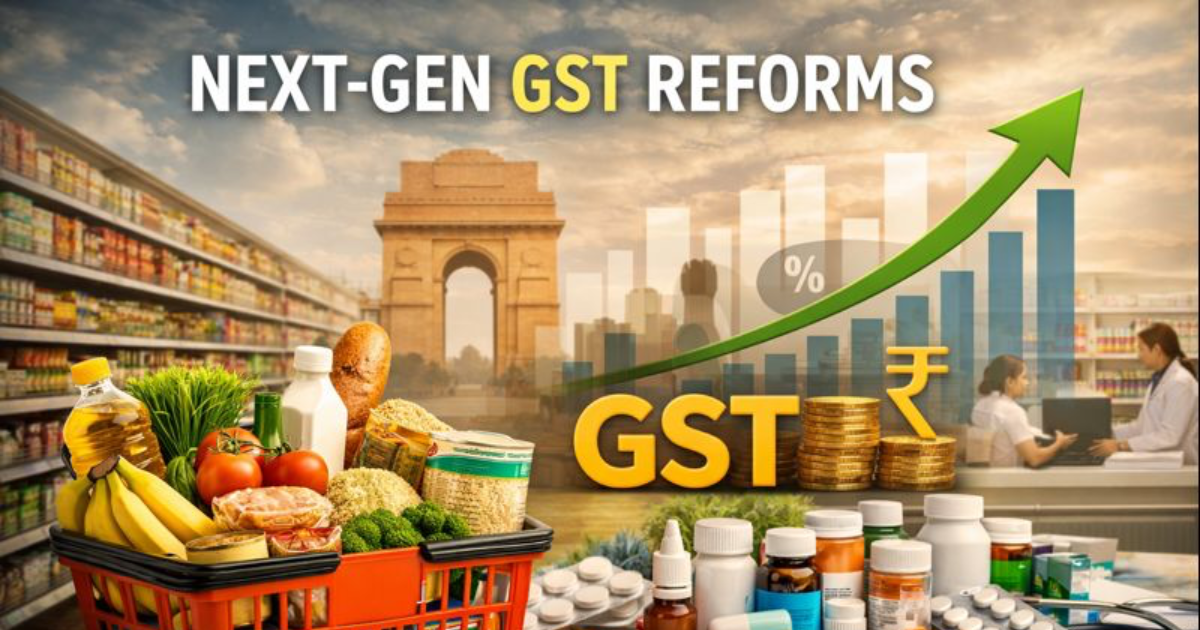
India’s next phase of Goods and Services Tax reform is unfolding without the drama of rate shocks or headline-grabbing announcements. Instead, it is a carefully calibrated reset aimed at something far more tangible: lowering the cost of essentials that households buy every month. From groceries and packaged food to life-saving medicines, the government’s proposed next-generation GST reforms are designed to plug inefficiencies, reduce hidden taxes, and smoothen the supply chain in ways that could translate into real savings at the checkout counter.
While GST has largely succeeded in unifying India’s fragmented indirect tax system since its launch in 2017, policymakers have increasingly acknowledged that the structure still carries distortions that inflate prices, especially for low-margin, high-volume goods. The next wave of reforms seeks to address these gaps, with consumers emerging as direct beneficiaries.
Why Essentials Still Cost More Than They Should
At first glance, groceries and medicines already sit in lower GST slabs or are exempt. Fresh fruits, vegetables, milk, and unbranded staples attract zero tax, while most packaged foods and medicines fall under the 5 or 12 percent slabs. Yet consumers often pay more than expected. The reason lies not only in the final GST rate, but in the layers of inefficiency that accumulate before a product reaches the shelf.
Input tax credit blockages, inverted duty structures, classification disputes, and compliance costs have quietly added to prices over the years. Manufacturers and distributors, unable to fully claim credits on inputs, have had little choice but to pass on these costs. The result is a tax system that looks light on paper but feels heavier in practice.
Rationalising Slabs to Remove Hidden Inflation
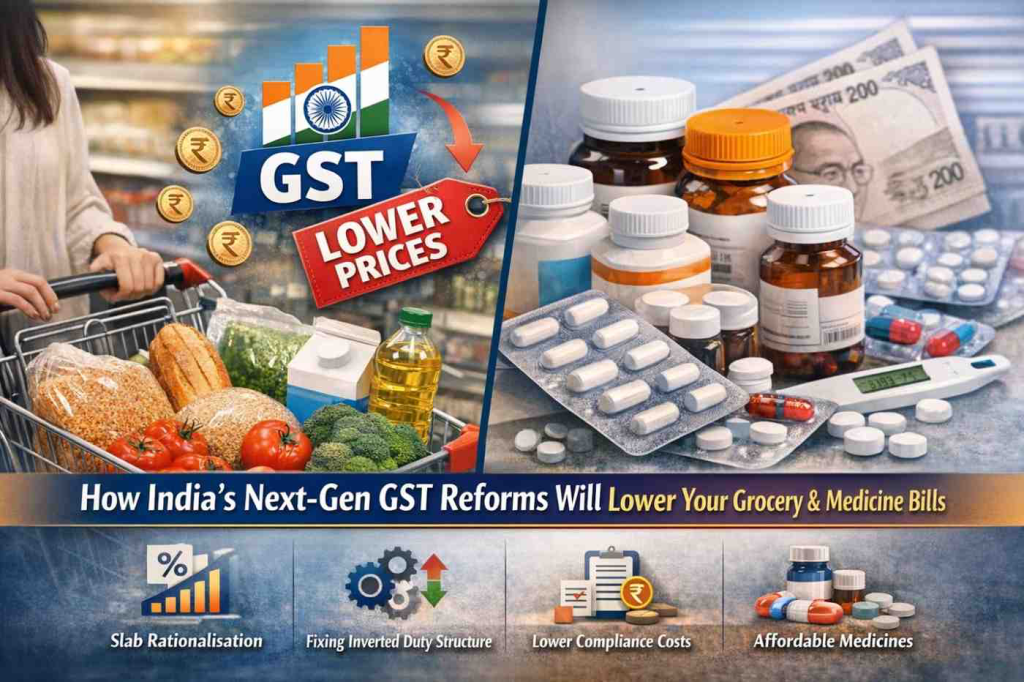
One of the central pillars of the upcoming reforms is GST slab rationalisation. Policymakers are working to merge overlapping slabs and eliminate anomalies that distort pricing. For groceries, this could mean clearer definitions between essential and non-essential packaged foods, reducing disputes that currently push businesses to price conservatively.
In the pharmaceutical sector, rationalisation aims to ensure that critical medicines remain firmly in the lowest slabs, while reducing ambiguity around formulations, combinations, and packaging. By removing uncertainty, companies can plan pricing more efficiently rather than building buffers to account for future tax challenges.
Fixing the Inverted Duty Structure
Few GST issues have been as persistent as the inverted duty structure, where the tax on inputs is higher than the tax on the final product. This is common in food processing and pharmaceuticals, where raw materials, packaging, and logistics attract higher GST than the finished goods.
The next-gen reforms propose targeted corrections to this imbalance. By aligning input and output tax rates more closely, businesses will be able to claim full credits instead of absorbing losses. Over time, this reduces production costs, creating room for lower consumer prices without squeezing manufacturer margins.
Lower Compliance Costs, Lower Shelf Prices
GST compliance has become easier than in its early years, but for small suppliers, distributors, and kirana-linked supply chains, it remains expensive and complex. Frequent return filings, reconciliations, and audits add to overheads that eventually get priced into products.
The upcoming reforms are expected to simplify return structures, expand automated reconciliations, and reduce the burden on smaller players in essential goods supply chains. As compliance costs fall, especially for wholesalers and regional distributors, the savings can flow downstream to retailers and consumers.
Cleaner Supply Chains Mean Fewer Mark-Ups
Another less visible but crucial reform area is supply chain formalisation. As GST data analytics improve, tax leakages and informal mark-ups become harder to sustain. This is particularly relevant for groceries and medicines, where multiple intermediaries often operate on thin margins but high volumes.
With better invoice matching and real-time reporting, unnecessary layers in the supply chain are gradually being squeezed out. The result is a more direct movement of goods from manufacturers to retailers, reducing cumulative mark-ups that quietly inflate consumer bills.
Impact on Medicines and Healthcare Affordability
For medicines, the stakes are especially high. Even small reductions in tax inefficiencies can have a meaningful impact on household healthcare spending. The reforms are aligned with broader public health goals, ensuring that tax policy does not undermine affordability.
By improving credit flow to pharmaceutical manufacturers and distributors, the government is indirectly supporting price stability, especially for chronic care drugs that families purchase month after month. Over time, this could complement price controls under the National List of Essential Medicines, creating a more sustainable affordability framework.
What Consumers Will Notice on Their Bills
These reforms are unlikely to trigger sudden, dramatic price cuts. Instead, their impact will be gradual and cumulative. Consumers may notice fewer price hikes, more stable MRP revisions, and better consistency across brands and regions. Over several months, this stability can translate into meaningful savings on monthly grocery and medicine bills.
For middle-class and lower-income households, where essentials account for a significant share of spending, even small reductions can improve disposable income and financial resilience.
A Reform Focused on Everyday Economics
India’s next-generation GST reforms mark a shift in focus from macro-level tax efficiency to micro-level consumer impact. By addressing structural flaws rather than chasing headline rate cuts, the government is betting on a quieter but more durable form of relief.
If implemented as envisioned, these changes could make GST not just a tool for revenue and compliance, but a mechanism that genuinely eases the cost of living. For millions of Indian households, that would mean a tax reform they feel not in policy papers, but in their monthly grocery baskets and medicine cabinets.
Add digitalherald.in as a preferred source on google – click here
Last Updated on: Wednesday, January 28, 2026 12:30 pm by Digital Herald Team | Published by: Digital Herald Team on Wednesday, January 28, 2026 12:30 pm | News Categories: News