India’s public healthcare system has entered a critical phase of expansion with a renewed focus on senior citizens. As part of this shift, the Ayushman Bharat Pradhan Mantri Jan Arogya Yojana has been updated to strengthen coverage for the elderly through what is commonly referred to as the Ayushman Bharat Senior Citizen Card. The initiative is designed to ensure that advancing age does not become a financial burden when medical care is needed most. With rising treatment costs and longer life expectancy, this update is being seen as a timely intervention aimed at protecting senior citizens from catastrophic healthcare expenses.
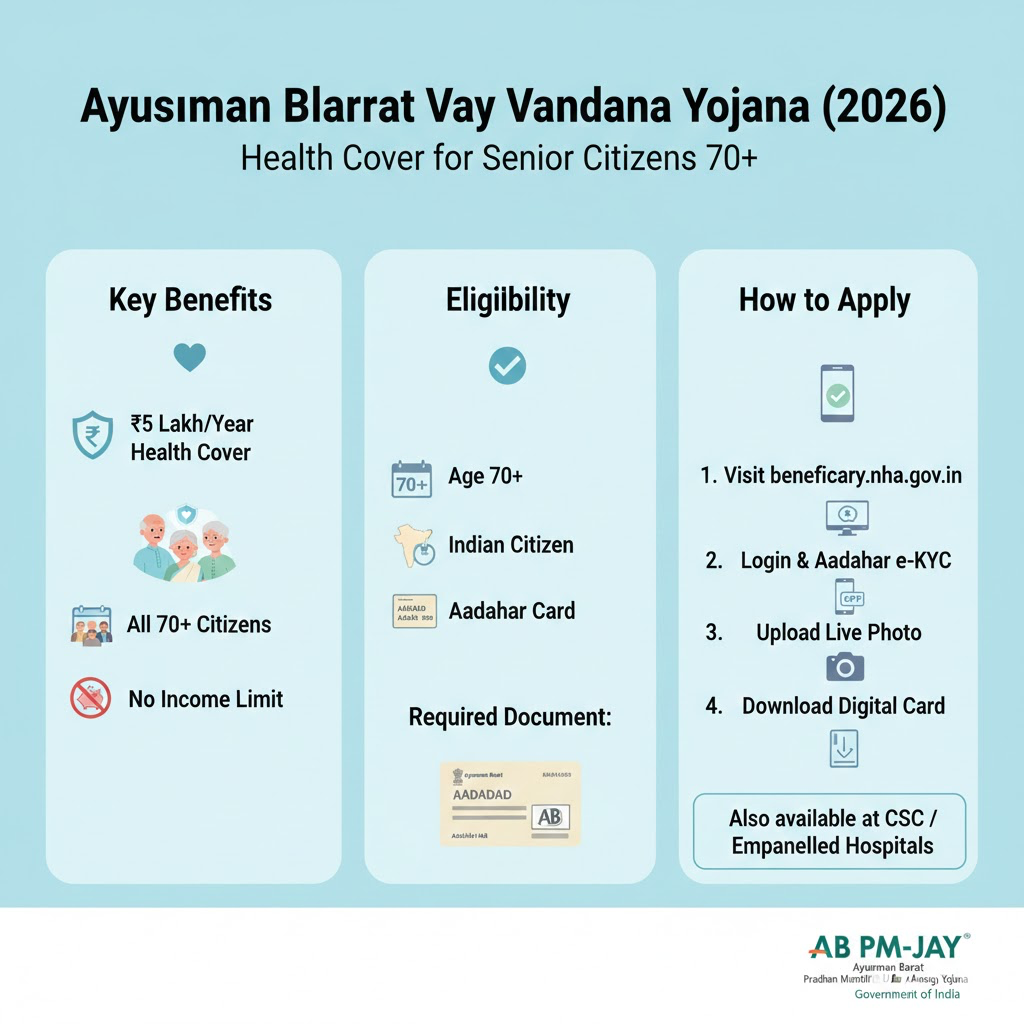
The scheme continues to offer a health insurance cover of up to ₹5 lakh per year for eligible families, but special emphasis is now being placed on awareness, access, and enrolment of elderly beneficiaries who often struggle with paperwork, digital processes, and private insurance exclusions.
What the Ayushman Bharat Senior Citizen Card Represents
The Senior Citizen Card under Ayushman Bharat functions as a dedicated identity and access tool that links elderly beneficiaries directly to the PM-JAY ecosystem. Once issued, the card allows eligible seniors to avail cashless treatment at empanelled government and private hospitals across India. It covers a wide range of secondary and tertiary care procedures, including surgeries, critical illness treatment, and long-term hospitalisation.
For senior citizens, this is particularly significant because most private health insurance policies either impose high premiums, restrict entry age, or exclude pre-existing diseases. The Ayushman Bharat framework removes these barriers by offering coverage irrespective of age, medical history, or prior conditions.
Eligibility Criteria for Senior Citizens Under Ayushman Bharat
Eligibility for the Ayushman Bharat Senior Citizen Card is primarily determined through socio-economic data captured in government databases. Senior citizens belonging to families identified in the Socio-Economic Caste Census are automatically considered eligible. This includes elderly individuals from rural households without stable income sources and urban households falling under notified occupational categories.
Age plays a central role in prioritisation but does not operate in isolation. Senior citizens aged 60 years and above are eligible if their family is already covered under PM-JAY or meets the deprivation and vulnerability criteria set by the government. There is no income cap defined in monetary terms, but eligibility is assessed through housing conditions, asset ownership, and occupational status rather than salary slips or tax returns.
Importantly, there is no exclusion based on existing medical conditions, making the scheme particularly valuable for elderly citizens suffering from chronic illnesses such as diabetes, heart disease, kidney disorders, or arthritis.
Health Coverage Benefits Available to Elderly Beneficiaries
Under the ₹5 lakh annual health cover, senior citizens can access treatment for over a thousand medical procedures. These include cardiology, orthopaedics, oncology, neurology, nephrology, and general surgery, among others. Hospitalisation expenses, pre-hospital diagnostics, post-hospital medication, and follow-up care are included within the approved treatment packages.
The coverage is provided on a family floater basis, meaning the ₹5 lakh limit applies collectively to all eligible members of a family. However, in households with senior citizens, the scheme has proven to significantly reduce out-of-pocket expenditure, especially for high-cost surgeries and prolonged treatments.
Another critical benefit is portability. Elderly beneficiaries can seek treatment at any empanelled hospital across India, regardless of their home state, which is particularly useful for those living with children in different cities or states.
Step-by-Step Process to Apply for the Senior Citizen Card
The application process for the Ayushman Bharat Senior Citizen Card has been simplified to ensure ease of access for elderly applicants. Senior citizens or their family members can check eligibility through the official Ayushman Bharat portal or by visiting the nearest Common Service Centre. Eligibility verification is done using Aadhaar or other government-issued identity documents.
Once eligibility is confirmed, biometric authentication is conducted, and the Ayushman Bharat card is generated. The card can be printed immediately or downloaded digitally. In many states, special enrolment drives are conducted at primary health centres, district hospitals, and senior citizen welfare camps to assist elderly applicants who may not be comfortable with online systems.
For bedridden or highly dependent seniors, state authorities and local health workers often facilitate doorstep verification and enrolment, ensuring that physical limitations do not become a barrier to coverage.
Role of States in Strengthening Senior Citizen Coverage
While Ayushman Bharat is a centrally sponsored scheme, state governments play a crucial role in implementation and outreach. Several states have introduced top-up schemes or expanded benefits for senior citizens, increasing coverage amounts or including additional treatments not listed under the national package.
States are also focusing on empanelling more private hospitals, especially those offering geriatric care, dialysis services, and cancer treatment. This expansion is critical in ensuring that elderly beneficiaries do not face long waiting periods or travel long distances for specialised treatment.
Why the Update Matters in an Ageing India
India’s senior citizen population is projected to rise sharply over the next two decades, placing increased pressure on healthcare infrastructure and household finances. The Ayushman Bharat Senior Citizen Card update acknowledges this demographic reality and attempts to build a safety net for those who are often the most vulnerable.
Healthcare expenses are one of the leading causes of debt among elderly households, particularly when pensions are limited or non-existent. By offering a reliable, cashless health cover, the scheme reduces dependence on family savings, loans, or charity, allowing senior citizens to seek timely medical care with dignity.
Looking Ahead: Awareness and Access Remain Key
Despite the scale and intent of the scheme, awareness remains uneven, particularly in rural areas and among urban informal workers. Experts stress that increased information campaigns, simplified documentation, and continued investment in hospital capacity are essential to ensure that the benefits of the Ayushman Bharat Senior Citizen Card reach every eligible elderly citizen.
As healthcare costs continue to rise, the success of this initiative will be measured not just by enrolment numbers but by how effectively it shields senior citizens from financial distress during medical emergencies. With sustained policy support and effective ground-level execution, the Ayushman Bharat Senior Citizen Card has the potential to become one of the most impactful social security measures for India’s ageing population.
Add digitalherald.in as a preferred source on google – click here
Last Updated on: Thursday, February 5, 2026 10:32 am by Digital Herald Team | Published by: Digital Herald Team on Thursday, February 5, 2026 10:32 am | News Categories: News