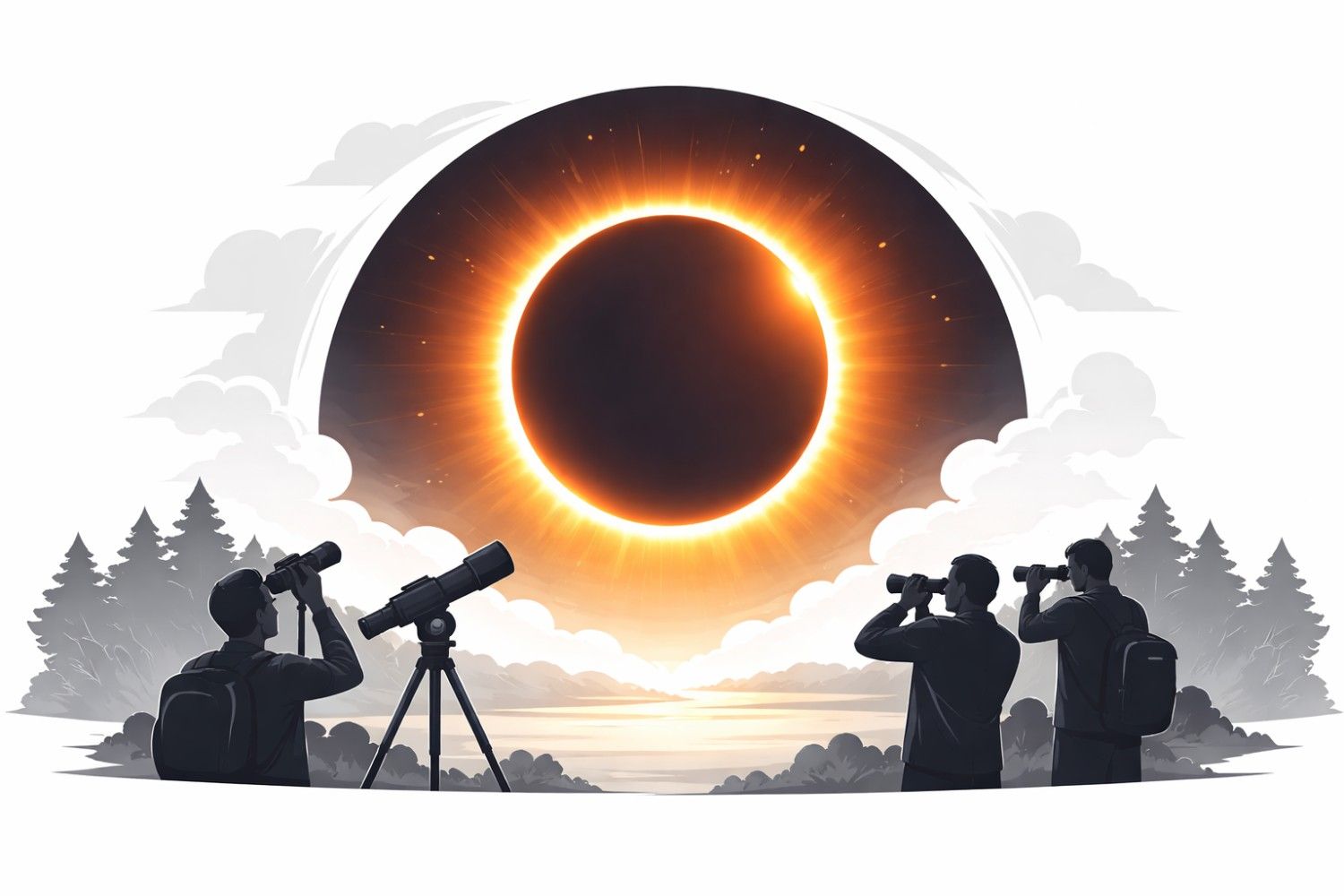
The first solar eclipse of 2026 is taking place today, February 17, creating a rare “Ring of Fire” effect in parts of the Southern Hemisphere. This astronomical event has attracted global attention, as it marks the year’s first major sky spectacle.
However, the eclipse will not be visible from India, as its main path lies far south of the equator. The annular phase is occurring mostly over remote Antarctic regions, with only partial views in a few countries. For skywatchers worldwide, the event is significant because annular eclipses are visually striking and do not occur frequently in the same location.
What Is Happening in the Sky Today
The February 17, 2026 eclipse is an annular solar eclipse, commonly called a “Ring of Fire.” During this type of eclipse, the Moon moves between the Earth and the Sun but appears slightly smaller than the Sun.
As a result, the Moon cannot fully block the Sun’s disk. Instead, a bright ring of sunlight remains visible around the Moon’s edge. This glowing ring gives the eclipse its popular name.
Astronomers classify this as the first solar eclipse of 2026, and it is part of a broader eclipse season that also includes a lunar eclipse in early March and a total solar eclipse in August.
Key Timings of the Solar Eclipse
According to international astronomical data, the partial eclipse began around 9:56 GMT, with the maximum annular phase near 12:12 GMT, and the partial phase ending around 14:27 GMT. These timings vary by region depending on local time zones.
Where the ‘Ring of Fire’ Is Fully Visible
The full annular “Ring of Fire” phase is visible mainly over remote parts of Antarctica and nearby ocean areas. The path of annularity stretches across western Antarctica and surrounding regions of the Southern Ocean.
This path is extremely remote, meaning very few people can witness the full ring effect in person. In many cases, the eclipse is being observed mainly by research teams stationed in Antarctica.
Countries Seeing a Partial Solar Eclipse
While the full ring effect is limited to Antarctica, a partial solar eclipse is visible across several regions in the Southern Hemisphere.
These include parts of southern Africa and South America, such as South Africa, Namibia, Botswana, Tanzania, Mauritius, Madagascar, Argentina, and Chile. In these locations, the Moon covers only part of the Sun, so the dramatic ring effect is not visible.
Large parts of the Atlantic, Indian, Pacific, and Southern Oceans are also experiencing partial phases of the eclipse.
Will the Solar Eclipse Be Visible in India
The February 17, 2026 solar eclipse is not visible anywhere in India. Astronomical data shows that the eclipse path lies entirely in the Southern Hemisphere, far from the Indian subcontinent.
As a result, there is no partial or full eclipse visible in the country, and no special viewing precautions are required locally. Those interested in the event can watch live streams from international observatories and space agencies.
Why This Eclipse Is Unusual
This eclipse is notable because of its remote path. Unlike many solar eclipses that pass over populated regions, the 2026 annular eclipse travels almost entirely across Antarctica, one of the least inhabited places on Earth.
The path of annularity is about 2,661 miles long and roughly 383 miles wide. Because of this, the eclipse is being described as an event that will be seen mostly by scientists and research teams rather than the general public.
What Causes a ‘Ring of Fire’ Eclipse
A solar eclipse happens when the Moon passes directly between the Earth and the Sun. But the type of eclipse depends on the Moon’s distance from Earth.
In an annular eclipse, the Moon is farther away from Earth than usual, so it appears slightly smaller in the sky. It cannot fully cover the Sun, and a bright ring of sunlight remains visible around the Moon. This is what creates the dramatic “Ring of Fire” effect.
Safety Advice for Viewing the Eclipse
Astronomers stress that looking directly at the Sun during any eclipse is dangerous without proper protection.
Anyone watching a solar eclipse should use certified solar eclipse glasses. It is not safe to look at the Sun through cameras, telescopes, or binoculars without proper solar filters. Regular sunglasses do not provide enough protection.
These precautions apply even during partial eclipses.
Upcoming Eclipses After February 2026
Skywatchers can look forward to more eclipse events later in the year.
A total lunar eclipse is expected on March 3–4, 2026, followed by a total solar eclipse on August 12, 2026, visible in parts of Europe and the Atlantic region. Another partial lunar eclipse is scheduled for August 28, 2026.
These events will be visible to much larger populations compared with the February annular eclipse.
Why Solar Eclipses Matter
Solar eclipses are important for both science and public interest. They allow astronomers to study the Sun’s outer atmosphere, observe solar activity, and test scientific instruments.
For the public, eclipses remain one of the most dramatic natural sky events. Annular eclipses are especially popular because of the striking ring-shaped view of the Sun.
Bottom Line
The February 17, 2026 annular solar eclipse is creating a dramatic “Ring of Fire,” but only over remote Antarctic regions. Partial views are visible in parts of southern Africa and South America, while India and most of the world cannot see the event directly.
Even though the full effect is limited to a remote path, the eclipse remains a major astronomical highlight of 2026, with more eclipse events expected later in the year.
Disclaimer: The information presented in this article is intended for general informational purposes only. While every effort is made to ensure accuracy, completeness, and timeliness, data such as prices, market figures, government notifications, weather updates, holiday announcements, and public advisories are subject to change and may vary based on location and official revisions. Readers are strongly encouraged to verify details from relevant official sources before making financial, investment, career, travel, or personal decisions. This publication does not provide financial, investment, legal, or professional advice and shall not be held liable for any losses, damages, or actions taken in reliance on the information provided.
Last Updated on: Tuesday, February 17, 2026 10:29 am by Digital Herald Team | Published by: Digital Herald Team on Tuesday, February 17, 2026 10:29 am | News Categories: Technology