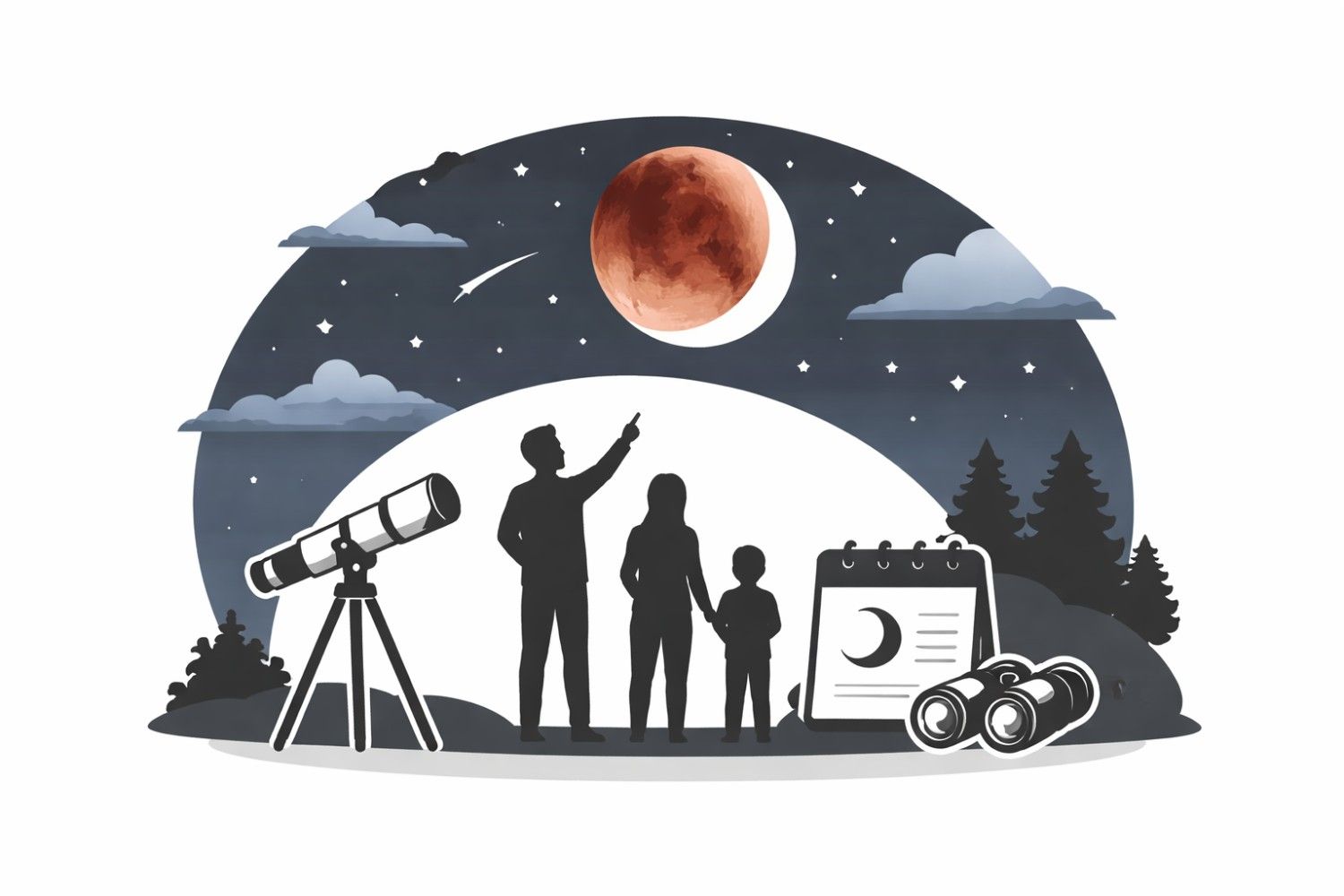
The Lunar Eclipse 2026 is trending across India as skywatchers prepare for one of the most anticipated celestial events of the year. Social media searches for “Lunar Eclipse 2026 date in India” and “Chandra Grahan timings” have surged, with astronomy enthusiasts and the general public eager to know when and how to watch the phenomenon.
A lunar eclipse is one of the safest and most fascinating astronomical events visible to the naked eye. Unlike a solar eclipse, no special protective glasses are required. As India gets ready to witness the event, here is everything you need to know in simple terms.
What Is a Lunar Eclipse?
A lunar eclipse happens when the Earth comes between the Sun and the Moon. The Earth blocks sunlight from directly reaching the Moon. As a result, the Moon moves into the Earth’s shadow.
There are three types of lunar eclipses:
• Total lunar eclipse – The entire Moon enters the Earth’s shadow and often appears reddish.
• Partial lunar eclipse – Only a portion of the Moon is covered by the shadow.
• Penumbral lunar eclipse – The Moon passes through the outer part of the Earth’s shadow, causing slight darkening.
The reddish colour seen during a total lunar eclipse is often called a “Blood Moon.” This happens because sunlight passing through Earth’s atmosphere bends and filters out blue light.
Lunar Eclipse 2026: Key Date and Expected Timings
According to global astronomical predictions and eclipse calendars, one of the major lunar eclipses in 2026 is expected in early March 2026.
Exact timings for India depend on the phase of the eclipse and the Moon’s position at that time. Lunar eclipses are usually visible at night when the Moon is above the horizon.
The key phases typically include:
• Penumbral start
• Partial eclipse start
• Totality (if applicable)
• Maximum eclipse
• End of eclipse
Indian astronomy organisations are expected to release detailed local timings closer to the event date.
Skywatchers are advised to check official sources such as government observatories and science institutions for accurate city-wise timing updates.
Will the Lunar Eclipse 2026 Be Visible in India?
Visibility depends on the Moon’s position during the event.
If the eclipse occurs during nighttime in India and the Moon is above the horizon, it will be visible across most parts of the country, weather permitting.
Cloud cover and pollution levels can affect viewing clarity. Clear skies will offer the best experience.
In many past lunar eclipses, large parts of India have been able to witness partial or total phases.
Observers in northern, southern, eastern, and western regions may experience slight variations in timing but the event remains largely similar nationwide.
Why Lunar Eclipse 2026 Is Trending Today
There are several reasons why Lunar Eclipse 2026 is generating online buzz:
• Increased interest in astronomy among young audiences
• Social media reminders and event countdown posts
• Curiosity about “Blood Moon” visuals
• Cultural and religious significance associated with Chandra Grahan
Many schools and science clubs are also planning awareness sessions and telescope viewing events.
The accessibility of smartphone astronomy apps has also made it easier for people to track celestial events.
Is It Safe to Watch a Lunar Eclipse?
Yes, it is completely safe to watch a lunar eclipse with the naked eye.
Unlike a solar eclipse, there is no risk to eyesight. You can watch the Moon directly without protective glasses.
For better viewing, you can use:
• Binoculars
• A small telescope
• A tripod-mounted camera
Photographers often use long-exposure settings to capture detailed images.
Families are encouraged to watch together as it can be an educational experience for children.
Cultural Significance of Chandra Grahan in India
In India, a lunar eclipse is traditionally called Chandra Grahan.
Some communities observe rituals such as fasting or temple visits. Certain temples may adjust prayer timings based on eclipse hours.
However, scientific institutions clarify that a lunar eclipse is a natural astronomical event with no harmful effects.
Many modern families combine cultural traditions with scientific understanding, turning the event into a learning opportunity.
How Long Will the Eclipse Last?
A lunar eclipse can last several hours from start to finish.
The total phase, if it occurs, may last around one hour or more, depending on the Earth’s shadow alignment.
The penumbral phase begins earlier and ends later, but it may be harder to notice without instruments.
The gradual movement of the Earth’s shadow across the Moon makes the event calm and visually dramatic.
Best Places in India to Watch the Eclipse
You do not need to travel far to see a lunar eclipse.
However, better viewing conditions are found in:
• Open grounds away from city lights
• Rooftops with a clear eastern or southern sky
• Hill stations with low pollution
• Rural areas with minimal artificial lighting
Major cities like Delhi, Mumbai, Bengaluru, Chennai, and Kolkata usually witness strong public interest during such events.
Local astronomy groups often host open-sky sessions.
Scientific Importance of Lunar Eclipses
Lunar eclipses help scientists and students understand:
• Orbital motion of Earth and Moon
• Earth’s atmosphere effects
• Light scattering
• Celestial mechanics
They also provide opportunities for public science engagement.
Institutions such as planetariums and research centres often organise lectures and live sessions during eclipse nights.
Difference Between Lunar and Solar Eclipse
It is important to understand the difference:
A solar eclipse happens when the Moon blocks sunlight from reaching Earth.
A lunar eclipse happens when Earth blocks sunlight from reaching the Moon.
Solar eclipses require protective eyewear. Lunar eclipses do not.
Solar eclipses are visible only from specific narrow paths. Lunar eclipses can be seen from anywhere on Earth where it is nighttime.
Weather and Viewing Tips
To get the best experience:
• Check local weather forecasts
• Reach your viewing spot at least 30 minutes before peak time
• Avoid bright street lights
• Use a stable surface for photography
Apps that track Moon position can help you identify the direction and height of the Moon.
If the sky is cloudy in your area, live streams from global observatories may be available online.
How Often Do Lunar Eclipses Occur?
Lunar eclipses occur several times a year globally. However, not all of them are visible from India.
On average, there are about two to four lunar eclipses each year worldwide. Some are partial or penumbral.
A total lunar eclipse visible in India is considered a special event for sky enthusiasts.
Public Interest and Social Media Buzz
Search trends show growing curiosity about celestial events.
Hashtags related to Lunar Eclipse 2026 are trending across platforms. Users are sharing eclipse calendars, viewing tips, and old eclipse photos.
Astronomy has become more popular among students, thanks to online learning resources and digital planetariums.
This rising interest reflects a broader enthusiasm for space science in India.
Conclusion
Lunar Eclipse 2026 is capturing national attention as India prepares to witness a spectacular celestial event.
With clear skies and simple preparation, millions may get the chance to observe this natural phenomenon safely.
Whether viewed for scientific curiosity, cultural tradition, or simple wonder, a lunar eclipse reminds us of Earth’s place in the larger universe.
As the date approaches, official timing updates and weather forecasts will help skywatchers plan better.
For now, Lunar Eclipse 2026 remains one of the most talked-about astronomical events, bringing together science, tradition, and public excitement under the night sky.
Disclaimer: The information presented in this article is intended for general informational purposes only. While every effort is made to ensure accuracy, completeness, and timeliness, data such as prices, market figures, government notifications, weather updates, holiday announcements, and public advisories are subject to change and may vary based on location and official revisions. Readers are strongly encouraged to verify details from relevant official sources before making financial, investment, career, travel, or personal decisions. This publication does not provide financial, investment, legal, or professional advice and shall not be held liable for any losses, damages, or actions taken in reliance on the information provided.
Edited by Mantena sasank
Last Updated on: Thursday, February 26, 2026 11:44 am by Digital Herald Team | Published by: Digital Herald Team on Thursday, February 26, 2026 11:44 am | News Categories: Lifestyle