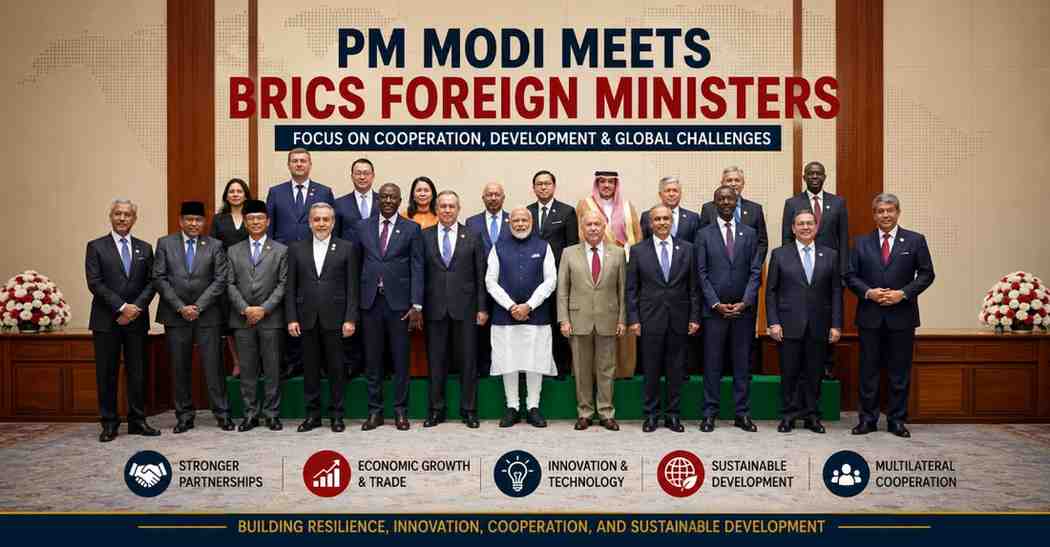
Prime Minister Narendra Modi held talks with foreign ministers from BRICS nations and partner countries in New Delhi, focusing on strengthening multilateral cooperation and addressing global challenges.
High-level BRICS engagement underway in New Delhi
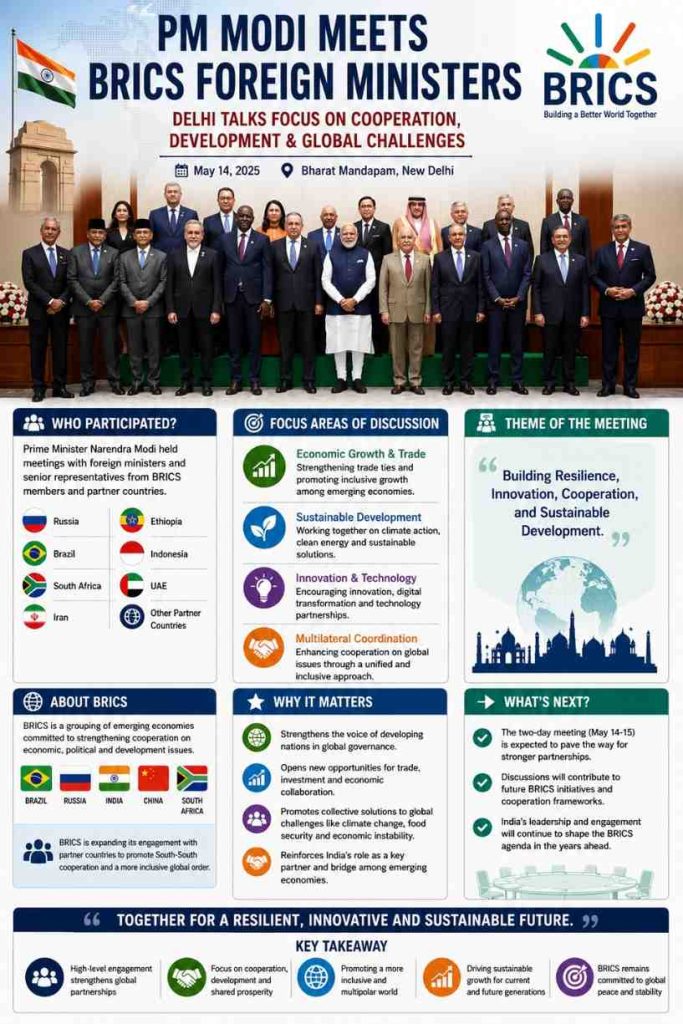
Prime Minister Narendra Modi met foreign ministers and senior representatives from BRICS countries and partner nations on May 14 in New Delhi, as part of ongoing diplomatic engagements linked to the BRICS Foreign Ministers’ Meeting.
The discussions took place alongside a two-day meeting chaired by External Affairs Minister S. Jaishankar at Bharat Mandapam, bringing together leaders from key emerging economies and partner nations.
Key highlights of the meeting
Engagement with global partners
The Prime Minister held bilateral interactions with several senior leaders, including foreign ministers from Russia, Brazil, South Africa, Iran, Ethiopia, and Indonesia, among others.
Focus on cooperation and development
The meetings centred on enhancing collaboration in areas such as:
- Economic growth and trade
- Sustainable development
- Innovation and technology
- Multilateral coordination
Theme of the summit
This year’s discussions are guided by the theme: “Building Resilience, Innovation, Cooperation, and Sustainable Development.”
India’s role in BRICS diplomacy
India’s hosting of the foreign ministers’ meeting highlights its active role in shaping global conversations among emerging economies.
The BRICS platform—comprising Brazil, Russia, India, China, and South Africa—has increasingly expanded its engagement with partner countries, reflecting a broader push toward inclusive multilateralism.
Official engagement and diplomatic messaging
Officials have emphasized that the meetings aim to strengthen strategic partnerships and promote cooperation across economic and geopolitical domains.
The presence of representatives from both BRICS members and partner nations underscores the group’s growing relevance in global diplomacy.
Context: Expanding BRICS influence
BRICS has evolved from an economic grouping into a broader forum addressing global governance, development challenges, and geopolitical issues.
Recent expansions and partnerships signal efforts to:
- Increase representation of developing economies
- Enhance South-South cooperation
- Promote alternative frameworks for global collaboration
Why this matters
The outcomes of BRICS engagements can influence:
- Global economic coordination
- Trade and investment flows among emerging markets
- Multilateral responses to global challenges such as climate change and economic instability
For India, active participation strengthens its position as a key voice among developing nations.
Public and global impact
For businesses and economies, stronger BRICS cooperation may:
- Open new trade and investment opportunities
- Improve coordination on global economic issues
- Support innovation and sustainable growth initiatives
For global governance, it reflects a shift toward more diverse and multipolar engagement.
What lies ahead
The ongoing foreign ministers’ meeting is expected to lead to further discussions and potential agreements on cooperation frameworks.
Future engagements within BRICS will likely focus on deepening partnerships and addressing shared global challenges.
Prime Minister Modi’s meetings with BRICS foreign ministers underscore India’s expanding diplomatic role and the growing importance of multilateral cooperation among emerging economies. As the grouping continues to evolve, its influence on global economic and political dynamics is expected to increase.
Key Insights
- The BRICS platform is increasingly positioning itself as a counterbalance in global governance, offering developing economies a stronger collective voice in institutions traditionally dominated by Western powers.
- India’s active engagement reflects its strategy to strengthen South-South cooperation while maintaining strategic autonomy amid shifting global alliances.
- The inclusion of partner countries beyond core BRICS members indicates a gradual move toward a broader multilateral coalition, potentially expanding the group’s economic and geopolitical influence.
- Cooperation in areas like innovation, technology, and sustainable development highlights BRICS’ attempt to align economic growth with long-term global priorities, including climate resilience and digital transformation.
- Engagement with countries such as Iran, Indonesia, and Ethiopia signals a focus on diversifying trade and energy partnerships, which could reduce dependence on traditional supply chains.
- For India, deeper BRICS collaboration may translate into greater opportunities in trade, investment, and global policymaking, particularly in emerging markets across Asia, Africa, and Latin America.
Input & Images: Hindusthan Samachar
Edited by Manten Sasank
Add Digital Herald as preferred source on google – click here
Also read – Trump Arrives in Beijing for High-Stakes Talks with Xi Jinping on Trade, Technology, and Global Security
Last Updated on: Thursday, May 14, 2026 6:16 pm by Mantena Sasank | Published by: Mantena Sasank on Thursday, May 14, 2026 6:14 pm | News Categories: News, Politics