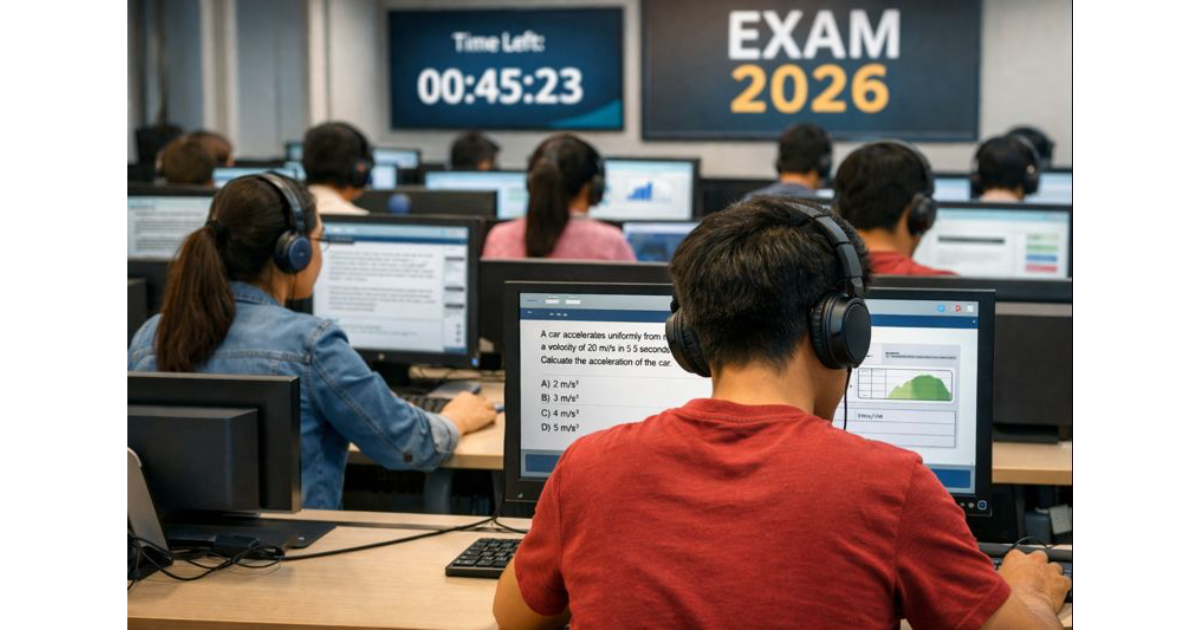
The year 2026 is emerging as a turning point for India’s competitive examination system. From national-level entrance tests to recruitment exams for government services, authorities are moving away from purely memory-based assessment models toward formats that test conceptual understanding, analytical ability, and real-world application. These changes are not cosmetic. They reflect deeper policy priorities aligned with the National Education Policy, the growing use of technology in assessments, and the need to reduce exam stress while improving fairness and transparency.
For millions of students preparing for engineering, medical, civil services, banking, teaching, and other competitive pathways, understanding how exam patterns and evaluation methods are evolving has become as important as mastering the syllabus itself.
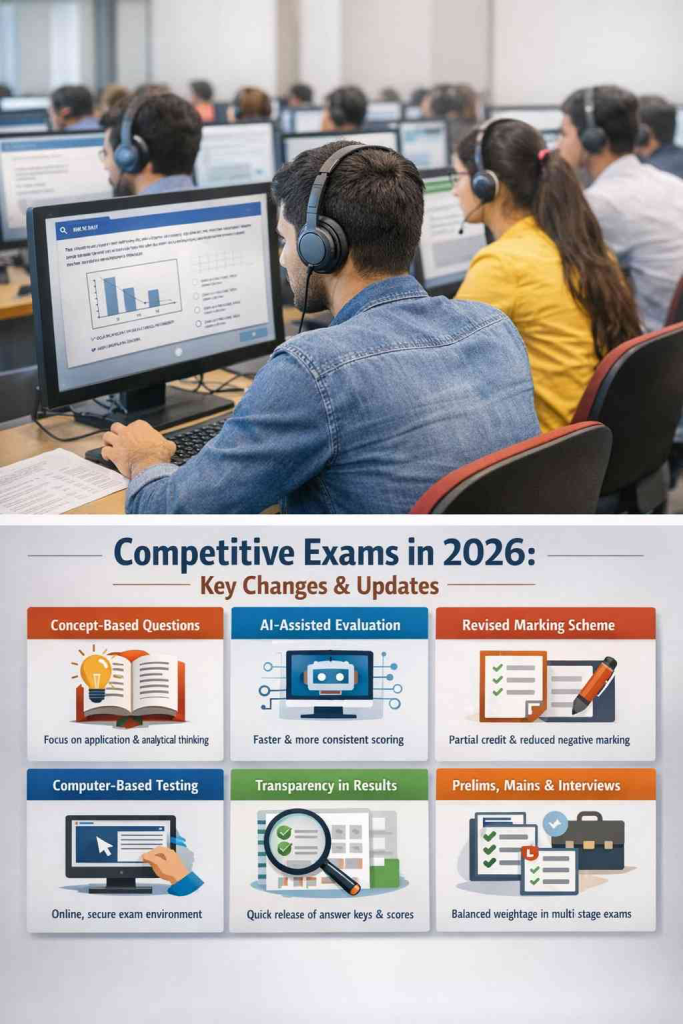
Shift from Rote Learning to Conceptual Assessment
One of the most noticeable changes across competitive exams in 2026 is the clear move away from questions that reward rote memorisation. Exam-setting bodies are increasingly framing questions that require candidates to interpret data, apply principles to unfamiliar situations, or combine concepts from multiple chapters. This shift is evident in entrance exams for higher education as well as in recruitment tests conducted by central and state agencies.
In practical terms, students are encountering longer, scenario-based questions, case studies, and problem-solving formats that cannot be cracked through last-minute revision alone. This change is intended to identify candidates who possess genuine subject understanding rather than those who have mastered pattern recognition or guesswork strategies.
Growing Role of Application-Based and Multi-Concept Questions
Competitive exams in 2026 are also seeing a rise in questions that link two or more topics together. Instead of testing isolated facts, evaluators are assessing whether students can integrate knowledge across domains. For science and technical exams, this often means combining theory with numerical reasoning. For humanities and aptitude-based tests, it involves analytical reading, inference, and decision-making under constraints.
This trend has changed preparation strategies significantly. Coaching institutes and self-study aspirants alike are placing greater emphasis on concept clarity, revision through problem sets, and exposure to diverse question styles rather than repetitive mock tests based on older patterns.
Revised Marking Schemes and Evaluation Logic
Evaluation systems in 2026 are being fine-tuned to balance accuracy with risk-taking. Several exams have revised negative marking rules, introduced partial credit for multi-step answers, or adjusted weightage to reduce the impact of blind guessing. The aim is to reward logical thinking even when the final answer is incorrect, particularly in analytical or numerical sections.
In descriptive and mixed-mode exams, evaluation rubrics are becoming more structured. Answers are being assessed for clarity of reasoning, logical flow, and relevance rather than length or ornamentation. This change is especially relevant for exams that include essay writing, comprehension, or subjective responses, where standardised digital evaluation tools are now assisting human examiners.
Technology-Driven Testing and AI-Assisted Evaluation
The integration of technology into competitive exams has accelerated in 2026. Computer-based testing is now the norm for most major examinations, with improved question randomisation, adaptive difficulty in select tests, and enhanced security protocols to curb malpractice.
On the evaluation side, artificial intelligence tools are being used to pre-screen answer sheets, flag inconsistencies, and support faster result processing. While final decisions still involve human oversight, AI-assisted evaluation has reduced delays and improved consistency, particularly in large-scale exams involving millions of candidates.
Increased Transparency in Results and Answer Keys
Another significant development in 2026 is the emphasis on transparency. Exam authorities are increasingly releasing provisional answer keys, response sheets, and score normalisation details within days of the exam. This allows students to assess their performance, raise objections, and understand how final scores are calculated.
For students, this transparency has reduced anxiety and speculation. It has also increased accountability, as discrepancies can be identified and addressed before final results are declared.
Changing Weightage Between Prelims, Mains, and Interviews
In multi-stage competitive exams, authorities are revisiting how weightage is distributed across different phases. Preliminary exams are being positioned more clearly as screening tests, focusing on speed and basic competence, while main examinations and interviews are carrying greater weight in final selection.
This recalibration encourages students to treat each stage differently in their preparation. Clearing the preliminary round is no longer sufficient; sustained performance across stages has become critical.
Impact on Student Preparation and Coaching Models
These exam pattern and evaluation changes are reshaping how students prepare in 2026. The traditional reliance on shortcuts, repeated question banks, and purely exam-oriented tricks is proving less effective. Successful candidates are those who invest time in understanding fundamentals, practising application-based problems, and developing exam temperament.
Coaching institutions are also adapting by redesigning curricula, focusing on concept-building, and incorporating technology-driven assessment tools. Self-learners, meanwhile, are benefiting from improved access to digital resources, mock platforms, and official exam guidelines.
What Students Should Keep in Mind Going Forward
As competitive exams continue to evolve, students need to stay informed and flexible. Relying on outdated preparation strategies can be risky in a system that is actively redefining how merit is measured. Regularly reviewing official notifications, understanding revised evaluation criteria, and aligning study plans with current exam logic are now essential steps in any serious preparation journey.
A More Balanced but Demanding Future
The competitive exam landscape in 2026 is more balanced, transparent, and concept-oriented than ever before. At the same time, it is more demanding, requiring deeper engagement with subjects and stronger analytical skills. For students willing to adapt, these changes offer a fairer chance to demonstrate true ability. For those who cling to old patterns, the transition may be challenging.
Ultimately, the reforms signal a long-term shift toward assessments that value understanding over memorisation and competence over chance — a change that could redefine academic and professional selection in India for years to come.
Also read : https://newsestate.in/how-recent-policy-decisions-could-influence-indias-economic-growth-outlook/
Add digitalherald.in as a preferred source on google – click here
Last Updated on: Monday, February 2, 2026 3:20 pm by Digital Herald Team | Published by: Digital Herald Team on Monday, February 2, 2026 3:20 pm | News Categories: News