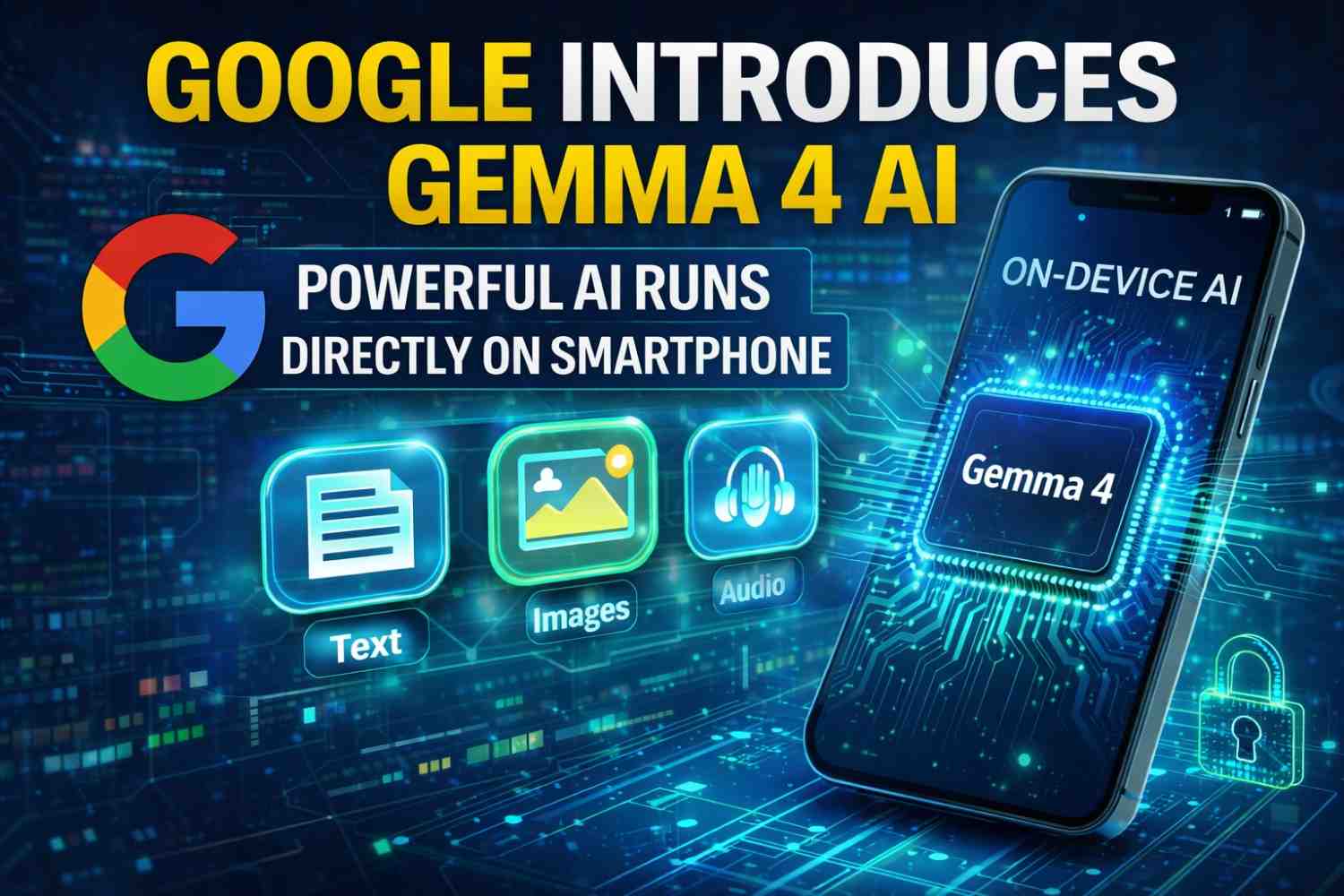
New AI system focuses on on-device processing, offering faster performance and improved data privacy
Google has introduced its latest artificial intelligence model, Gemma 4, designed to operate directly on personal devices such as smartphones and laptops. Developed by Google’s AI division, the model represents a shift toward on-device computing, reducing reliance on cloud-based processing.
Key Highlights
Gemma 4 is built to handle multiple types of data, including text, images, and audio, without requiring a constant internet connection. Unlike traditional AI systems that depend on remote servers, this model processes information locally on the device.
This approach enables faster response times and allows users to access AI-powered features even in offline environments.
Features and Capabilities
The new AI model can perform a range of tasks, including summarising content, generating notes, assisting with coding, and creating visual data representations. It can also interact with applications on the device, making it suitable for everyday productivity use.
Gemma 4 is designed to run across various platforms, including Android smartphones, iPhones, laptops, and compact systems like Raspberry Pi devices.
Official Position
Google has positioned Gemma 4 as a step toward making AI more accessible and efficient for everyday users. By embedding the AI model directly into devices, the company aims to improve both performance and usability without relying heavily on internet connectivity.
Context and Background
Most existing AI tools operate through cloud infrastructure, where user inputs are processed on external servers. While this allows for large-scale computing power, it can raise concerns about latency and data privacy.
On-device AI models like Gemma 4 aim to address these issues by keeping data processing within the user’s device, reducing the need to transmit sensitive information over networks.
Public Impact
For users, the introduction of on-device AI could lead to faster and more reliable access to intelligent features. It may also enhance privacy, as personal data does not need to leave the device for processing.
The development could benefit areas with limited internet connectivity, enabling broader access to AI tools without continuous online access.
Conclusion
Google’s Gemma 4 marks a significant development in the evolution of artificial intelligence, highlighting a move toward decentralised and device-based computing.
As on-device AI technology continues to advance, it is expected to play a growing role in everyday digital experiences, shaping how users interact with smart devices in the future.
Image Credit: AI-generated image for illustrative purposes
Edited by Manten Sasank
Add Digital Herald as preferred source on google – click here
Also read – Sensex Ends 185 Points Higher, Nifty Closes Above 22,700 as IT Stocks Lead Recovery
Last Updated on: Friday, April 3, 2026 3:14 pm by Mantena Sasank | Published by: Mantena Sasank on Friday, April 3, 2026 3:14 pm | News Categories: Technology, News, Trending