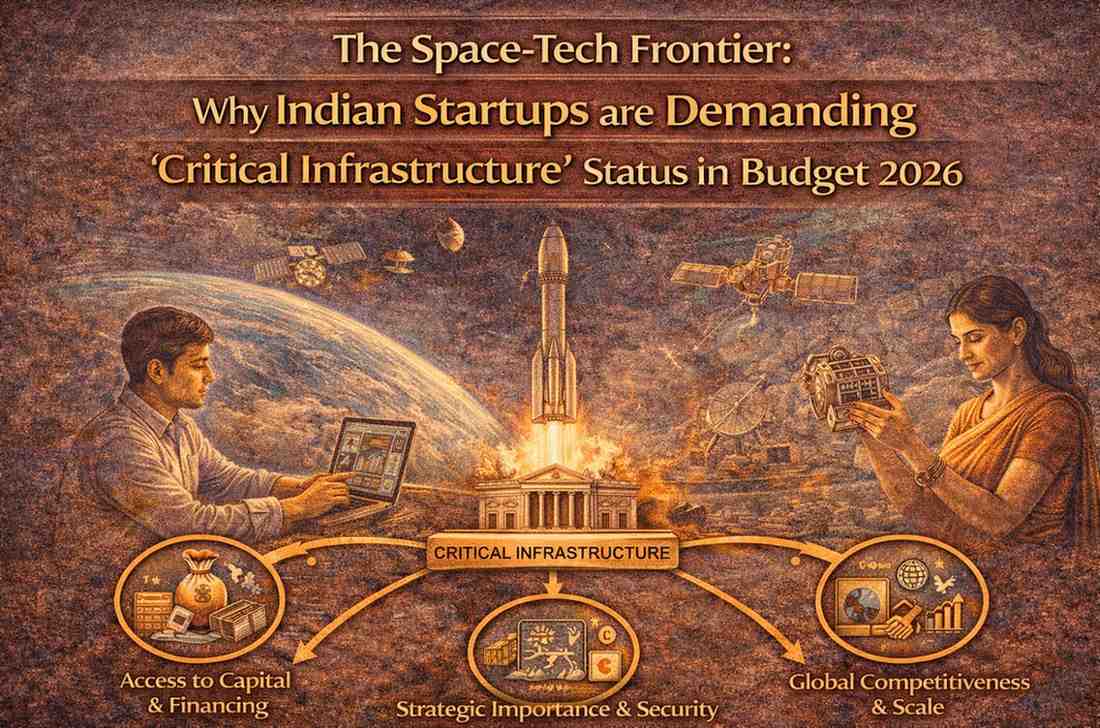
India’s space sector is entering a decisive phase. Once dominated almost entirely by government-led missions, the industry is now witnessing a surge of private participation, driven by a growing ecosystem of space-tech startups. From satellite manufacturing and launch services to earth observation and downstream data applications, these companies are positioning themselves as key contributors to national capability. As expectations rise ahead of Budget 2026, space-tech startups are increasingly calling for the sector to be granted ‘critical infrastructure’ status, a move they argue is essential for scaling operations, attracting investment, and strengthening India’s strategic autonomy in space.
The Rise of India’s Private Space-Tech Ecosystem
Over the past few years, India’s space-tech landscape has expanded rapidly. Policy reforms opening the sector to private players, combined with global demand for satellite-based services, have encouraged entrepreneurs to enter what was once a highly restricted domain. Startups are now working across the value chain, including launch vehicles, satellite platforms, propulsion systems, space-grade electronics, and data analytics.
This growth reflects a broader shift in how space is viewed—not just as a scientific endeavour, but as a commercial and strategic asset. With global space economies expanding and competition intensifying, Indian startups see a narrow window to establish themselves as credible players.
What ‘Critical Infrastructure’ Status Means
Critical infrastructure status is typically reserved for sectors considered vital to a country’s economic security, national defence, and public well-being. Industries with this designation often receive regulatory support, easier access to financing, priority in policy frameworks, and enhanced protection during crises.
For space-tech startups, this status would signal formal recognition of space infrastructure—such as satellites, launch systems, and ground stations—as essential national assets. Founders argue that such recognition would align space-tech with sectors like power, telecommunications, and transportation, which already enjoy similar treatment.
Why Space-Tech Startups Are Making the Case Now
The push ahead of Budget 2026 is strategic. Many space-tech startups are transitioning from research and development to commercial deployment, a phase that demands significant capital and long-term planning. High upfront costs, long gestation periods, and regulatory complexity make space ventures inherently risky.
Startups believe that critical infrastructure status would help reduce these risks by improving access to long-term, low-cost funding and encouraging domestic and international investors to view the sector as stable and strategically backed by the government.
Access to Capital and Financing Challenges
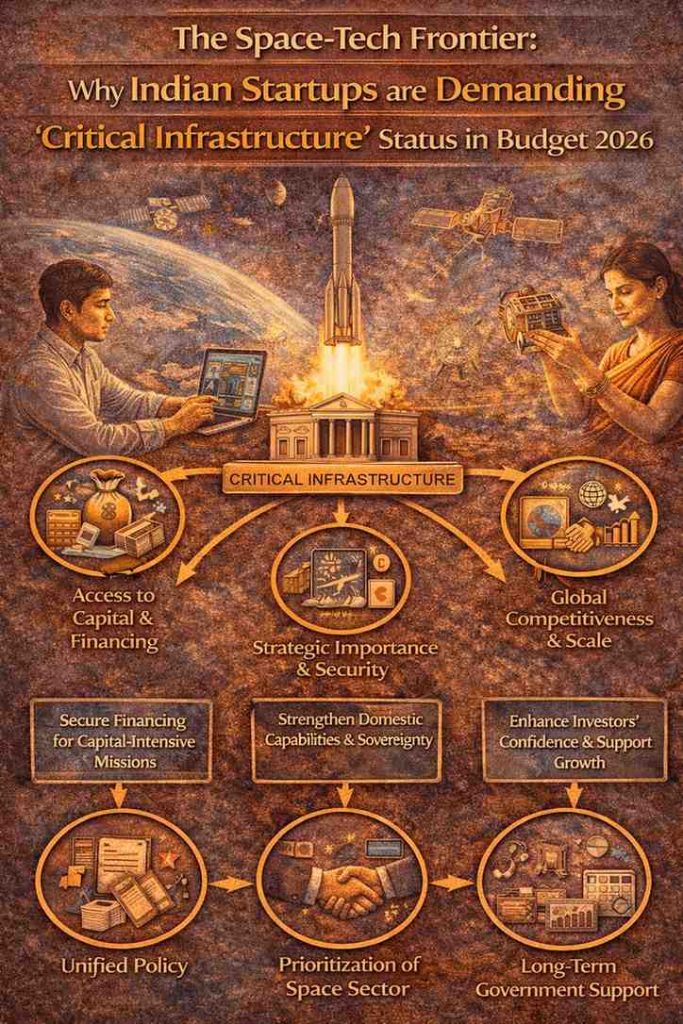
One of the strongest arguments for critical infrastructure status relates to financing. Space-tech projects often require large investments before generating revenue, unlike typical technology startups with faster monetisation cycles. Traditional lenders are cautious due to perceived risks, while venture capital funding alone may not be sufficient for capital-intensive missions.
If classified as critical infrastructure, space-tech companies could gain access to infrastructure financing, specialised credit lines, and government-backed guarantees. This would make debt financing more viable and reduce overreliance on equity dilution in early stages.
Strategic and National Security Considerations
Space infrastructure plays a crucial role in communication, navigation, weather forecasting, disaster management, and defence. Startups operating in these areas argue that their work directly supports national resilience and security.
Granting critical infrastructure status would acknowledge the strategic importance of privately built space assets and encourage closer integration between government agencies and startups. This could strengthen domestic capabilities and reduce dependence on foreign space services.
Boosting Investor Confidence and Global Competitiveness
Policy certainty is a key factor for investors, especially in emerging sectors. Startups believe that critical infrastructure recognition would send a strong signal of long-term government commitment to the space industry.
Such a move could also enhance India’s competitiveness in the global space market. As countries race to build commercial space ecosystems, supportive policy frameworks can make the difference between attracting global partnerships or losing talent and capital to more established markets.
Regulatory and Operational Benefits
Beyond financing, critical infrastructure status could streamline regulatory processes. Space-tech startups currently navigate complex approval mechanisms related to licensing, security clearances, and spectrum allocation.
A unified framework recognising space as critical infrastructure could simplify coordination between multiple authorities, reduce delays, and improve operational efficiency. Faster approvals and clearer compliance norms would help startups focus on innovation and execution.
Concerns and Policy Trade-Offs
While the demand has gained traction, policymakers must balance support with oversight. Designating space-tech as critical infrastructure raises questions about regulation, security controls, and accountability, particularly when private companies manage sensitive assets.
There is also the challenge of defining eligibility. Not all startups operate at the same scale or strategic relevance, and policymakers may need to distinguish between core infrastructure providers and downstream service companies.
How Budget 2026 Could Shape the Outcome
Budget 2026 is seen as a crucial moment for the sector. Startups are not only seeking a formal designation but also complementary measures such as tax incentives, dedicated space funds, and enhanced public procurement opportunities.
Even partial recognition, such as infrastructure-like financing benefits or priority lending status, could significantly improve the operating environment. The budget’s approach will signal how seriously the government views private space enterprises as long-term partners in national development.
The Road Ahead for India’s Space-Tech Ambitions
India stands at an inflection point in its space journey. The combination of state-led expertise and private-sector innovation offers a powerful model for growth. Space-tech startups’ demand for critical infrastructure status reflects their ambition to move from experimental ventures to pillars of national capability.
The space-tech frontier is no longer distant or theoretical. As Budget 2026 approaches, the decisions taken will shape whether India’s private space ecosystem can scale sustainably, compete globally, and contribute meaningfully to economic growth and strategic strength in the years ahead.
Also read – https://digitalherald.in/maintenance-laws-in-india/
Add digitalherald.in as preferred source on google – click here
Last Updated on: Tuesday, January 27, 2026 10:01 am by Digital Herald Team | Published by: Digital Herald Team on Tuesday, January 27, 2026 10:01 am | News Categories: India