The Union Public Service Commission (UPSC) — the constitutional body that recruits for central civil services — published the Civil Services Examination (CSE) 2026 notification in early February 2026 and opened the online application window. The notice sets out statutory eligibility, the examination structure (Preliminary → Main → Personality Test), key dates and procedural rules that govern candidate registration and selection. This article summarises the official requirements and the syllabus candidates must study, explains how to apply through the UPSC portal, highlights recent rule changes flagged by reporting, and identifies practical steps and caveats aspirants should note as they prepare for the three-stage selection process. Union Public Service Commission.
Background: how UPSC CSE works and why the notification matters
The Civil Services Examination is India’s primary recruitment route to the All India Services (including the Indian Administrative Service and Indian Police Service) and Group A and Group B central services. The selection process comprises a qualifying Preliminary examination (objective papers), the Main examination (written papers, including optional subjects) and the Personality Test or interview. The annual notification is the formal legal instrument that specifies precise eligibility limits, examination dates, fee rules, the syllabus for each paper and procedures for application and document submission. The notification therefore determines who may lawfully appear and under what terms.
Key developments in the 2026 notification and related reporting
The 2026 notification was uploaded to the UPSC website and the online application portal was activated in early February 2026, with the Commission setting a specific application window and giving an examination date for the Preliminary exam in May 2026. Several news outlets summarised the broad contours of the notification, and some reported additional procedural clarifications and rule changes that candidates should note. Journalistic accounts also cited the likely number of vacancies that will be filled from this recruitment cycle.
A notable set of operational clarifications reported in press coverage relates to restrictions on re-appearing serving officers: contemporary reporting flagged that serving Indian Administrative Service (IAS) and Indian Foreign Service (IFS) officers are not allowed to reappear in CSE 2026, and that rules governing serving police officers’ eligibility have been tightened in some respects. These measures aim to prevent sitting officers from re-entering the selection process once they are in post. Candidates should read the official notification and the appended rules for precise text and exceptions rather than rely on media summaries alone.
What the notification says: dates, application window and basic process
According to the official notification, the Civil Services (Preliminary) Examination, 2026 notification was issued on 4 February 2026 and the Commission set the Preliminary examination date. The online application window was opened the same month with a closing date for application submission. Aspirants must complete the UPSC online form, upload required documents and pay any applicable fee through the official portal. Candidates should always use the Commission’s published PDF notification and the official website for authoritative instructions; the Commission’s notifications and the online portal remain the controlling sources for deadlines and steps.
(For convenience: press reports and the UPSC page indicate that the application window ran from early February and closed on 24 February 2026; the Preliminary examination date was listed as 24 May 2026 in the examination calendar.)
Eligibility: age, educational qualification, nationality and attempts
Nationality and basic educational requirement
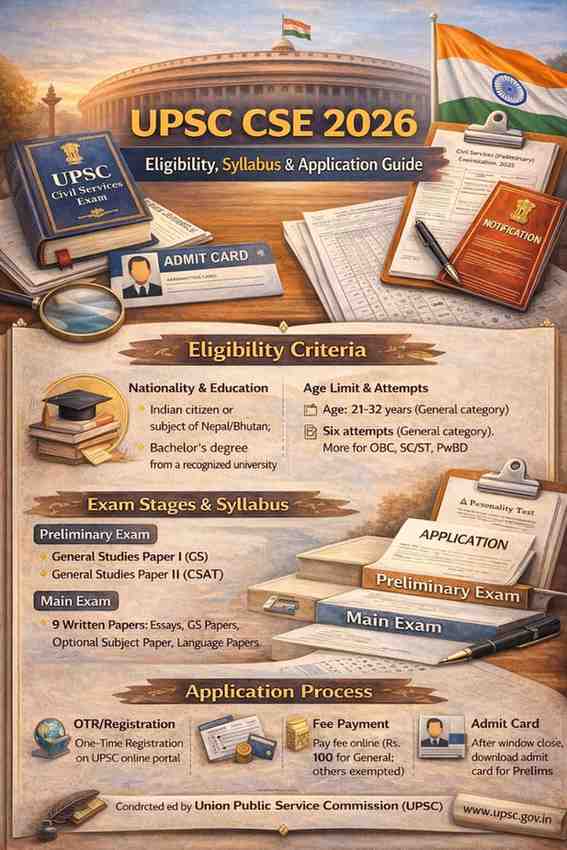
Candidates must meet nationality requirements specified in the notification: Indian citizens are eligible for most posts; certain specific posts allow subjects of Nepal/Bhutan and persons of Indian origin or Tibetan refugees under defined conditions. The minimum educational qualification is a degree from a recognised university (or an equivalent qualification recognised by the Government). Candidates who have appeared in the final year/semester of a qualifying degree may ordinarily apply provisionally but must produce proof of passing before the Main examination/Personality Test as specified in the rules. These are longstanding statutory requirements repeated in the Commission’s notification.
Age limits and relaxations
The notification reiterates the basic age limits that govern who may apply for CSE:
- General category candidates must be at least 21 years old and must not have attained the age of 32 years on the critical cut-off date specified by the Commission for the year in question. For CSE 2026, press coverage and the Commission’s documentation give the conventional date-of-birth window used to calculate eligibility for that year (the Commission’s PDF sets out the exact date range used to compute the age limit).
- Statutory age relaxations apply as per existing rules: OBC candidates receive 3 years’ relaxation, SC/ST candidates 5 years, and persons with benchmark disabilities (PwBD) receive additional relaxation per the notified schedule. The notification and the Commission’s rules explain the specific upper-age limits for each category; aspirants should consult the notice to compute their precise eligibility.
Number of attempts
The number of attempts permitted follows the Commission’s rules: general category candidates are ordinarily allowed six attempts, OBC candidates nine attempts, while SC/ST candidates may attempt until they reach the maximum age limit (effectively unlimited within the age ceiling). Specific adjustments apply to PwBD categories and other special categories. These limits are statutory and have been carried forward in the current rules; candidates must check the notification’s Appendix/Annexures for the precise attempt-count rules that apply to their category.
Syllabus: what to study for Prelims and Mains
The UPSC syllabus remains the authoritative guide for subjects and topics candidates must prepare. The Commission publishes separate, detailed syllabi for the Preliminary and Main examinations; aspirants should use the official PDFs on the UPSC website as their primary study plan. Below we outline the examination structure and summarise the topics that appear in the Commission’s published syllabus documents.
Preliminary Examination (screening stage)
The Preliminary stage consists of two objective (multiple-choice) papers:
- General Studies Paper I — This is the qualifying paper that covers current events of national and international importance; history of India; Indian and world geography; Indian polity and governance; economic and social development; environmental ecology and biodiversity; and general science and technology. The syllabus identifies themes and topic clusters that the Commission uses to set the paper.
- General Studies Paper II (CSAT) — The Civil Services Aptitude Test (CSAT) assesses comprehension, interpersonal skills, logical reasoning, basic numeracy and decision-making skills. The CSAT is qualifying in nature and candidates must secure the minimum qualifying marks (as fixed by the Commission) to have their Paper I evaluated for merit.
The Preliminary stage is a qualifying/screening step; the merit list for the Main examination is drawn on the basis of Paper I marks for those who meet the CSAT qualifying threshold. The official syllabus PDF describes sub-topics for each broad area; candidates should consult the document for exact wording.
Main Examination (written and more comprehensive)
The Main stage comprises nine papers that are written and conventional (essay) in form, of which the language paper (qualifying) and one elective/optional subject (two papers) play specific roles:
- Essay paper — Candidates write essays on multiple general topics.
- General Studies Papers I–IV — These four papers cover Indian heritage and culture, modern history, governance, social justice, international relations, technology, economic development and ethics, integrity and aptitude. The Commission’s syllabus lists sub-topics for each paper and specifies that candidates must answer questions that test analytical and expression skills over substantial thematic areas.
- Optional subject (Paper V and VI) — Candidates choose one optional subject from the list published by UPSC; they write two papers in that subject (both count for ranking).
- Qualifying language papers — The Main includes a paper in an Indian language (as a qualifying test) and an English language paper. These language papers are qualifying; marks do not contribute to the merit ranking but candidates must secure passing marks.
- Personality Test — After written papers are evaluated, successful candidates are called for the Personality Test (interview), which assesses suitability for a career in public service.
The detailed syllabus text for each General Studies paper and the optional subject list are contained in the Commission’s published syllabus PDFs. Candidates should use the official documents as their definitive syllabus checklist.
How to apply: step-by-step (official route)
The Commission operates an online application system. Applicants must register, complete the multi-part online form and upload necessary certificates and a photograph/signature, and pay the prescribed fee where applicable. The following points summarise the process as described in the notification and on the UPSC portal:
- Registration and OTR (One-Time Registration): New applicants create a profile on the UPSC online portal. The profile stores identity and contact information used for subsequent UPSC examinations; the Commission’s documentation emphasises that certain registration details are required only once but candidates must update them where necessary.
- Filing the application: The online form comprises several parts (personal details, educational qualifications, service preferences, optional subject selection, choice of examination centre, etc.). Candidates should complete all parts and verify entries before final submission. The published notification lists the exact documents to be uploaded and the format/size restrictions.
- Fee payment: The notification sets the application fee (and exemptions for eligible candidates). Historically, a fee of Rs. 100 has applied for many general candidates, with women, SC/ST, PwBD and certain other categories exempt; the specific charges and modes of payment for 2026 are detailed in the notification. Candidates who pay by online modes receive a confirmation and are advised to retain transaction receipts.
- Correction window and admit card: After the application window closes, UPSC sometimes opens a limited correction window for certain fields; the Commission then issues admit cards before the Preliminary examination as downloadable e-summons. Candidates should monitor the UPSC website and their registered email/SMS for instructions and the release of the e-admit card.
A word of caution: several third-party coaching portals publish step-by-step guides and screenshots of the application process. These are useful for orientation, but applicants must follow the Commission’s online instructions and the official notification for binding procedures, permitted file formats and fee details.
Selection stages, evaluation and ranking
The Commission’s selection mechanism is sequential:
- Preliminary Examination (objective): Paper I determines the candidate’s qualification for Mains, subject to clearing the CSAT qualifying threshold. Marks in Paper I are used to shortlist candidates for the Main only; they are not counted in the final ranking.
- Main Examination (written): The written papers that count toward the final ranking include the Essay, General Studies Papers, and Optional subject papers; language papers are qualifying only.
- Personality Test (interview): The Commission interviews candidates, awarding marks that are added to written marks to produce the final rank.
The Commission releases final combined marks and category-wise results; allocations to specific services are determined by rank, candidate preferences, and service-wise allocation rules. Aspiring candidates should review the detailed rules in the notification’s appendices for tie-breaking rules, mark normalisation (if any), and the method of final appointment.
Practical impact of recent rule clarifications reported in the press
Reporting around the 2026 notification highlighted operational clarifications aimed at preserving the integrity of appointments and preventing serving officers from re-appearing under circumstances that would undermine continuity of service. For example, press accounts stated that serving IAS and IFS officers are barred from re-appearing in CSE 2026 and that restrictions have been introduced to curb certain avenues that allowed officers to re-contest for the same service. These measures, if read into the Rules and applied, affect internal career mobility and the ability of serving officers to re-enter selection; aspirants and serving officers should consult the exact rule text in the notification’s appendices for the binding legal wording and any transitional provisions.
Press coverage also reported an expected vacancies figure for CSE 2026 (roughly 933 vacancies in some news items). Vacancy numbers are occasionally indicated as “expected” in media reporting; the Commission’s final vacancy allocation and appointment lists are definitive. Candidates should treat vacancy numbers in media reports as indicative until the Commission’s final vacancy statement and appointment lists are published.
Practical tips for aspirants and procedural caveats
- Use only official sources for critical dates and instructions. The UPSC notification PDF and the Commission’s website and portal are the controlling authorities for deadlines, exam centres, application formats and fee details. Third-party summaries are helpful but not authoritative.
- Check eligibility carefully before applying. Small differences in cut-off dates for age and the precise interpretation of educational qualifications or nationality criteria can affect eligibility. The notification contains detailed definitions and example calculations; consult the Appendices for clarity.
- Keep certified copies of supporting documents ready. While the initial application may accept provisional certificates (for final-year students), candidates must produce proof of qualification and category certificates at the stages specified by the Commission. Failure to substantiate claims can lead to disqualification.
- Plan optional subject and language choices early. Optional subjects and the selection of medium/language are fixed in the application and affect preparation strategy and test scheduling. Review past papers and the official optional list before locking in choices.
- Monitor rule updates and corrigenda. The Commission occasionally issues clarifications or corrigenda to the notification after publication; registered candidates should regularly check the UPSC website and their registered email for such notices.
What to watch next: post-notification actions by the Commission
- Finance/fee and exemption clarifications: If the Commission issues further clarifications on fee exemptions or digital payment options, candidates should follow the official advisory.
- Admit card release and exam centre instructions: UPSC issues e-summons for the Preliminary exam; these contain venue and time-slot instructions as well as rules on identity verification (including face authentication and document requirements).
- Publication of result lists and cut-offs: After the Preliminary exam, the Commission publishes a list of qualified candidates for the Main and the cut-off marks; later the Mains and Personality Test results are published with final rank lists. Candidates should plan timelines accordingly.
Sources and further reading
This article is based on the UPSC notification and Commission webpages, the official syllabus postings on the UPSC site, and contemporaneous reputable reporting summarising the notification and operational details. Readers should consult the primary documents cited below for the definitive legal text and procedural instructions.
- Official UPSC notification — Civil Services (Preliminary) Examination, 2026 (notification PDF).
- UPSC official website and examinations calendar (UPSC home and Exam Notification pages).
- UPSC published syllabus and General Studies paper PDFs (UPSC syllabus pages).
- Press coverage summarising the notification and procedural clarifications (Economic Times, Times of India and other established outlets). These items describe the application window, exam date and press-reported operational clarifications; aspirants should confirm details in the Commission’s notification.
Final note
This explainer consolidates the principal, verifiable points a candidate must know after the UPSC CSE 2026 notification: who may apply, what the Prelims and Mains cover, how to apply online and where to find the authoritative legal text. Given the legal and procedural character of UPSC rules, candidates with specific borderline eligibility questions or complex service-related queries (for example, serving officers, people with multiple nationalities, or special disability-category circumstances) should consult the Commission’s notification appendices and, where necessary, seek an official clarification from UPSC before finalising an application.
Last Updated on: Thursday, February 5, 2026 11:23 am by Digital Herald Team | Published by: Digital Herald Team on Thursday, February 5, 2026 11:23 am | News Categories: India