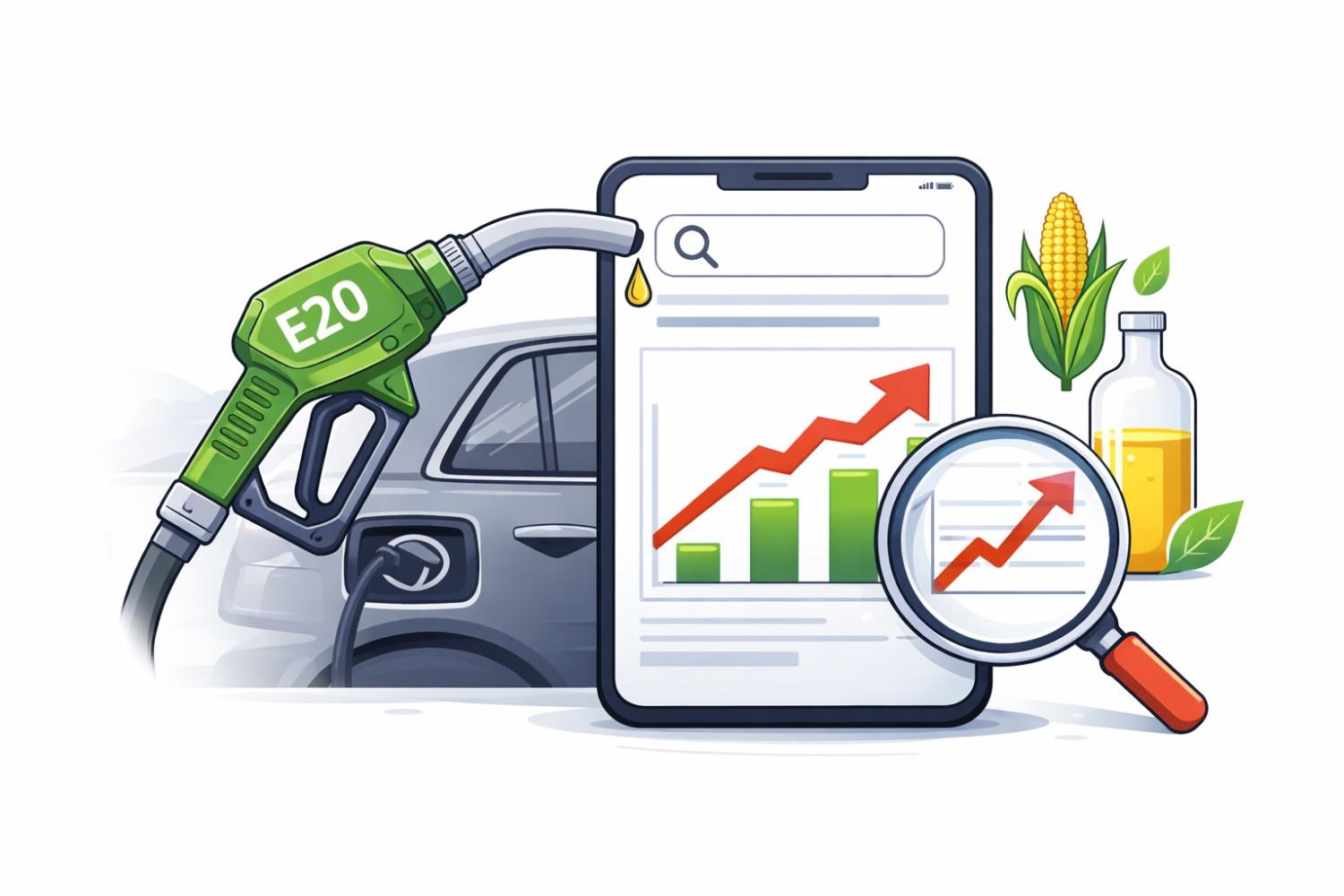
Searches for “E20 petrol” have surged across India, reflecting rising consumer interest in the government’s ethanol-blended fuel rollout. As fuel stations expand E20 availability and more vehicles become compatible, car and bike owners are actively seeking clarity on usage, benefits, and engine safety.
India’s transition toward higher ethanol blending is part of a broader strategy to reduce crude oil imports and promote cleaner energy. With E20 petrol now available in several cities and set for wider adoption, the topic is gaining momentum online.
Here is a detailed breakdown of what E20 petrol means, why it is trending, and how it impacts Indian consumers.
What Is E20 Petrol?
E20 petrol is a fuel blend that contains 20% ethanol and 80% petrol.
Ethanol is a biofuel made from agricultural products such as sugarcane, maize, and other biomass sources. Blending ethanol with petrol reduces dependence on imported crude oil and lowers carbon emissions.
India had earlier implemented E10 petrol (10% ethanol blending). The shift to E20 marks the next phase in the ethanol blending programme.
Why Is E20 Petrol Trending Now?
There are several reasons behind the spike in online searches.
First, the Government of India has been gradually rolling out E20 fuel at retail outlets. As more petrol pumps display E20 signage, consumers are searching for information.
Second, automobile manufacturers have started introducing E20-compliant vehicles. Car buyers want to know whether their vehicles can run safely on the new fuel.
Third, fuel pricing and compatibility concerns have led to confusion among vehicle owners. Many users are asking:
Is E20 safe for my car?
Does E20 reduce mileage?
What is the price of E20 petrol?
Is E20 available in my city?
The combination of policy rollout and consumer uncertainty is driving search traffic.
Government’s Ethanol Blending Target
India’s ethanol blending programme has clear milestones.
The government advanced its target to achieve 20% ethanol blending (E20) by 2025–26, ahead of the earlier schedule.
The aim is to:
Reduce crude oil imports
Lower carbon emissions
Support farmers and rural income
Improve energy security
India imports a large portion of its crude oil requirement. Increasing domestic biofuel usage helps reduce foreign exchange outflow.
Vehicle Compatibility: What Owners Need to Know
One of the biggest concerns among consumers is engine compatibility.
Automobile manufacturers have stated that vehicles manufactured from a certain period onward are designed to handle E20 fuel.
Older vehicles may be compatible with E10 but not necessarily with E20.
Car owners are advised to:
Check their vehicle manual
Confirm with authorised dealerships
Avoid mixing incompatible fuel types unnecessarily
Most major car and two-wheeler manufacturers in India have announced a transition toward E20-ready engines.
However, compatibility may vary by model and year of manufacture.
Impact on Mileage and Performance
Ethanol contains less energy per litre compared to pure petrol. This means E20 may slightly affect fuel efficiency.
Experts suggest that mileage differences may be noticeable but not drastic in compatible vehicles.
The real-world impact depends on engine design and driving conditions.
Manufacturers have adjusted engine calibration in newer vehicles to optimise performance with E20 fuel.
Fuel Pricing and Availability
In most cases, E20 petrol is priced similar to or slightly different from regular petrol, depending on local taxes and blending costs.
Fuel pricing in India is influenced by global crude rates, state taxes, and distribution margins.
Availability is being expanded in phases. Major oil marketing companies are increasing E20 supply across urban and semi-urban locations.
Consumers are advised to check with local fuel stations regarding availability.
Environmental and Economic Benefits
The shift to E20 petrol has environmental advantages.
Blending ethanol reduces tailpipe emissions compared to pure petrol. It also supports India’s climate commitments.
From an economic perspective, ethanol production supports farmers. Sugar mills and ethanol plants benefit from increased demand.
The policy also encourages investment in biofuel infrastructure.
Reducing oil imports improves India’s trade balance and energy security.
Industry Response
Automobile manufacturers have been preparing for the E20 transition.
Several brands have announced that their new models are E20-compatible.
Fuel system components, engine materials, and calibration have been upgraded to handle higher ethanol content.
Oil marketing companies have also invested in storage and blending infrastructure.
The transition requires coordination between government agencies, oil companies, and automakers.
Concerns and Clarifications
Despite the benefits, concerns remain.
Some vehicle owners worry about:
Engine wear and tear
Warranty implications
Fuel system corrosion
Mileage reduction
Automobile companies have clarified that E20-compliant vehicles are tested for durability.
However, owners of older vehicles should verify compatibility before regular use.
Government advisories and manufacturer guidelines should be followed carefully.
Rural and Agricultural Impact
The ethanol blending programme has a strong rural dimension.
Ethanol production from sugarcane and grains provides additional income to farmers.
This reduces surplus stock in the sugar industry and stabilises agricultural markets.
The policy is seen as part of India’s broader push for self-reliance in energy and agriculture.
Increased ethanol production also generates employment in rural processing units.
Global Context
India is not alone in using ethanol-blended fuel.
Countries such as Brazil and the United States have long-standing ethanol blending programmes.
Brazil, for example, uses high ethanol blends in many vehicles.
India’s E20 rollout aligns with global biofuel trends.
However, climate, vehicle mix, and fuel standards differ by country.
Digital Search Behaviour Reflects Policy Awareness
The spike in E20 petrol searches highlights how consumers now track policy changes in real time.
When new fuel types are introduced, digital platforms become the first source of information.
Search engines show rising interest in keywords such as:
E20 petrol meaning
E20 petrol benefits
E20 petrol disadvantages
E20 fuel launch date
This indicates growing public awareness about energy policy.
What Consumers Should Do
Vehicle owners should take practical steps:
Confirm if their vehicle is E20-compatible
Follow manufacturer guidelines
Monitor fuel efficiency after switching
Avoid panic or misinformation
Official announcements from oil companies and automakers should be considered the primary source of truth.
Consumers should avoid relying on unverified social media claims.
Looking Ahead
The transition to E20 petrol will continue over the next few years.
By the target year of 2025–26, E20 is expected to be widely available across India.
Future policies may explore even higher biofuel blends, depending on infrastructure readiness and industry adaptation.
For now, awareness and correct usage remain key.
Conclusion
The surge in E20 petrol searches signals strong consumer interest in India’s evolving fuel policy.
As the country moves toward 20% ethanol blending by 2025–26, vehicle compatibility and fuel efficiency remain top concerns for motorists.
The policy aims to reduce oil imports, lower emissions, and support farmers.
With wider rollout and increasing availability, E20 petrol is set to become a major part of India’s energy transition.
For Indian consumers, staying informed and following official guidance will ensure a smooth shift to the new fuel blend.
Disclaimer: The information presented in this article is intended for general informational purposes only. While every effort is made to ensure accuracy, completeness, and timeliness, data such as prices, market figures, government notifications, weather updates, holiday announcements, and public advisories are subject to change and may vary based on location and official revisions. Readers are strongly encouraged to verify details from relevant official sources before making financial, investment, career, travel, or personal decisions. This publication does not provide financial, investment, legal, or professional advice and shall not be held liable for any losses, damages, or actions taken in reliance on the information provided.
edited by mantena sasank
Last Updated on: Friday, February 27, 2026 12:02 pm by Digital Herald Team | Published by: Digital Herald Team on Friday, February 27, 2026 12:02 pm | News Categories: Automobile