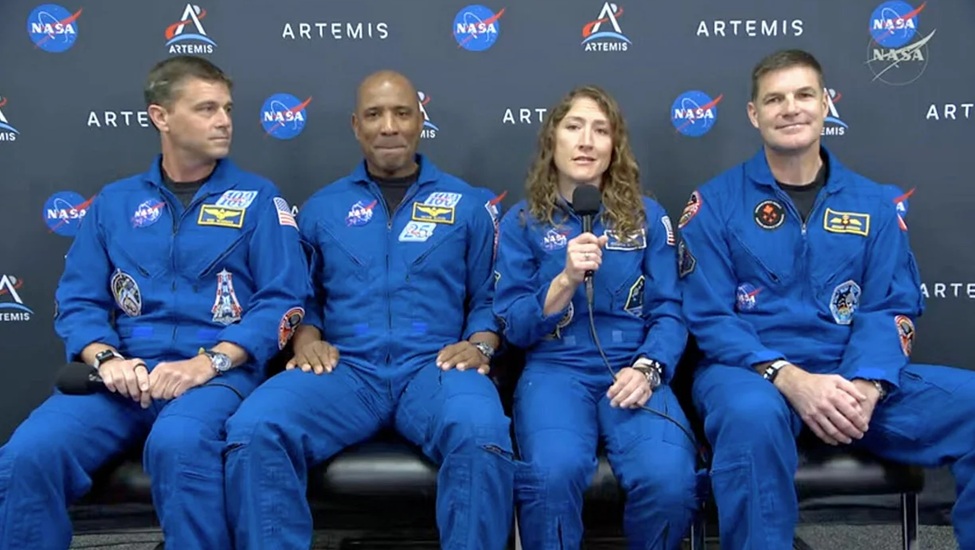
Four astronauts prepare for historic lunar flyby as space agency advances long-term Moon exploration plans
The crew of Artemis II has confirmed readiness for a landmark mission that will send humans toward the Moon for the first time in more than five decades. The launch is scheduled for April 1 from Kennedy Space Center, where NASA’s next-generation rocket system will carry astronauts beyond low Earth orbit.
Mission Overview and Key Details
The four-member crew includes commander Reid Wiseman, pilot Victor Glover, mission specialist Christina Koch, and mission specialist Jeremy Hansen.
They will travel aboard the Orion spacecraft, launched by NASA’s Space Launch System. The mission represents a major step in NASA’s Artemis program, which aims to establish a sustained human presence on the Moon.
The countdown is expected to begin late on March 31, leading to a planned liftoff at 6:24 p.m. EDT on April 1. NASA has allocated a two-hour launch window, with weather conditions currently forecast to be favorable.
What Artemis II Will Do
Unlike future missions, Artemis II will not attempt a lunar landing. Instead, it will carry astronauts on a 10-day journey around the Moon before returning to Earth.
After launch, the spacecraft will spend about a day in high Earth orbit for system checks. It will then head toward the Moon, using a “free-return trajectory,” meaning the Moon’s gravity will guide the spacecraft back toward Earth without requiring major course corrections.
The crew is expected to pass approximately 6,500 kilometers above the Moon’s surface on the far side, a region never directly visible from Earth.
Historic Distance and Milestone
NASA officials say the mission could set a new record for the farthest distance humans have traveled from Earth—around 406,000 kilometers—surpassing the record set during Apollo 13.
This will also be the first crewed lunar mission since Apollo 17, the final mission of the Apollo era.
Official Remarks
Speaking ahead of the launch, commander Reid Wiseman described the mission as both historic and technically demanding. He noted that while this will be the first time humans fly aboard the Space Launch System, the crew feels prepared after extensive training and testing.
NASA officials have emphasized that Artemis II is designed primarily as a systems test. It will evaluate navigation, propulsion, communication, and life-support capabilities in deep space—critical for future missions.
Background: The Artemis Program
The Artemis program, led by NASA, is the United States’ flagship effort to return humans to the Moon and eventually enable missions to Mars.
The program began with Artemis I, an uncrewed test flight that successfully orbited the Moon. Artemis II builds on that success by introducing astronauts into deep space missions once again.
Future missions, including Artemis III, are expected to attempt a crewed lunar landing, potentially targeting the Moon’s south pole—a region believed to contain water ice.
Why This Mission Matters
Artemis II is a critical step toward long-term lunar exploration. By testing systems in real conditions with astronauts on board, NASA aims to reduce risks for future landing missions.
The mission also signals renewed global interest in human space exploration, with international collaboration playing a key role. Canadian astronaut Jeremy Hansen’s inclusion reflects partnerships beyond the United States.
What Happens Next
Following its journey, the Orion capsule is expected to re-enter Earth’s atmosphere and splash down in the Pacific Ocean near California around April 10.
If successful, Artemis II will pave the way for more complex missions later this decade, including efforts to establish a sustained human presence on the Moon.
Input & Images: Hindusthan Samachar
Edited by Manten Sasank
Add Digital Herald as preferred source on google – click here
Also read – Iran Strike on Kuwait Desalination Plant Kills Indian Worker, Raises Fears Over Gulf Infrastructure Security
Last Updated on: Monday, March 30, 2026 10:43 am by Mantena Sasank | Published by: Mantena Sasank on Monday, March 30, 2026 10:43 am | News Categories: News