
A new analysis by the Congressional Budget Office suggests the proposed “Golden Dome” missile defense system could cost far more than initial White House projections, raising questions over funding and feasibility.
Cost estimates far exceed initial projections
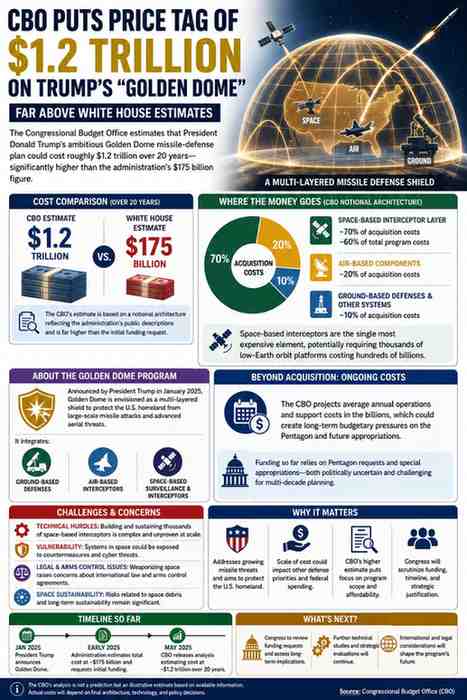
The United States’ proposed “Golden Dome” missile defense program could require approximately $1.2 trillion over two decades, according to a report by the Congressional Budget Office (CBO).
The estimate is significantly higher than earlier figures shared by the Trump administration, which had indicated a total cost of around $175 billion.
The CBO’s assessment includes development, deployment, and long-term operational expenses, offering a more comprehensive view of the program’s financial scale.
Key highlights of the CBO report
Majority of cost tied to space-based systems
The analysis found that a large portion of the total cost would come from deploying space-based interceptor systems.
These systems would involve a network of satellites designed to detect and neutralize missile threats, potentially requiring thousands of units in low-Earth orbit.
Acquisition and operational costs
The report estimates:
- Over $1 trillion in acquisition costs alone
- Additional billions annually for operations and maintenance
This long-term financial commitment could place sustained pressure on defense budgets.
Complex system architecture
The proposed “Golden Dome” is envisioned as a multi-layered defense system combining:
- Ground-based missile defenses
- Air-based interception capabilities
- Space-based surveillance and interceptors
Official stance and policy intent
The Trump administration has described the program as a strategic initiative aimed at strengthening homeland security against advanced missile threats.
Officials argue that the system could enhance early warning capabilities and improve the ability to counter large-scale missile attacks.
Why this matters
The sharp difference between official estimates and the CBO’s projections has intensified debate over the program’s viability.
A project of this scale could:
- Significantly increase long-term defense spending
- Influence US military priorities
- Affect budget allocations across other sectors
Challenges and concerns
Technical and strategic hurdles
Experts note that deploying space-based missile defense systems presents complex technical challenges, including system reliability and vulnerability to countermeasures.
Legal and geopolitical implications
The expansion of space-based defense capabilities may raise concerns related to:
- Arms control agreements
- Space militarization
- International security dynamics
Funding uncertainty
Securing consistent funding over multiple decades remains a major challenge, especially given political and budgetary constraints.
Broader context
The “Golden Dome” proposal comes amid growing global concerns over missile threats and advancements in military technology.
Countries are increasingly investing in missile defense systems, but large-scale, space-based architectures remain largely conceptual and untested at full scale.
Public and policy impact
For policymakers, the CBO’s findings highlight the need for careful evaluation of:
- Cost-benefit considerations
- Strategic priorities
- Long-term sustainability
For taxpayers, the debate centers on how such a large investment would affect national spending and fiscal balance.
What comes next
Congress is expected to closely examine the program as it considers future defense budgets and funding approvals.
Further technical studies, policy discussions, and international considerations will likely shape the program’s direction.
Conclusion
The CBO’s $1.2 trillion estimate has brought renewed scrutiny to the “Golden Dome” missile defense plan. While the project aims to address evolving security threats, its scale, cost, and complexity suggest that significant debate lies ahead before any large-scale implementation moves forward.
Input & Images: Hindusthan Samachar
Edited by Manten Sasank
Add Digital Herald as preferred source on google – click here
Also read – Indian Stock Market Extends Losses; Sensex Falls 1,456 Points, Nifty Drops Below 23,400
Last Updated on: Wednesday, May 13, 2026 10:18 am by Mantena Sasank | Published by: Mantena Sasank on Wednesday, May 13, 2026 10:18 am | News Categories: News, Politics