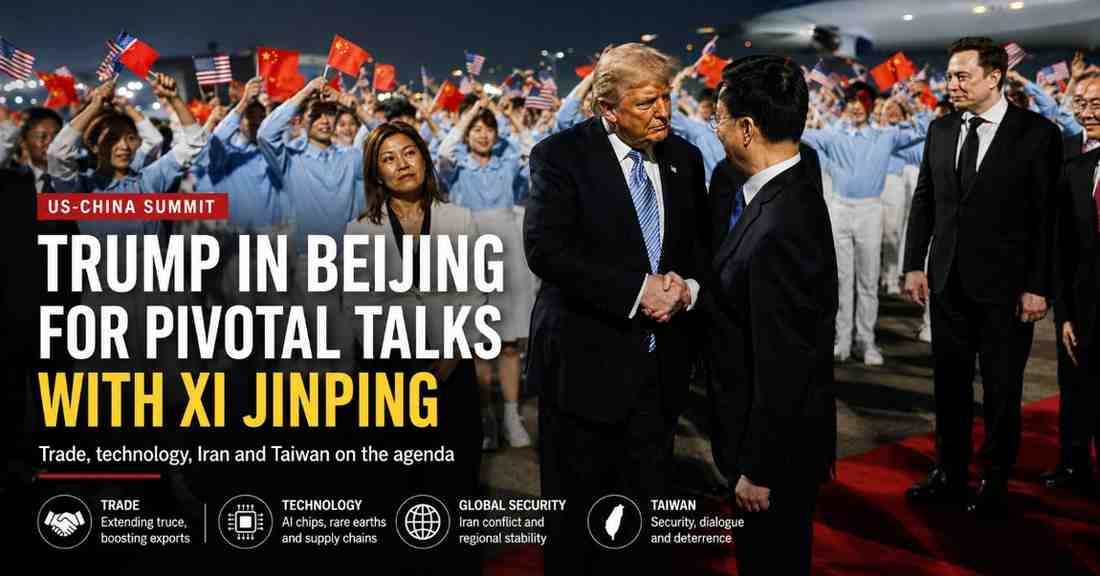
US President Donald Trump has arrived in Beijing for a closely watched summit with Chinese President Xi Jinping, with discussions expected to focus on trade tensions, technology access, and key geopolitical issues including Iran and Taiwan.
Trump begins China visit amid global and economic pressures
US President Donald Trump arrived in Beijing on May 14 for a multi-day state visit, marking his first trip to China in nearly a decade.
He was welcomed at Beijing Capital International Airport by senior Chinese officials, with formal ceremonies planned as part of the diplomatic engagement.
The visit sets the stage for high-level talks between Trump and Chinese President Xi Jinping, at a time when both countries are navigating complex economic and geopolitical challenges.
Key priorities of the summit
Trade and market access
Trade remains a central focus, with efforts expected to extend an existing trade truce and avoid further tariff escalations.
The United States is seeking greater access to Chinese markets, including opportunities for exports in sectors such as agriculture and aviation.
Technology and supply chains
Technology-related issues are likely to dominate discussions, particularly around semiconductor supply chains and access to critical materials such as rare earth elements.
Both sides are expected to explore ways to reduce disruptions while protecting strategic interests.
Geopolitical concerns: Iran and Taiwan
The ongoing Iran conflict and tensions around Taiwan are also expected to feature prominently.
While the United States continues its security commitments in the region, discussions may aim to reduce risks of escalation and maintain stability.
Diplomatic schedule and engagements
The visit includes a series of official and working engagements:
- Formal welcome ceremony in Beijing
- Closed-door bilateral discussions
- State banquet hosted by Chinese leadership
- Follow-up meetings and working sessions
These events combine ceremonial diplomacy with substantive negotiations.
Business delegation highlights economic focus
Trump is accompanied by senior US officials and leading business executives, reflecting a strong emphasis on economic cooperation and commercial outcomes.
The presence of industry leaders signals an effort to secure practical agreements that could benefit both economies.
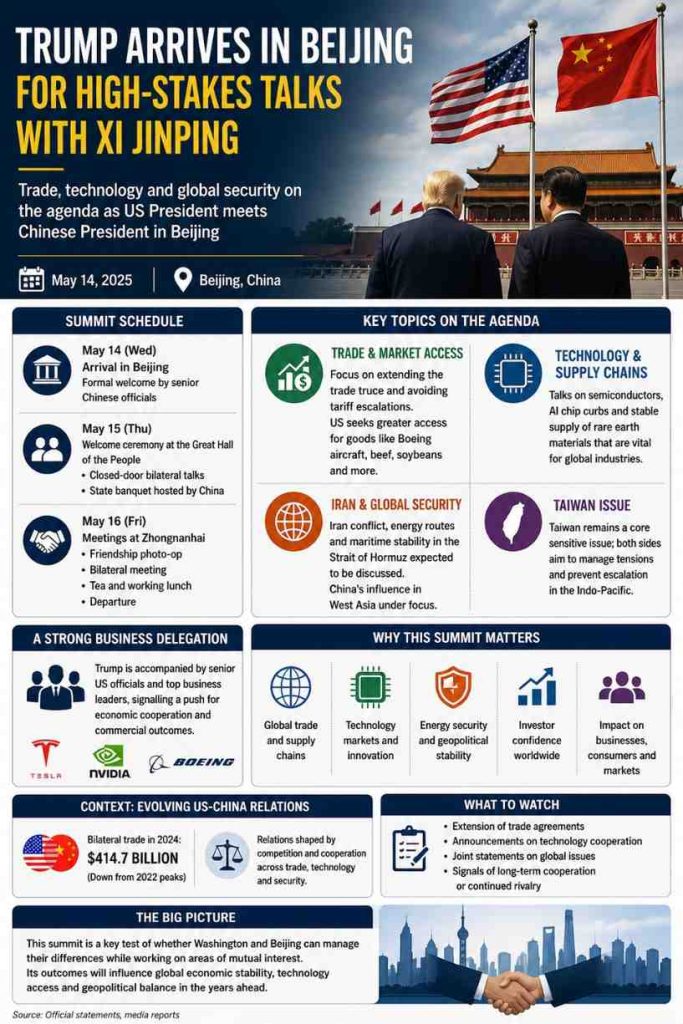
Context: Evolving US-China relations
US-China ties have remained complex, shaped by competition and cooperation across trade, technology, and security.
Bilateral trade volumes have fluctuated in recent years, and both sides have imposed measures affecting market access and supply chains.
The current summit is seen as an opportunity to stabilise relations and address ongoing points of friction.
Why this summit matters
The outcome of the talks could have far-reaching implications for:
- Global trade and supply chains
- Technology markets and innovation
- Energy security and geopolitical stability
- Investor confidence worldwide
Even incremental agreements between the two countries can influence global economic conditions.
Public and economic impact
For businesses and consumers, the discussions may affect:
- Prices of goods and commodities
- Availability of technology products
- Trade flows between major economies
For investors, signals from the summit could shape market sentiment and future investment decisions.
What to watch next
Observers will closely track:
- Any extension of trade agreements
- Announcements on technology cooperation
- Joint statements on geopolitical issues
- Signals of long-term cooperation or continued rivalry
Trump’s arrival in Beijing marks a significant moment in US-China diplomacy. As both sides engage in high-level talks, the outcomes will be closely watched for signs of progress in managing economic competition and geopolitical tensions in an increasingly uncertain global environment.
Key Insights
- The summit signals a shift toward managed competition, where both the US and China aim to stabilise ties without resolving deeper strategic differences.
- Semiconductors and rare earth supply chains remain central to negotiations, highlighting how technology has become a core geopolitical and economic battleground.
- Any extension of the trade truce could ease global market volatility, with ripple effects for emerging economies like India that rely on stable trade flows.
- China’s role in the Iran conflict and energy routes underscores its growing influence in West Asia and its importance in global energy security.
- Taiwan remains a key flashpoint, and even limited diplomatic understanding could help reduce the risk of escalation in the Indo-Pacific region.
- For India, shifts in US-China relations will be crucial, as they can impact trade dynamics, technology access, and regional strategic balance.
Input & Images: Hindusthan Samachar
Edited by Manten Sasank
Add Digital Herald as preferred source on google – click here
Also read – Trump to Visit Beijing for High-Stakes Summit with Xi Jinping Amid Global
Last Updated on: Thursday, May 14, 2026 5:59 pm by Mantena Sasank | Published by: Mantena Sasank on Thursday, May 14, 2026 5:22 pm | News Categories: Politics, News