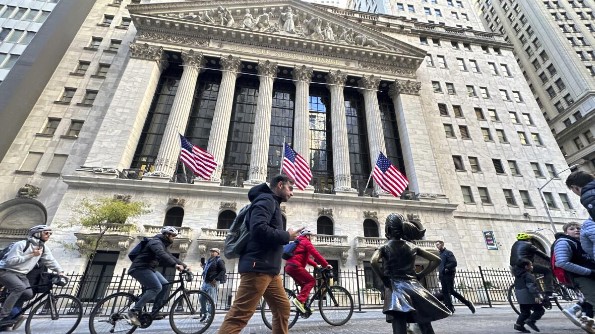
Global financial markets faced renewed pressure as escalating tensions between the United States and Iran fueled investor anxiety, triggering a broad retreat from risk assets across Wall Street, Europe, and Asia.
Concerns over potential military escalation in the Middle East weighed heavily on market sentiment, prompting investors to reassess risk exposure and shift toward safer assets. The sell-off extended across major equity markets as traders monitored developments surrounding reported attacks on U.S. military assets and rising uncertainty over the stability of a region critical to global energy supplies.
The market reaction highlights how geopolitical events continue to influence investment decisions, particularly when they involve major powers and strategically important energy corridors.
Wall Street Retreats as Risk Appetite Weakens
U.S. markets ended the previous trading session under pressure, with technology and growth-oriented stocks bearing the brunt of the decline.
Investor caution intensified amid reports of heightened military tensions involving Iran and American forces in the Gulf region. Market participants expressed concern that any further escalation could disrupt global trade flows, increase energy costs, and complicate the economic outlook at a time when investors are already navigating uncertainty surrounding interest rates and growth expectations.
Futures trading indicated continued caution, suggesting investors remain reluctant to take aggressive positions until greater clarity emerges.
Europe Records Mixed Performance
European markets also struggled to maintain momentum as geopolitical concerns spread beyond U.S. trading hours.
While some sectors showed resilience, major indices generally moved lower as investors weighed the potential consequences of a prolonged regional confrontation. Export-oriented industries, transportation companies, and energy-sensitive sectors remained particularly vulnerable to shifts in sentiment linked to developments in the Middle East.
Market strategists noted that European equities remain highly sensitive to energy-price fluctuations given the continent’s dependence on global supply chains and imported resources.
Asian Markets Lead Regional Declines
Asian equities experienced widespread selling pressure, with several major benchmarks recording significant losses.
Technology-heavy markets and export-driven economies were among the hardest hit as investors responded to growing uncertainty. South Korea and Japan witnessed some of the sharpest declines, reflecting concerns over global demand, supply-chain stability, and the broader impact of geopolitical disruptions on international commerce.
Markets in Hong Kong, Taiwan, China, Singapore, and Thailand also traded lower, underscoring the breadth of the risk-off sentiment across the region.
Only a handful of markets managed to buck the trend, supported by local factors and selective buying interest.
Why Investors Are Concerned
Financial markets tend to react strongly when geopolitical events threaten critical economic infrastructure or global trade routes.
The latest concerns center on the Gulf region, home to some of the world’s most important oil-exporting nations. Any disruption involving shipping lanes, military assets, or energy infrastructure can quickly influence commodity prices, inflation expectations, and investor confidence.
The Strait of Hormuz remains particularly significant because a substantial share of global crude oil and liquefied natural gas shipments passes through the narrow waterway each day.
Analysts warn that even if military incidents remain limited, uncertainty alone can increase volatility across financial markets.
Energy Markets in Focus
Investors are paying close attention to crude oil markets, which often serve as an immediate barometer of geopolitical risk.
Historically, tensions involving major energy-producing regions have led to price spikes, creating concerns for inflation, transportation costs, and corporate profitability. Higher energy prices can also influence central bank policy decisions and economic growth forecasts.
As a result, developments in the Middle East are being closely watched by investors, policymakers, and multinational corporations alike.
Outlook: Volatility Likely to Persist
Market participants expect volatility to remain elevated until there is greater clarity regarding the trajectory of U.S.-Iran relations and broader regional security conditions.
While economic fundamentals continue to support many global markets, geopolitical uncertainty has emerged as a dominant short-term risk factor. Investors are likely to remain cautious as they assess incoming developments, monitor energy markets, and evaluate potential implications for global growth.
For now, the widespread decline across major international markets serves as a reminder that geopolitical shocks can rapidly reshape investor sentiment, regardless of underlying economic conditions.
Key Highlights
- 📉 Global stock markets declined as escalating U.S.-Iran tensions triggered widespread risk aversion among investors.
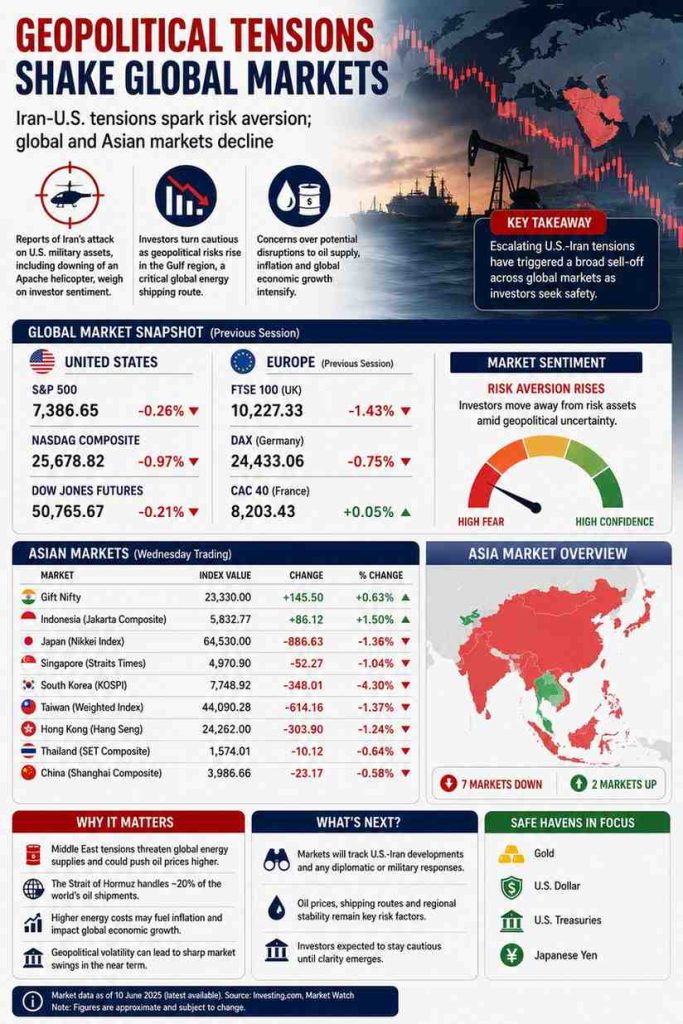
- 🇺🇸 Wall Street ended lower, with the S&P 500 falling 0.26% and the Nasdaq dropping 0.97% amid geopolitical concerns.
- 📊 Dow Jones futures remained under pressure, signaling continued investor caution.
- 🌍 European markets delivered mixed results, with the FTSE 100 falling 1.43% and Germany’s DAX losing 0.75%.
- 🇯🇵 Japan’s Nikkei Index dropped 1.36%, reflecting concerns over regional stability and global economic risks.
- 🇰🇷 South Korea’s KOSPI recorded the steepest decline, plunging 4.30% during trading.
- 🇹🇼 Taiwan’s Weighted Index fell 1.37%, while Hong Kong’s Hang Seng lost 1.24%.
- 🇨🇳 China’s Shanghai Composite also traded lower, declining 0.58%.
- 📈 Indonesia’s Jakarta Composite and Gift Nifty were among the few markets that posted gains.
- ⚠️ Investor sentiment was hit by reports of Iranian attacks on U.S. military assets and heightened geopolitical uncertainty in the Gulf region.
- ⛽ Markets are closely monitoring the Strait of Hormuz, a critical global energy shipping route that could be affected by regional tensions.
- 💰 Rising geopolitical risks have increased concerns about potential disruptions to oil supplies, inflation, and global economic growth.
- 🔍 Analysts expect continued market volatility until there is greater clarity on U.S.-Iran relations and Middle East security developments.
- 🌐 The broad-based sell-off highlights how geopolitical events can rapidly influence investor confidence across global financial markets.
Input & Images: Hindusthan Samachar
Edited by Manten Sasank
Add Digital Herald as preferred source on google – click here
Also read – Trump Alleges Iran Downed U.S. Military Helicopter Near Strait of Hormuz as Regional Tensions Intensify
Last Updated on: Wednesday, June 10, 2026 11:17 am by Mantena Sasank | Published by: Mantena Sasank on Wednesday, June 10, 2026 11:17 am | News Categories: Business