Indian equity markets traded lower in a volatile early session on Wednesday, extending weakness from the previous trading day as investors navigated mixed sectoral trends, cautious global sentiment, and renewed selling pressure in heavyweight stocks.
Although benchmark indices briefly recovered after opening losses and moved into positive territory during the opening minutes, the rebound proved short-lived as selling resumed across key sectors. Analysts said the market’s movement reflected a broader phase of consolidation after recent gains, with traders reacting to fluctuating global cues, commodity prices, and sector-specific repositioning.
By mid-morning, both the BSE Sensex and NSE Nifty had slipped back into negative territory amid continued swings between buying and profit-booking activity.
Benchmark Indices Struggle to Hold Early Gains
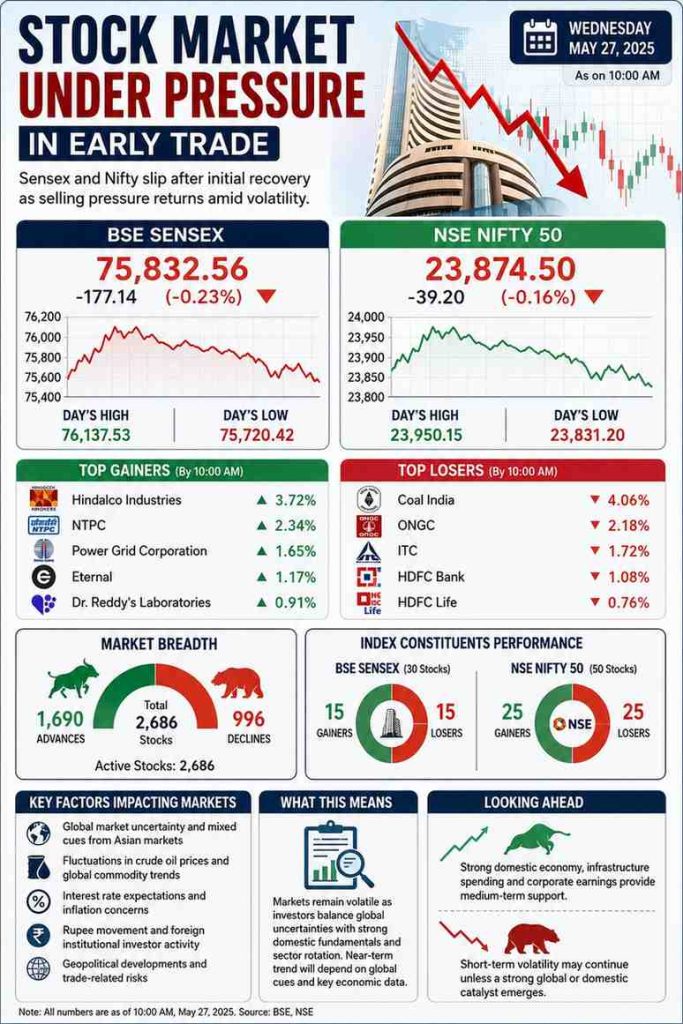
The BSE Sensex opened lower before recovering sharply in initial trade as bargain buying emerged in selected large-cap stocks. The index briefly crossed the 76,100 mark before renewed selling dragged it lower again.
Similarly, the NSE Nifty rebounded soon after the opening bell and climbed near the 23,950 level before volatility returned to the market.
By around 10 a.m., the Sensex was trading down more than 170 points near 75,830, while the Nifty slipped below 23,900.
Market participants said the inability of benchmark indices to sustain intraday gains highlighted persistent caution among investors despite selective buying support.
The volatility also followed weakness during Tuesday’s session, when both indices ended lower amid broad-based selling and profit-booking after recent market advances.
Sector Rotation Shapes Trading Activity
Trading patterns during the morning session suggested active sector rotation rather than broad panic selling.
Metal and power stocks attracted buying interest, with shares of Hindalco Industries, NTPC, and Power Grid Corporation among the notable gainers. Pharmaceutical stocks also showed relative resilience, supported by defensive positioning during uncertain market conditions.
Meanwhile, weakness remained visible in energy, banking, and consumer-oriented counters. Coal India, ONGC, HDFC Bank, HDFC Life, and ITC were among the major laggards in early trade.
Analysts noted that investors appear to be selectively reallocating capital toward sectors linked to infrastructure spending, industrial demand, and defensive earnings visibility, while trimming exposure in areas considered vulnerable to margin pressure or global commodity fluctuations.
Broader Market Breadth Remains Mixed
Despite the decline in benchmark indices, broader market participation remained relatively balanced.
More than 2,600 stocks were actively traded during the morning session, with advancing shares outnumbering decliners at one stage. Market breadth data indicated that while frontline indices faced pressure from heavyweight stocks, selective buying continued in mid-cap and sector-specific counters.
Within both the Sensex and Nifty components, gainers and losers remained nearly evenly split, reflecting uncertainty rather than a clear directional market trend.
Market experts said such mixed breadth often signals a transition phase in which investors rotate between sectors instead of exiting equities entirely.
Global Cues Continue to Influence Sentiment
Global market developments remained an important factor behind investor caution.
Asian markets have recently traded unevenly amid concerns surrounding global growth momentum, interest rate expectations, and geopolitical risks. Investors are also monitoring crude oil prices, U.S. Treasury yields, and central bank signals from major economies for indications about future monetary policy direction.
For India, fluctuations in oil prices remain particularly significant because of the country’s dependence on energy imports. Rising crude prices can increase inflationary pressures, widen the trade deficit, and influence corporate profitability across several sectors.
Currency movements are also being closely watched. A weaker rupee can raise imported inflation risks and affect sectors reliant on overseas inputs or foreign borrowing.
Domestic Fundamentals Continue to Provide Support
Despite near-term volatility, analysts said India’s broader macroeconomic outlook continues to offer medium-term support for equities.
Strong domestic consumption, ongoing government infrastructure spending, improving corporate balance sheets, and relatively stable banking-sector fundamentals have helped maintain investor confidence even during periods of global uncertainty.
Domestic institutional investors have also played an increasingly important stabilizing role in recent years, partially offsetting fluctuations in foreign portfolio investment flows.
Still, market strategists caution that short-term volatility may persist as investors continue assessing global economic conditions, inflation risks, and earnings expectations ahead of upcoming macroeconomic data releases.
Investors Focus on Directional Triggers
Traders are now expected to closely monitor several near-term market drivers, including:
- global commodity price movements,
- foreign institutional investor activity,
- central bank commentary,
- rupee stability,
- and geopolitical developments affecting global trade and energy markets.
Analysts say markets may remain range-bound in the near term unless a stronger domestic or international catalyst emerges.
For now, Wednesday’s session reflected a market searching for direction — supported by underlying domestic optimism but restrained by persistent external uncertainties and cautious investor positioning.
Key Highlights
- Indian benchmark indices traded lower in volatile early trade, with both the Sensex and Nifty slipping back into the red after an initial recovery.
- The Sensex fell over 170 points by mid-morning, while the Nifty dropped below the 23,900 mark amid renewed selling pressure.
- Metal and power stocks, including Hindalco, NTPC, and Power Grid, were among the top gainers during the session.
- Banking, energy, and consumer stocks faced selling pressure, with Coal India, ONGC, HDFC Bank, and ITC among the notable laggards.
- Market breadth remained relatively balanced, indicating selective sector rotation rather than broad-based panic selling.
- Investors continued to monitor global economic uncertainty, crude oil prices, interest rate expectations, and geopolitical developments affecting market sentiment.
- Analysts said India’s strong domestic economic fundamentals and infrastructure-driven growth outlook continue to support medium-term investor confidence despite near-term volatility.
Input & Images: Hindusthan Samachar
Edited by Manten Sasank
Add Digital Herald as preferred source on google – click here
Also read – RCB Crush Gujarat Titans to Reach Second Straight IPL Final
Last Updated on: Wednesday, May 27, 2026 11:33 am by Mantena Sasank | Published by: Mantena Sasank on Wednesday, May 27, 2026 11:33 am | News Categories: Business