
Gold prices continued to weaken across major Indian bullion markets on Thursday, reflecting softer domestic demand and cautious global sentiment, while silver rates remained steady for the third consecutive trading session.
The decline in gold prices comes amid fluctuating international market conditions, shifting expectations around interest rates, and intermittent profit-booking after recent record highs in precious metals. Traders said the correction has led to moderate price relief for retail buyers, though market sentiment remains cautious due to ongoing global economic uncertainty.
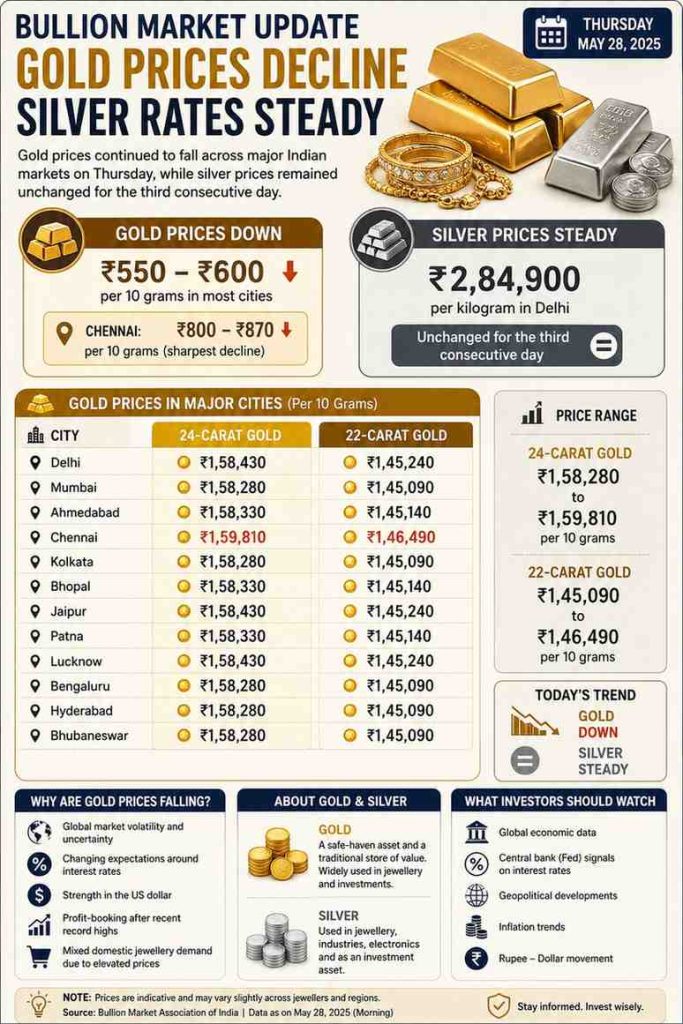
During early trade, gold prices fell by around ₹550 to ₹600 per 10 grams in most cities, while Chennai recorded a steeper decline compared with other major markets.
Gold Trades Lower Across Major Cities
According to bullion market data, 24-carat gold was trading between approximately ₹1,58,280 and ₹1,59,810 per 10 grams in key domestic markets. Prices for 22-carat gold ranged between ₹1,45,090 and ₹1,46,490 per 10 grams.
In Delhi, 24-carat gold was quoted around ₹1,58,430 per 10 grams, while 22-carat gold traded near ₹1,45,240.
Mumbai, Kolkata, Bengaluru, Hyderabad and Bhubaneswar reported similar pricing trends, with 24-carat gold hovering around ₹1,58,280 per 10 grams.
Chennai continued to remain among the costlier bullion markets in the country despite the sharper correction, with 24-carat gold trading near ₹1,59,810 per 10 grams.
Bullion traders said regional pricing differences are often influenced by transportation costs, local taxes, demand conditions, and jeweller inventory positions.
Silver Prices Hold Steady
Unlike gold, silver prices showed no movement during Thursday’s early trade.
In the Delhi bullion market, silver continued to trade at around ₹2,84,900 per kilogram for the third straight day. Market participants said silver has recently shown relatively stable pricing compared with gold, partly due to industrial demand expectations and tighter supply dynamics in some global markets.
Analysts noted that silver’s dual role as both a precious and industrial metal often creates a different pricing pattern from gold, especially during periods of broader economic uncertainty.
Global Factors Continue to Influence Bullion Prices
Market experts said international developments remain the primary driver behind recent fluctuations in gold prices.
Global bullion markets have been reacting to multiple factors, including:
- U.S. Federal Reserve interest rate expectations,
- movements in the U.S. dollar,
- geopolitical tensions,
- inflation concerns,
- and global economic growth forecasts.
Higher interest rates generally reduce the appeal of non-yielding assets such as gold, while geopolitical instability and inflation fears tend to support safe-haven demand.
Recent volatility in international markets has led to rapid shifts in investor positioning, contributing to price swings in precious metals globally.
Domestic Demand Remains Mixed
Jewellery demand in India has remained uneven in recent weeks as elevated prices continue to affect retail purchasing patterns.
Some jewellers reported that periodic price corrections are encouraging selective buying, particularly ahead of festive and wedding-related demand cycles. However, many consumers remain cautious after gold prices touched historically high levels earlier this year.
Industry observers say investment demand for gold continues to remain relatively strong among households seeking protection against inflation and financial market volatility.
Gold has traditionally held cultural and financial significance in India, serving both as an investment asset and a key component of household savings.
Investors Watching Global Economic Signals
Bullion dealers expect gold prices to remain highly sensitive to upcoming global economic data and central bank commentary.
Market participants are closely monitoring inflation trends, interest rate signals from major economies, and geopolitical developments that could influence safe-haven investment flows.
Analysts believe short-term volatility may continue, although long-term sentiment toward gold remains supported by global uncertainty, central bank buying activity, and persistent macroeconomic risks.
For now, Thursday’s decline offered temporary relief to domestic buyers, even as broader bullion markets continue navigating an uncertain global financial environment.
Key Highlights
- Gold prices declined across major Indian bullion markets, falling by ₹550–₹600 per 10 grams in most cities during early trade.
- Chennai witnessed a sharper correction, with gold prices dropping by up to ₹870 per 10 grams.
- 24-carat gold traded between ₹1.58 lakh and ₹1.59 lakh per 10 grams, while 22-carat gold remained above ₹1.45 lakh in key markets.
- Silver prices remained unchanged for the third consecutive day, trading at ₹2,84,900 per kilogram in the Delhi bullion market.
- Analysts attributed the weakness in gold prices to global market volatility, shifting interest rate expectations, and profit-booking after recent highs.
- Domestic jewellery demand remains cautious as elevated bullion prices continue to affect retail buying sentiment.
- Investors are closely monitoring global inflation trends, U.S. Federal Reserve signals, currency movements, and geopolitical developments for further direction in precious metal prices.
Input & Images: Hindusthan Samachar
Edited by Manten Sasank
Add Digital Herald as preferred source on google – click here
Also read – Indian Markets Slip in Volatile Early Trade as Investors Balance Sector Rotation and Global Uncertainty
Last Updated on: Thursday, May 28, 2026 6:34 pm by Mantena Sasank | Published by: Mantena Sasank on Thursday, May 28, 2026 6:34 pm | News Categories: Business