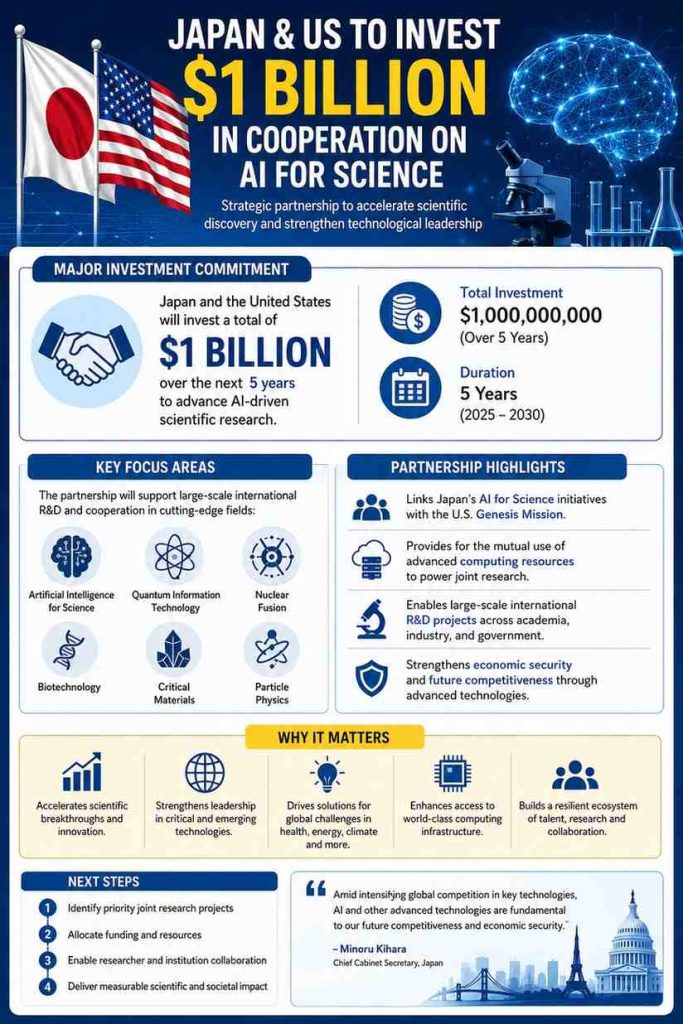
Japan and the United States have unveiled an ambitious new initiative to deepen cooperation in artificial intelligence-driven scientific research, committing a combined $1 billion investment over the next five years in what officials describe as a strategic effort to strengthen technological leadership and economic security.
The partnership comes as governments worldwide race to harness artificial intelligence for scientific discovery, industrial innovation, and national competitiveness. The joint program will support large-scale research projects, advanced computing infrastructure, and cross-border collaboration in some of the world’s most critical emerging technologies.
Japanese officials said the initiative will connect domestic AI-for-science programs with major U.S. research efforts, creating a framework for scientists, universities, and research institutions to share resources and accelerate breakthroughs across multiple disciplines.
AI Moves Beyond Chatbots Into Scientific Discovery
While public attention has largely focused on generative AI tools, policymakers increasingly view artificial intelligence as a transformative technology for scientific research.
AI systems are being deployed to analyze massive datasets, identify patterns beyond human capability, accelerate drug discovery, design advanced materials, model climate systems, and assist in complex engineering challenges. Researchers believe the technology could dramatically shorten development timelines for innovations that traditionally require years of experimentation.
The Japan-U.S. partnership reflects a growing recognition that leadership in AI will depend not only on software development but also on access to high-performance computing resources and international scientific collaboration.
Expanding Cooperation Across Strategic Technologies
Beyond artificial intelligence, the agreement is expected to strengthen cooperation in several high-priority fields viewed as critical to future economic growth and national security.
These include quantum information science, biotechnology, nuclear fusion research, particle physics, and the development of critical materials needed for advanced manufacturing and next-generation technologies.
Governments in both countries have increasingly identified these sectors as essential components of long-term technological competitiveness, particularly as global competition intensifies among major economic powers.
Experts note that breakthroughs in these fields often require enormous computational power, specialized research facilities, and international collaboration, making partnerships between technologically advanced nations increasingly important.
Strengthening Research Infrastructure
A key feature of the initiative is the expansion of shared computing capabilities.
Advanced scientific research increasingly depends on powerful computing systems capable of processing vast amounts of data and running sophisticated simulations. By enabling researchers to access resources across national boundaries, the partnership aims to remove barriers that can slow innovation.
The agreement is also expected to encourage greater collaboration among universities, research laboratories, technology companies, and government agencies in both countries.
Technology Competition Shapes Global Strategy
The announcement reflects a broader shift in international policy as countries seek to secure leadership in emerging technologies that are expected to shape economic and geopolitical influence for decades.
Artificial intelligence has become a central focus of this competition, with governments investing heavily in research, semiconductor development, data infrastructure, and advanced computing capabilities.
Analysts say the partnership demonstrates how technology policy is increasingly intertwined with national security considerations. Access to advanced AI systems, computing resources, and scientific talent is now viewed as a strategic advantage comparable to traditional economic and industrial strengths.
What the Partnership Could Mean
For researchers, the initiative may provide access to larger datasets, enhanced computing capacity, and expanded opportunities for international collaboration.
For businesses, advances generated through the program could contribute to innovations in healthcare, energy, manufacturing, and digital technologies. Breakthroughs in areas such as biotechnology and fusion energy could also have significant long-term economic implications.
While the full impact of the partnership will depend on the projects ultimately funded and the pace of scientific progress, the scale of the investment highlights the growing importance governments place on artificial intelligence as a driver of future innovation.
As nations compete to define the next era of technological advancement, the new Japan-U.S. initiative underscores a broader reality: scientific leadership is increasingly becoming a matter of strategic collaboration as much as national ambition.
Key Highlights
- 🇯🇵🇺🇸 Japan and the United States will jointly invest $1 billion over five years to advance artificial intelligence-driven scientific research.
- 🤖 The partnership aims to accelerate the use of AI in scientific discovery, research, and technological innovation.
- 🔬 Collaboration will support large-scale international R&D projects across multiple advanced technology sectors.
- 💻 Both countries will strengthen and share high-performance computing resources, enabling researchers to process complex scientific data more efficiently.
- ⚛️ Beyond AI, the initiative includes cooperation in quantum computing, nuclear fusion, biotechnology, particle physics, and critical materials research.
- 🌍 The agreement links Japan’s AI-for-science programs with the U.S. Genesis Mission, creating a framework for deeper scientific collaboration.
- 📈 Officials describe AI and advanced technologies as critical to future economic competitiveness, innovation, and national security.
- 🏭 The partnership is expected to benefit industries including healthcare, energy, manufacturing, and advanced technology development.
- 🌐 The announcement reflects growing global competition among major economies for leadership in emerging technologies.
- 🚀 Experts say the initiative could accelerate scientific breakthroughs by combining funding, talent, data resources, and computing infrastructure across both countries.
Input & Images: Hindusthan Samachar
Edited by Manten Sasank
Add Digital Herald as preferred source on google – click here
Also read – Gold Prices Slip Slightly Across India as Silver Holds Firm
Last Updated on: Friday, June 5, 2026 3:35 pm by Mantena Sasank | Published by: Mantena Sasank on Friday, June 5, 2026 3:35 pm | News Categories: News, Technology