A powerful earthquake struck off the southern coast of the Philippines on Monday morning, prompting tsunami warnings, emergency evacuations, and damage assessments across several provinces in Mindanao. Authorities launched rescue and monitoring operations as officials worked to determine the full impact of one of the strongest seismic events to affect the country in decades.
The earthquake occurred beneath waters near the southern Philippine island of Mindanao and was felt across a wide area of the region. Emergency agencies immediately activated disaster response protocols amid concerns over possible tsunami waves, structural damage, and aftershocks.
While initial reports indicated casualties and damage to buildings, authorities cautioned that the situation remained fluid and that assessments were continuing in affected communities.
Tsunami Warnings Prompt Coastal Evacuations
Following the quake, disaster management agencies issued tsunami advisories for vulnerable coastal areas. Residents in low-lying communities were urged to move to higher ground as officials monitored sea-level activity and potential wave impacts.
The warnings extended beyond the Philippines, with neighboring countries also closely watching conditions across parts of Southeast Asia. Authorities emphasized that tsunami threats can persist for several hours after a major undersea earthquake, requiring continued vigilance even after the initial tremors subside.
Emergency personnel were deployed to coastal zones to assist evacuations and provide updates to residents.
Buildings Damaged as Rescue Operations Continue
Early reports from southern Mindanao indicated structural damage in several urban centers. Buildings, commercial establishments, and public facilities were affected by the strong shaking, while power disruptions were reported in some locations.
Search-and-rescue teams were mobilized to inspect damaged structures and assist residents. Local governments established emergency coordination centers as engineers began evaluating the safety of critical infrastructure, including schools, government offices, transportation facilities, and healthcare institutions.
Officials stressed that casualty figures and damage estimates could change as information from remote areas becomes available.
Why the Philippines Faces Frequent Earthquake Risks
The Philippines is among the world’s most earthquake-prone nations due to its location along the Pacific Ring of Fire, a vast zone of seismic and volcanic activity that stretches around the Pacific Ocean.
The archipelago sits near several active tectonic plate boundaries where geological forces frequently generate earthquakes and volcanic eruptions. The region experiences thousands of tremors each year, although only a small percentage cause significant damage.
Major earthquakes have shaped the country’s disaster preparedness policies, leading to improvements in emergency response systems, evacuation planning, and public awareness campaigns.
Aftershocks Remain a Concern
Seismologists warned that powerful aftershocks often follow major earthquakes and can pose additional risks to weakened buildings and infrastructure.
Authorities urged residents to remain alert, avoid damaged structures, and follow official guidance. Disaster agencies continued monitoring seismic activity throughout the day while coordinating with local governments and emergency services.
Experts noted that deeper earthquakes can sometimes reduce surface destruction compared with shallow events of similar magnitude, though strong shaking can still be felt across extensive areas.
Regional and Economic Implications
Beyond immediate safety concerns, significant earthquakes can disrupt transportation networks, telecommunications, energy infrastructure, and commercial activity. Ports, airports, and supply chains are often placed under heightened observation following major seismic events.
The Philippines’ location at the crossroads of regional maritime routes means that severe natural disasters can have broader economic implications if infrastructure damage proves extensive.
For now, emergency response remains the priority as authorities focus on protecting lives, assessing structural damage, and monitoring coastal conditions.
Focus Turns to Recovery and Preparedness
As rescue efforts continue, government agencies are expected to intensify inspections of public infrastructure and coordinate relief operations where necessary. The earthquake serves as another reminder of the challenges faced by countries situated along active seismic zones and the importance of preparedness in minimizing disaster risks.
With aftershocks still possible and tsunami monitoring ongoing, authorities are urging residents to stay informed through official channels and follow emergency instructions as the situation develops.
Key Highlights
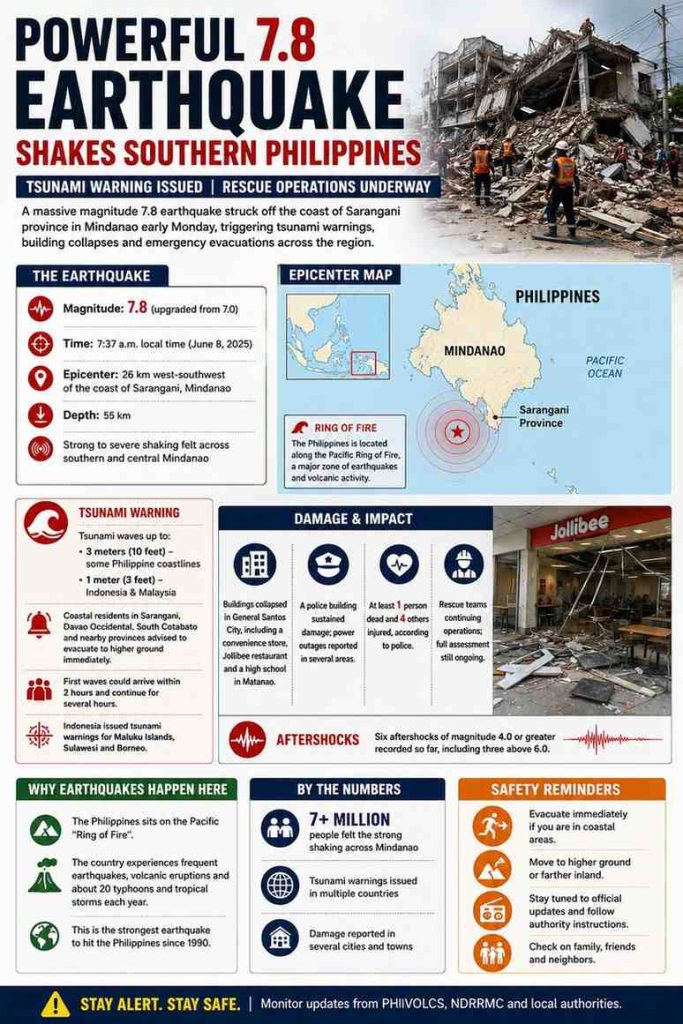
- 🌏 A powerful 7.8-magnitude earthquake struck off the coast of southern Philippines near Mindanao.
- 🚨 Authorities issued tsunami warnings for parts of the Philippines and neighboring regions following the undersea quake.
- 🌊 Tsunami waves of up to 3 meters (10 feet) were feared along some Philippine coastlines.
- 🏃 Coastal residents in affected provinces were urged to evacuate immediately to higher ground.
- 🏢 Several buildings reportedly suffered damage, including commercial establishments, public facilities, and a police building.
- ⚡ Power outages and infrastructure disruptions were reported in parts of the affected region.
- 💔 Initial reports indicated at least one fatality and multiple injuries, with rescue operations ongoing.
- 🔍 Emergency teams continue to assess the full extent of damage and search for victims.
- 🌋 The Philippines lies on the Pacific Ring of Fire, making it one of the world’s most earthquake-prone countries.
- 📈 Multiple strong aftershocks were recorded after the main quake, raising concerns about further damage.
- 👥 More than 7 million people across southern and central Mindanao reportedly experienced moderate to severe shaking.
- 🛟 Authorities remain on high alert as tsunami monitoring, infrastructure inspections, and emergency response efforts continue.
Input & Images: Hindusthan Samachar
Edited by Manten Sasank
Add Digital Herald as preferred source on google – click here
Also read – India Names Strong Squad for World Boxing Cup in China as Minakshi and Deepak Lead Medal Push
Last Updated on: Monday, June 8, 2026 10:21 am by Mantena Sasank | Published by: Mantena Sasank on Monday, June 8, 2026 10:20 am | News Categories: News