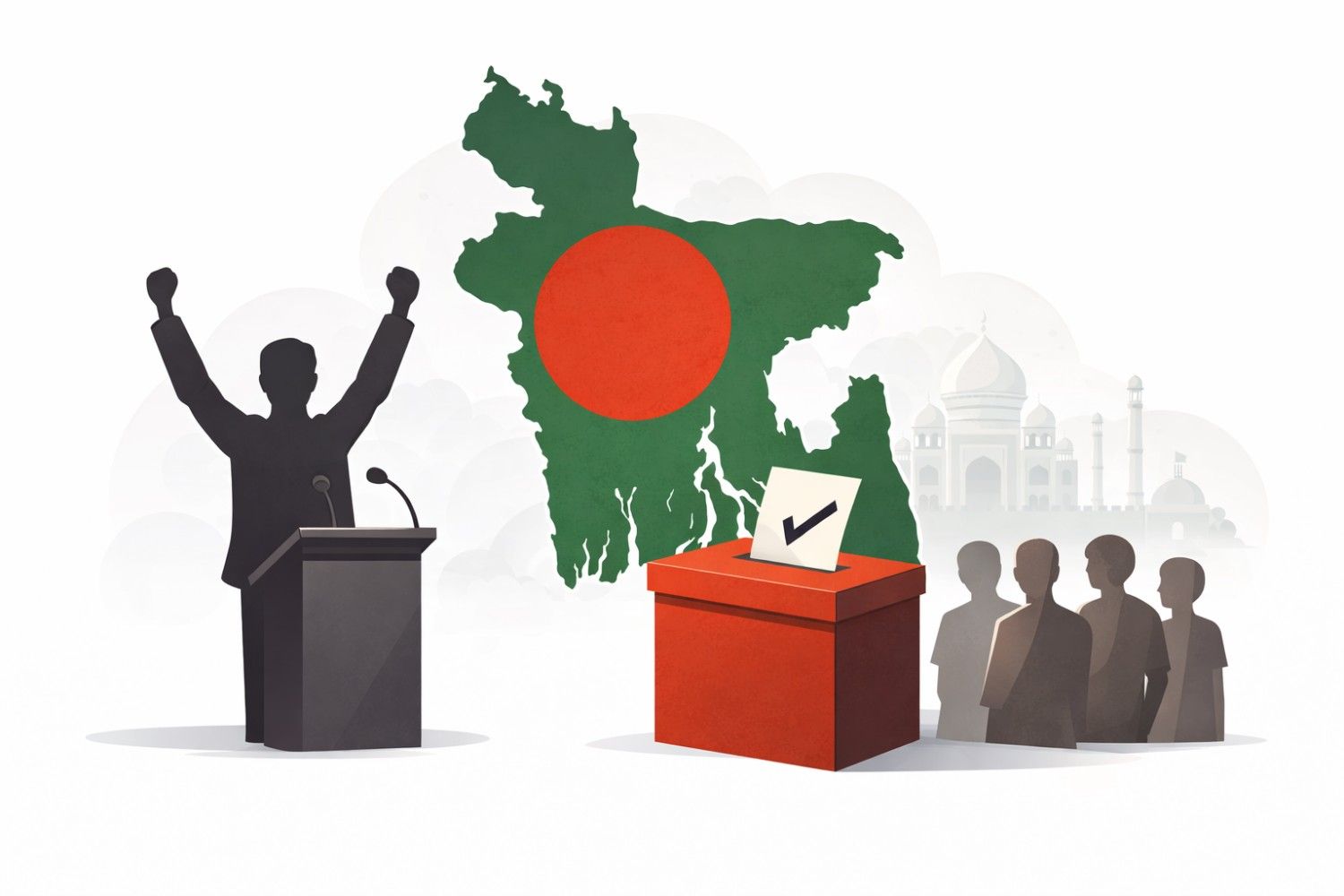
The Bangladesh Nationalist Party (BNP) has secured a sweeping victory in the February 12, 2026 general elections, marking a major political shift in South Asia. The result ends years of political turbulence and returns the BNP to power after a long period out of government.
The election is significant not only for Bangladesh but also for regional politics. The country plays an important role in trade, migration, and security in South Asia, and a change in leadership could influence relations with India, China, and other global powers.
Election Results: BNP Secures a Strong Mandate
The 2026 parliamentary elections were held across 299 constituencies. Early results show the BNP winning a clear majority in the national parliament. Reports indicate that the BNP and its allies secured over 200 seats, comfortably crossing the 151-seat majority mark required to form a government. In several projections, the party is seen heading toward a two-thirds majority, a strong mandate by any standard.
The election saw a voter turnout of around 59.44%, reflecting strong public participation after a period of political unrest.
A Historic Vote After the 2024 Political Upheaval
The 2026 election was the first national vote after the 2024 uprising that ended the long rule of former Prime Minister Sheikh Hasina. The country had been under an interim administration following months of protests and political uncertainty.
The latest vote was widely seen as a test of Bangladesh’s democratic recovery. With the BNP’s victory, the country is entering a new political phase after nearly two decades dominated by one political camp.
Tarique Rahman Set to Lead the Next Government
BNP leader Tarique Rahman is expected to become the next Prime Minister following the party’s strong performance. Rahman, the son of former President Ziaur Rahman and former Prime Minister Khaleda Zia, returned to Bangladesh after years abroad to lead the election campaign.
He won key parliamentary seats and is now positioned to form the new government with a strong majority. The BNP leadership has indicated that its main priorities will include economic recovery, job creation, anti-corruption measures, and institutional reforms.
Why the Election Matters for South Asia
Bangladesh is one of the fastest-growing economies in South Asia and a key regional partner in trade and security. Political changes in Dhaka often influence India-Bangladesh relations, regional trade routes, migration policies, security cooperation, and China’s economic projects in the region.
With a new government in place, many countries will be watching the policy direction of the BNP leadership.
Impact on India-Bangladesh Relations
India has traditionally maintained strong ties with Bangladesh, especially during the previous government’s tenure. Early signals suggest that India is seeking stable relations with the new BNP leadership, with leaders from New Delhi expressing willingness to work with the incoming government.
For India, Bangladesh is important in areas such as border security, trade and logistics, connectivity projects, energy cooperation, and counter-terrorism efforts. The BNP’s approach to India will be closely watched, as past governments from the party have had more complex relations with New Delhi.
China’s Role and Regional Competition
China has become a major investor in Bangladesh, funding infrastructure projects, ports, and industrial zones. Under the new government, analysts expect Dhaka to continue economic cooperation with China while balancing ties between India and China.
This approach is likely to focus on trade-driven foreign policy. The balancing act could shape regional geopolitics, especially as South Asia becomes an important area of global strategic competition.
Economic Policy: What the New Government May Focus On
The BNP has promised policies aimed at economic stability and job creation. Bangladesh’s economy has faced several challenges in recent years, including inflation pressures, currency fluctuations, rising import costs, and youth unemployment.
The new government is expected to focus on boosting exports, supporting small businesses, attracting foreign investment, and strengthening the manufacturing sector. Economic performance will likely be the main factor shaping public opinion about the new leadership.
Opposition Landscape: Jamaat Emerges as Main Rival
With the BNP forming the government, the opposition space is expected to be led by Jamaat-e-Islami and its allies. The party has secured a significant number of seats, making it a major force in parliament.
This could lead to a new political dynamic, where parliament sees stronger opposition debates and coalition politics may become more important. Policy negotiations could play a bigger role in shaping legislation.
Democratic Reforms and Institutional Changes
Alongside the election, Bangladesh also held a referendum on constitutional and political reforms. These reforms are expected to focus on term limits for leaders, judicial independence, electoral transparency, and strengthening democratic institutions.
If implemented effectively, these changes could reshape the country’s political system for the long term.
Regional Trade and Connectivity Implications
Bangladesh is a key link in several regional connectivity projects, including India-Bangladesh-Nepal transport corridors, Bay of Bengal trade routes, and cross-border energy pipelines. A stable government in Dhaka could accelerate these projects, improving regional trade and logistics.
For India’s eastern states, closer economic ties with Bangladesh could lead to faster cargo movement, more export opportunities, and improved infrastructure links.
Security and Migration Concerns
Security cooperation between India and Bangladesh has been a major focus in recent years. The new government’s policies on border management, illegal migration, and counter-terrorism will be closely watched by neighbouring countries.
A stable political environment in Bangladesh is often linked to better regional security outcomes.
What Global Powers Are Watching
Beyond South Asia, major global powers are also watching developments in Bangladesh. The country’s strategic location in the Bay of Bengal makes it important for maritime trade routes, Indo-Pacific strategy, and regional infrastructure projects.
Countries such as the United States, China, and Japan are expected to continue economic and diplomatic engagement with the new government.
Challenges Ahead for the BNP Government
Despite its strong victory, the BNP faces several immediate challenges. These include managing economic pressures, delivering on reform promises, handling opposition criticism, and maintaining political stability.
Public expectations are high, especially after years of political unrest.
What the Results Mean for South Asian Politics
The BNP’s victory marks a major shift in the political landscape of South Asia. It signals a change in Bangladesh’s domestic leadership, possible adjustments in foreign policy priorities, new dynamics in India-Bangladesh relations, and increased regional political competition.
The outcome could influence how regional alliances and economic partnerships evolve in the coming years.
Bottom Line
The 2026 Bangladesh election has delivered a decisive victory for the BNP, ending a period of political uncertainty and bringing new leadership to power. With a strong parliamentary majority, the party is set to form the next government under Tarique Rahman.
The result is likely to reshape domestic policies and influence regional politics across South Asia. For India and neighbouring countries, the focus will now shift to how the new government manages diplomacy, trade, and security ties in the months ahead.
Disclaimer: The information presented in this article is intended for general informational purposes only. While every effort is made to ensure accuracy, completeness, and timeliness, data such as prices, market figures, government notifications, weather updates, holiday announcements, and public advisories are subject to change and may vary based on location and official revisions. Readers are strongly encouraged to verify details from relevant official sources before making financial, investment, career, travel, or personal decisions. This publication does not provide financial, investment, legal, or professional advice and shall not be held liable for any losses, damages, or actions taken in reliance on the information provided.
Last Updated on: Friday, February 13, 2026 2:04 pm by Digital Herald Team | Published by: Digital Herald Team on Friday, February 13, 2026 2:04 pm | News Categories: General, Politics