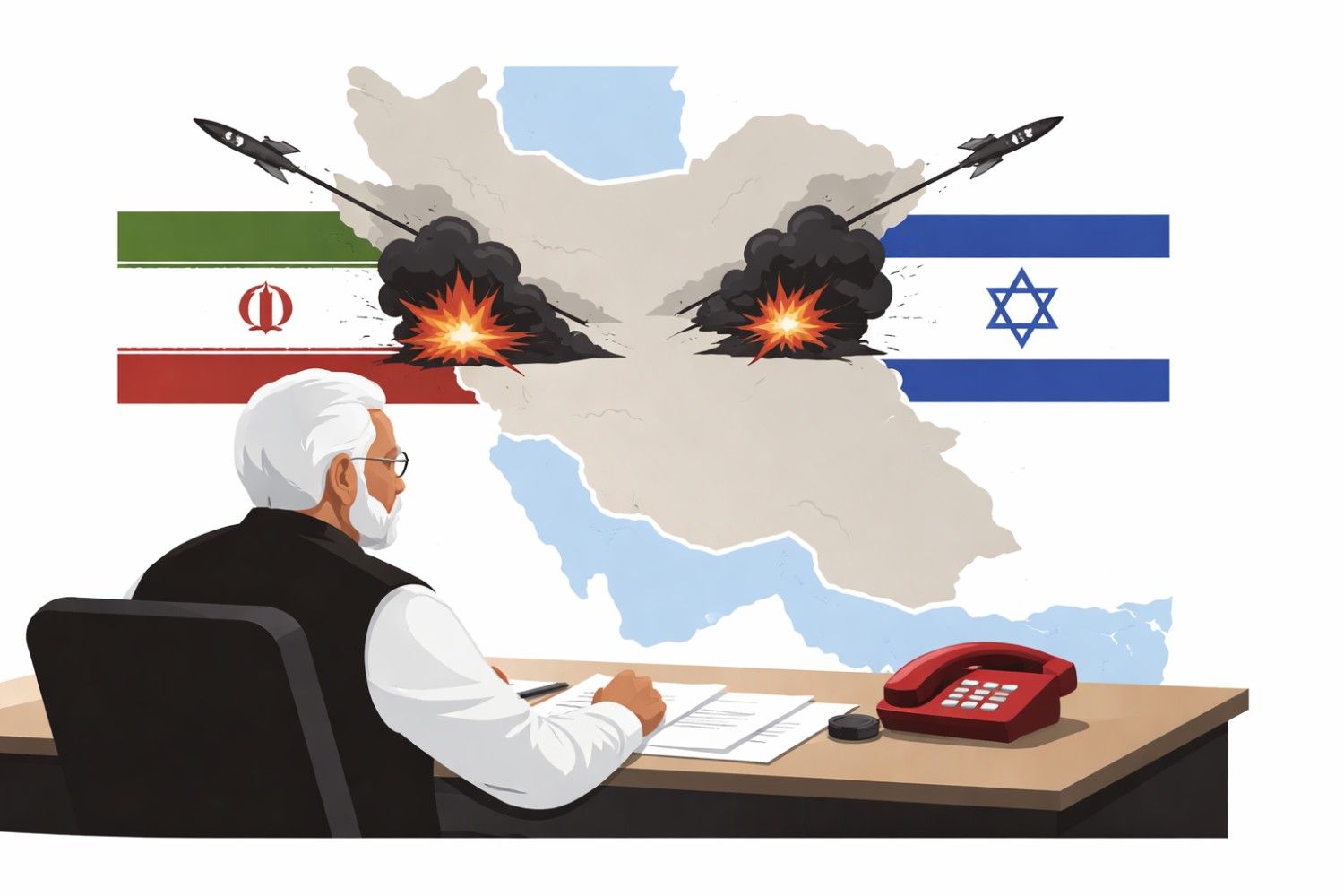
India Reviews Security Preparedness Amid Rising West Asia Crisis
Prime Minister Narendra Modi chaired a high-level security meeting as tensions between Iran and Israel sharply escalated, raising global concerns over regional stability and energy security.
The meeting comes at a time when West Asia is witnessing one of its most serious security crises in recent years. With both Iran and Israel engaged in direct confrontations and military actions, global markets have reacted with volatility. For India, which depends heavily on oil imports and has millions of citizens living in the region, the developments are significant.
The review meeting signals that New Delhi is closely monitoring the situation and assessing its possible impact on national security, energy supplies, trade routes, and the safety of Indian nationals abroad.
Who Attended the High-Level Meeting?
The security review was chaired by Prime Minister Narendra Modi. Senior officials from key ministries and security agencies were present.
Participants typically include the National Security Adviser, senior officials from the Ministry of External Affairs, Defence Ministry representatives, and intelligence chiefs. Such meetings are part of India’s established protocol when global conflicts threaten regional stability or Indian interests.
The purpose of the meeting was to evaluate the evolving security situation, examine potential risks, and prepare contingency responses.
Why the Iran-Israel Tensions Matter for India
The conflict between Iran and Israel is not just a regional issue. It carries global consequences.
For India, there are four major concerns:
1. Energy Security
India imports more than 80% of its crude oil requirements. A large portion of this comes from West Asian countries.
Any disruption in shipping routes, especially through the Strait of Hormuz, can impact global oil supply. Even fears of disruption can push crude oil prices higher.
Rising oil prices directly affect:
- Petrol and diesel rates in India
- Inflation levels
- Government subsidy burden
- Current account deficit
If tensions continue, Indian consumers may feel pressure through higher fuel and transport costs.
2. Safety of Indian Nationals
Over 8 million Indians live and work in West Asia. Countries in the Gulf region host large Indian communities.
Whenever regional tensions escalate, the Indian government reviews evacuation plans and safety advisories. In past crises, India has successfully carried out evacuation missions, including during conflicts in Iraq, Libya, and Ukraine.
Ensuring the safety of Indian citizens remains a top priority.
3. Trade and Shipping Routes
West Asia is a crucial trade corridor for India.
Any military escalation can impact:
- Shipping insurance costs
- Maritime security in the Arabian Sea
- Export-import supply chains
Indian exporters and importers closely monitor developments in the region.
4. Strategic and Diplomatic Balance
India maintains strong ties with both Iran and Israel.
India shares deep defence and technology cooperation with Israel. At the same time, Iran remains strategically important for connectivity projects such as the Chabahar Port, which helps India access Afghanistan and Central Asia.
New Delhi must maintain a careful diplomatic balance without taking sides.
India’s Diplomatic Approach So Far
India’s foreign policy in West Asia has evolved significantly over the past decade.
Prime Minister Narendra Modi became the first Indian Prime Minister to visit Israel in 2017, marking a new chapter in bilateral relations.
India has also continued engagement with Iran, especially on connectivity and regional trade issues.
New Delhi’s consistent position in regional conflicts has been:
- Call for restraint
- Avoid escalation
- Support dialogue and diplomacy
- Protect civilian lives
This balanced approach helps India safeguard its strategic autonomy.
What Happens If the Conflict Escalates Further?
If tensions between Iran and Israel expand into a wider military confrontation, several risks may arise.
Oil Price Shock
Global crude prices could rise sharply. Even a small supply disruption can lead to price spikes.
India, being the world’s third-largest oil importer, would face higher import bills. This can affect:
- Inflation
- Rupee stability
- Fiscal calculations
Regional Instability
Escalation could draw in other regional actors. That would widen the conflict zone and increase uncertainty.
Impact on Indian Diaspora
In case of a severe conflict, India may need to prepare for evacuation operations. The government has previously demonstrated strong coordination capabilities during crisis evacuations.
India’s Strategic Calculations
India’s foreign policy today focuses on strategic autonomy. It avoids alignment in major geopolitical conflicts unless national interests are directly affected.
India has built strong defence ties with Israel, including cooperation in:
- Missile systems
- Drone technology
- Border security equipment
At the same time, Iran remains important for India’s regional connectivity plans and energy interests.
Balancing these relationships requires diplomatic precision.
Global Reactions and Market Response
International markets have shown volatility amid rising tensions.
Oil prices have reacted to security developments in the region. Global leaders have called for de-escalation to prevent further instability.
The United Nations and major powers have urged restraint to avoid a wider war.
For India, the focus remains on preparedness rather than reaction.
What the Security Review Signals
The high-level meeting chaired by Prime Minister Narendra Modi sends a clear message.
India is:
- Monitoring the situation closely
- Preparing for multiple scenarios
- Coordinating across ministries
- Prioritising national security and citizen safety
Such reviews are preventive steps, not reactive measures.
Impact on India’s Foreign Policy Going Forward
The Iran-Israel crisis may shape India’s foreign policy in several ways.
1. Reinforcing Strategic Autonomy
India is likely to continue avoiding public alignment with either side.
2. Strengthening Energy Diversification
New Delhi may accelerate efforts to diversify oil suppliers to reduce risk exposure.
3. Boosting Maritime Security
Given the importance of sea routes, India could increase naval vigilance in the Arabian Sea.
4. Expanding Diplomatic Engagement
India may intensify diplomatic communication with key regional players to safeguard its interests.
Why This Matters Now
The West Asia crisis comes at a time when the global economy is already facing uncertainty.
For Indian households, any spike in oil prices can affect daily expenses.
For businesses, supply chain disruptions can raise costs.
For policymakers, balancing diplomacy becomes more complex.
The security meeting underlines that India is not a passive observer. It is actively evaluating risks and preparing responses.
The Road Ahead
The situation between Iran and Israel remains fluid.
Much will depend on diplomatic efforts in the coming days.
For now, India’s strategy appears clear:
- Maintain balance
- Protect economic interests
- Ensure citizen safety
- Support de-escalation
As tensions evolve, further policy steps may follow.
India’s response will likely remain measured, strategic, and guided by long-term national interests.
The high-level review chaired by Prime Minister Narendra Modi shows that New Delhi is alert and prepared during a period of global uncertainty.
For Indian readers, the key takeaway is simple: while the conflict is unfolding thousands of kilometres away, its impact can be felt at home — especially through oil prices, economic stability, and foreign policy decisions.
The coming days will determine how the crisis shapes regional security and India’s strategic calculations in West Asia.
Disclaimer: The information presented in this article is intended for general informational purposes only. While every effort is made to ensure accuracy, completeness, and timeliness, data such as prices, market figures, government notifications, weather updates, holiday announcements, and public advisories are subject to change and may vary based on location and official revisions. Readers are strongly encouraged to verify details from relevant official sources before making financial, investment, career, travel, or personal decisions. This publication does not provide financial, investment, legal, or professional advice and shall not be held liable for any losses, damages, or actions taken in reliance on the information provided.
Edited by mantena sasank
Last Updated on: Monday, March 2, 2026 9:52 am by Digital Herald Team | Published by: Digital Herald Team on Monday, March 2, 2026 9:52 am | News Categories: India