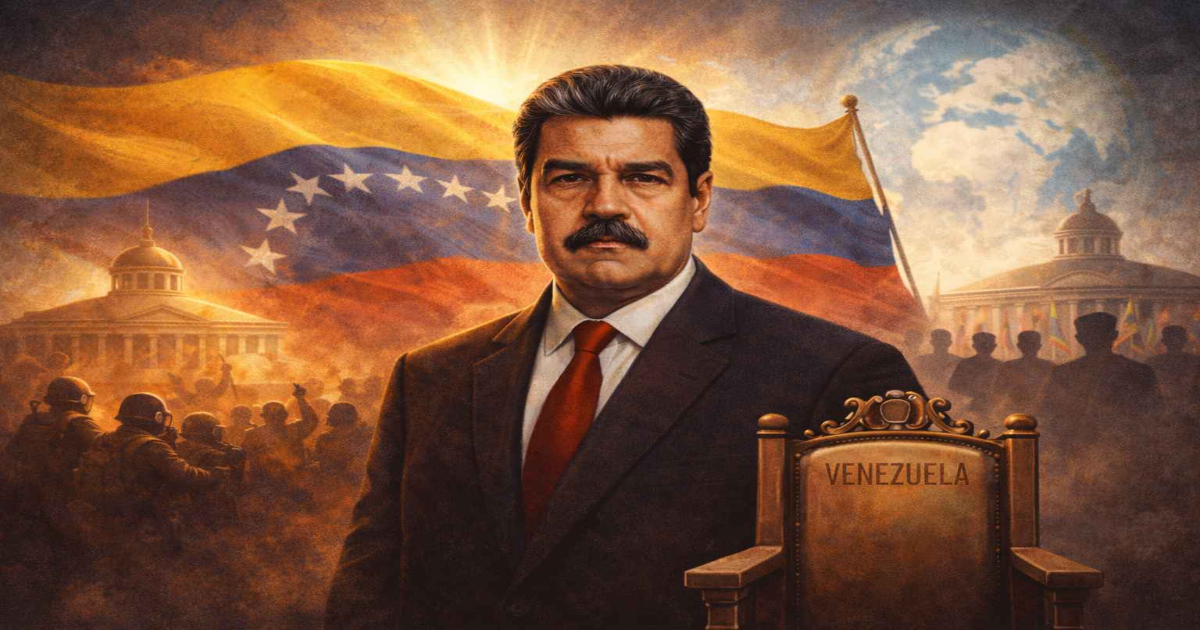
In a dramatic turn of events that has captured global attention, Venezuela’s presidency has entered an unprecedented period of upheaval. Long-time leader Nicolás Maduro, who had served as the country’s president for over a decade following Hugo Chávez’s death, was captured by U.S. forces in Caracas in early January 2026 and subsequently flown to New York to face federal charges. The operation marked a significant escalation in international involvement in Venezuela’s internal crisis and plunged the country into deeper uncertainty.
The U.S. Operation and Maduro’s Arrest
On January 3, 2026, U.S. military forces executed a large-scale operation in Venezuela’s capital, seizing President Nicolás Maduro and his wife, Cilia Flores, on accusations related to narco-terrorism, drug trafficking, and other serious federal charges. The raid, described by U.S. officials as a “precision” mission, involved dozens of aircraft and elite units, and resulted in multiple casualties among Venezuelan security forces and civilians, according to U.S. assessments.
Maduro and Flores appeared in a federal court in New York City under heavy guard, where both pleaded not guilty to the charges. Maduro has maintained that he is still the legitimate president of Venezuela, framing his detention as unlawful and politically motivated.
Interim Leadership: Delcy Rodríguez Steps In
In the aftermath of Maduro’s capture, Venezuela’s Supreme Court and military moved swiftly to install Vice President Delcy Rodríguez as the country’s interim president. A long-time ally and seasoned political figure, Rodríguez’s rise to the presidency has been controversial. She initially denounced the U.S. operation as an “illegal kidnapping” but has since signaled a cautious willingness to engage diplomatically with external actors under intense pressure.
Rodríguez’s interim tenure is set against a backdrop of constitutional ambiguity and deep political fractures. Although the Supreme Court declared Maduro’s absence “temporary,” giving her authority to lead, questions remain about the legitimacy of her government and when free elections might be held. The United States and other global powers have expressed skepticism about her mandate, urging a transition to democratic elections.
Domestic Unrest and Paramilitary Tensions
While official institutions have attempted to maintain order, armed militias known as “colectivos” have surged across the capital, enforcing control and suppressing dissent on the streets of Caracas. Reports describe tense confrontations, mobile checkpoints, and increased scrutiny of civilians, contributing to a climate of fear and unpredictability within Venezuelan society.
The Rodríguez government has declared states of emergency and enacted measures aimed at quelling opposition, with media crackdowns and arrests of journalists drawing sharp criticism from human rights observers.
Regional and Global Reactions
The international community’s response to Maduro’s capture and the ensuing power shift has been deeply divided. Countries such as Russia have openly supported Rodríguez’s interim leadership, denouncing perceived neocolonial threats and asserting Venezuela’s right to sovereignty. Other governments, particularly in Latin America and Europe, have strongly condemned the U.S. strike, warning it sets a dangerous precedent and violates international law.
Global organizations such as the United Nations have voiced concern over the use of force and urged peaceful, diplomatic resolutions to the crisis.
The Broader Political Backdrop
The crisis did not emerge overnight. Venezuela’s political landscape has been marked by contested elections, mass protests, and accusations of authoritarianism for years. Major demonstrations erupted in 2024 after Maduro’s controversial re-election, which many opposition leaders and external observers deemed neither free nor fair. These protests were met with harsh crackdowns and an expanding list of political prisoners.
Long-standing economic challenges, hyperinflation, and a severe decline in oil production have compounded the instability, pushing millions of Venezuelans into hardship and displacement.
What Comes Next for Venezuela?
With the president in U.S. custody and a divided nation at a crossroads, Venezuela’s future remains uncertain. Key questions now include:
- Will interim leadership lead to free and fair elections?
- Can political reconciliation be achieved amid deep polarization?
- How will foreign powers influence the nation’s recovery and sovereignty?
The situation continues to evolve rapidly, and analysts warn that without clear democratic processes and accountability, Venezuela risks years of political instability and economic disruption.
The recent dramatic developments in Venezuela — from the U.S. capture of Nicolás Maduro to the installation of Delcy Rodríguez as interim president — illustrate a pivotal moment in the country’s turbulent history. Whether this leads to meaningful political reform or further fracture remains to be seen, but the global impact and domestic consequences will continue to be felt for years to come.
Last Updated on: Thursday, January 8, 2026 10:37 am by Mantena Sasank | Published by: Mantena Sasank on Wednesday, January 7, 2026 5:06 pm | News Categories: Politics