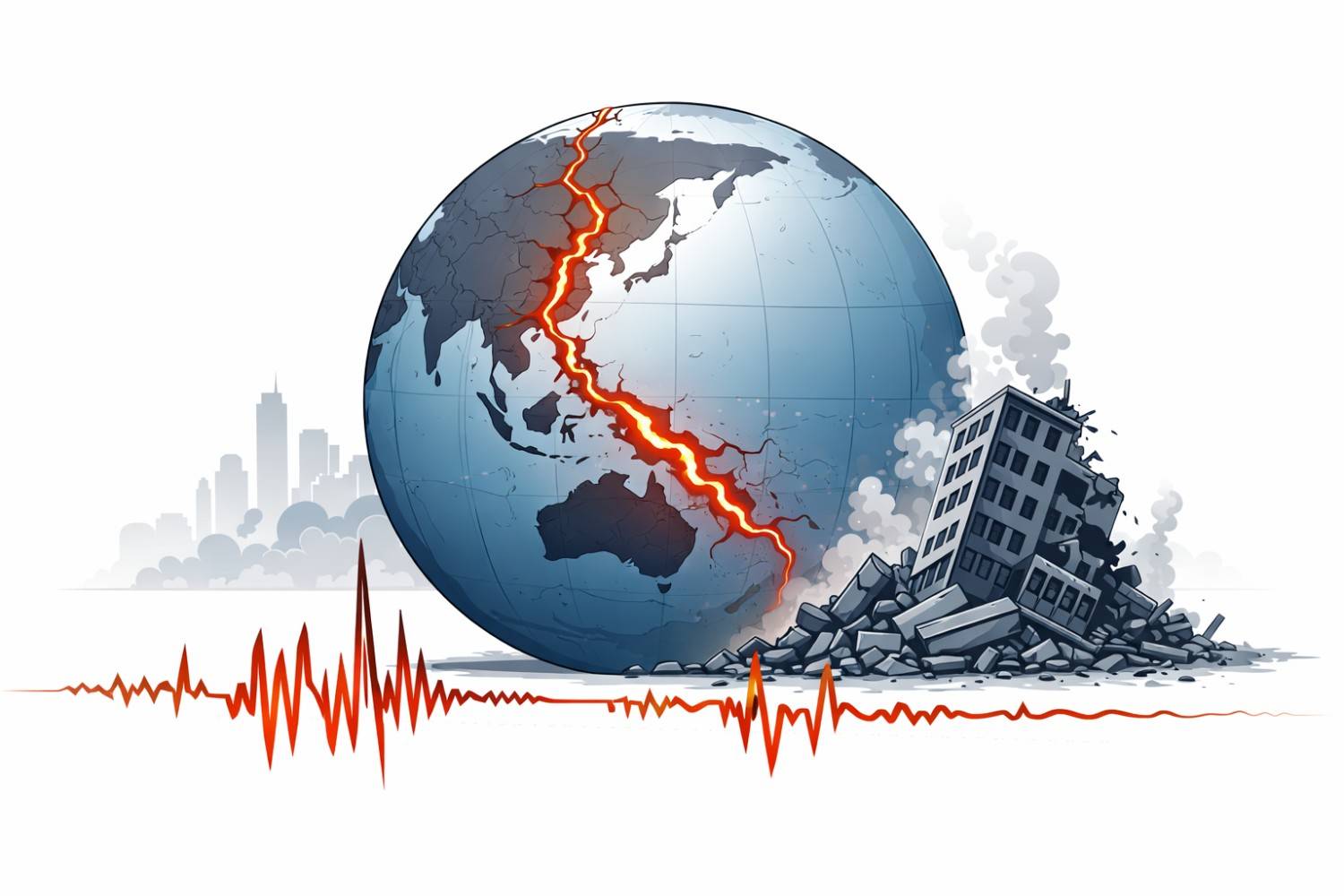
Global seismic activity has increased over the past week, with several moderate to strong earthquakes recorded across Asia, the Pacific, and parts of the Americas. Most of the tremors did not cause major damage, but the spread of activity across multiple regions has kept scientists and emergency agencies alert.
From a magnitude 6.0 quake near Russia’s Kuril Islands to a magnitude 5.5 tremor in Pakistan, the past few days have seen steady seismic movement across major tectonic zones. Global monitoring data also shows hundreds of smaller earthquakes being recorded daily, which is typical but highlights the constant movement of the Earth’s crust.
Global Seismic Snapshot: Key Numbers This Week
Recent global monitoring reports show a consistent pattern of earthquake activity. On February 15, 2026, data recorded 1 earthquake above magnitude 6.0, 3 earthquakes above magnitude 5.0, and about 40 earthquakes above magnitude 4.0. In total, more than 490 earthquakes were detected worldwide in a single day.
Another daily report estimated total seismic energy at around 2.9 × 10¹⁴ joules, equal to more than 79 gigawatt hours of energy. These numbers show that while very large quakes remain limited, moderate and small tremors are happening frequently across the globe.
Asia-Pacific Region: Strong Quakes Near Russia, Indonesia, and Myanmar
Kuril Islands, Russia
A magnitude 6.0 earthquake struck waters near the Kuril Islands on February 15, 2026. The quake occurred at a depth of about 10 kilometers, with no immediate reports of major damage or casualties. This region lies along the Pacific Ring of Fire, one of the world’s most active seismic belts.
Pakistan
A magnitude 5.5 earthquake was recorded in Pakistan on February 13, 2026, also at a shallow depth of around 10 kilometers. Initial reports did not mention major damage, but the tremor was strong enough to be widely monitored by global agencies.
Myanmar and Northeast India Region
A series of smaller quakes were also recorded in Myanmar and nearby areas. On February 16, 2026, a magnitude 3.3 earthquake struck at a depth of 50 kilometers. Earlier the same week, the region experienced a magnitude 4.5 earthquake and two smaller magnitude 3.2 tremors.
Monitoring data also showed smaller earthquakes near the India-Myanmar border and parts of Tibet. These quakes are common in the Himalayan seismic zone, where tectonic plates continue to collide.
Indonesia
Indonesia remains one of the world’s most active seismic regions. In early February, a magnitude 5.8 earthquake struck near Pacitan in East Java, causing injuries and structural damage in several districts.
Regional reports also listed strong quakes in the South Pacific and Indonesia, including events above magnitude 5.5. This activity reflects the intense tectonic movement along the Pacific Ring of Fire.
Americas: Activity in Chile and the United States
Chile
Seismic data showed a magnitude 6.2 earthquake near Ovalle, Chile, during the second week of February. Chile sits along the boundary of the Nazca and South American plates, making it one of the most earthquake-prone countries in the world.
United States
In the western United States, smaller quakes were recorded. A magnitude 3.5 earthquake struck near West Valley City, Utah, on February 13, 2026. While the quake was minor, residents reported feeling tremors across nearby towns.
Earlier reports also noted earthquake swarms in parts of California, though most were low-magnitude events.
Other Notable Global Tremors
Global seismic records over the past week also showed a magnitude 6.4 earthquake near the U.S. Virgin Islands region, along with strong tremors near Vanuatu in the Pacific. Multiple earthquakes above magnitude 4.5 were recorded across oceanic plate boundaries.
Most of these events occurred in remote or offshore locations, reducing the risk of major damage.
Why Earthquake Activity Appears to Rise
Experts say that a rise in reported earthquake activity does not always mean the Earth is becoming more dangerous.
One reason is natural tectonic movement. The Earth’s crust is always shifting, and hundreds of small earthquakes happen every day, especially along plate boundaries.
Another factor is improved monitoring technology. Modern seismic networks can detect smaller tremors that might have gone unnoticed in the past.
Clusters of earthquakes and aftershocks also contribute to higher numbers. When one earthquake occurs, it can trigger several smaller tremors in the same area.
Major Earthquake Zones to Watch
Several regions remain under close monitoring because of frequent seismic activity.
The Pacific Ring of Fire stretches from South America to Asia and accounts for most of the world’s large earthquakes.
The Himalayan belt includes countries such as India, Nepal, Pakistan, and Myanmar, which sit along a major collision zone between tectonic plates.
The Mediterranean and Middle East region experiences frequent moderate quakes due to complex plate movements.
In the western Americas, countries like Chile, Mexico, and the western United States remain active because of subduction zones and major fault systems.
Impact on India and Nearby Regions
India itself did not experience any major damaging earthquakes this week. However, nearby regions such as Myanmar, Tibet, and Pakistan recorded moderate tremors.
This serves as a reminder that large parts of northern and northeastern India lie in active seismic zones. Cities in these regions are advised to follow earthquake-resistant building standards and maintain emergency preparedness plans.
Safety Tips During an Earthquake
Authorities recommend basic safety steps in case of a tremor. People should drop, cover, and hold under sturdy furniture. It is important to stay away from windows and heavy objects that may fall.
If outdoors, move to an open area away from buildings and power lines. Elevators should be avoided during shaking. Preparedness remains the best way to reduce risk in earthquake-prone areas.
What Scientists Are Watching Next
Seismologists say there is no clear sign of a single global “mega-event.” Instead, the current pattern reflects normal tectonic activity across multiple regions.
However, scientists continue to monitor active subduction zones in the Pacific, the Himalayan fault systems, and earthquake swarms near major fault lines. These areas have the potential to produce stronger earthquakes in the future.
Bottom Line
Global earthquake activity has remained elevated this week, with notable tremors across Asia, the Pacific, and the Americas. The strongest events included a magnitude 6.0 quake near Russia and a 5.5 tremor in Pakistan, along with multiple smaller shocks worldwide.
While most quakes caused little or no damage, the widespread activity highlights the constant movement of Earth’s tectonic plates.
For India, no major quake struck this week, but nearby seismic zones remain active, underlining the importance of preparedness and safe construction.
Disclaimer: The information presented in this article is intended for general informational purposes only. While every effort is made to ensure accuracy, completeness, and timeliness, data such as prices, market figures, government notifications, weather updates, holiday announcements, and public advisories are subject to change and may vary based on location and official revisions. Readers are strongly encouraged to verify details from relevant official sources before making financial, investment, career, travel, or personal decisions. This publication does not provide financial, investment, legal, or professional advice and shall not be held liable for any losses, damages, or actions taken in reliance on the information provided.
Last Updated on: Tuesday, February 17, 2026 10:40 am by Digital Herald Team | Published by: Digital Herald Team on Tuesday, February 17, 2026 10:40 am | News Categories: General