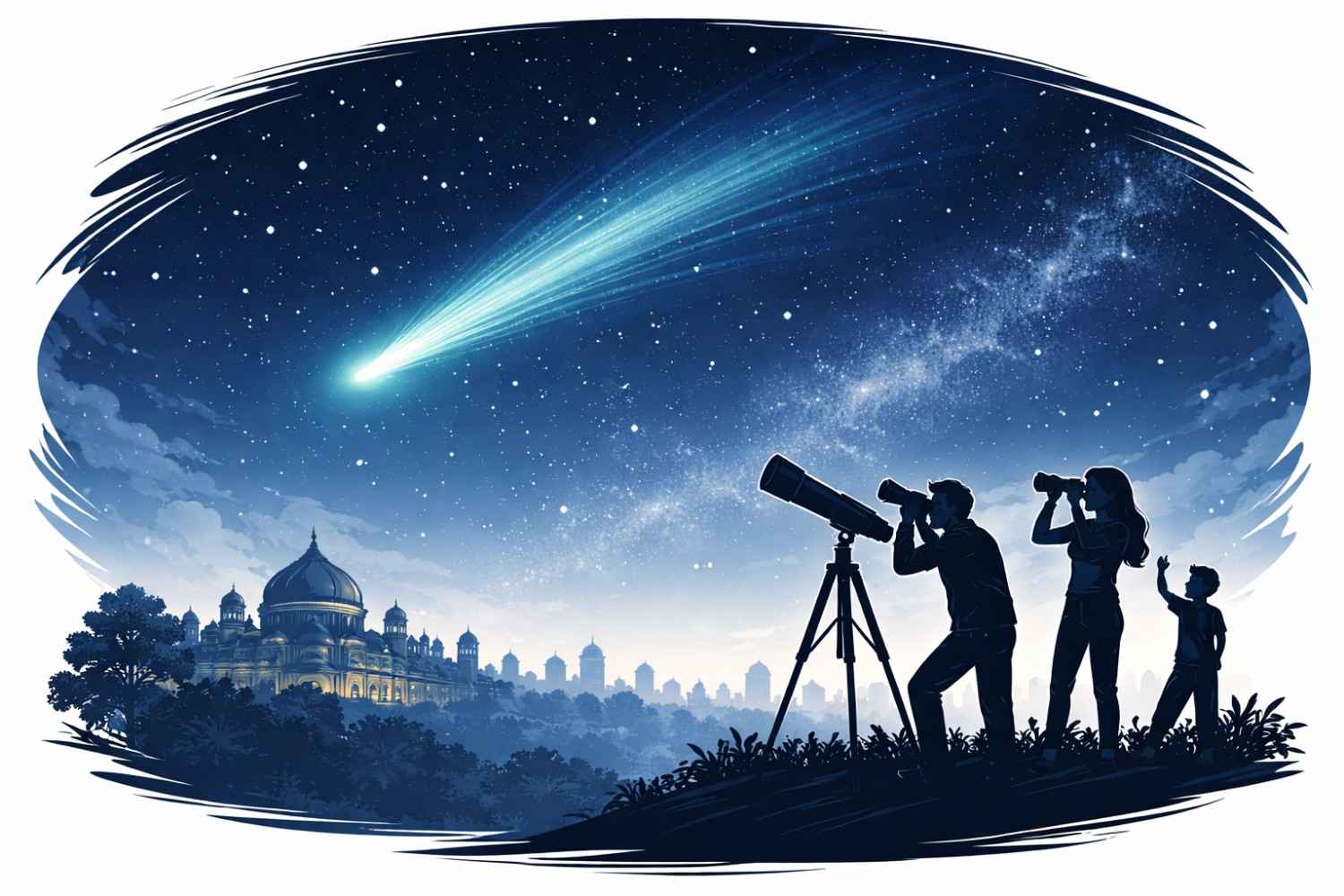
A rare comet visible in parts of the Indian sky today has triggered a sharp rise in online searches related to astronomy, skywatching, and stargazing timings. As images and viewing tips circulate on social media, interest in how to spot the comet from India has grown rapidly.
Sky enthusiasts, students, and amateur astronomers are searching for clear information on visibility timing, viewing direction, and whether the comet can be seen with the naked eye. The surge reflects how rare celestial events continue to capture public imagination.
Here is what Indian readers need to know about today’s comet visibility and why it matters.
Which Comet Is Visible Today?
Astronomy platforms have reported visibility of Comet 12P/Pons-Brooks, often described as a “rare” or periodic comet that returns to the inner solar system approximately once every 71 years.
Comet 12P/Pons-Brooks has been visible in the evening sky during certain windows this month, depending on local weather and light pollution levels.
Its current appearance has drawn attention because such periodic comets are not visible frequently within a human lifetime.
Why Searches Are Rising Across India
Search trends show increased queries for:
- “Comet visible in India today”
- “How to see comet tonight”
- “Comet timing India”
- “Best time to see comet Feb”
- “Can comet be seen without telescope”
The spike comes as clearer skies in several cities have improved viewing chances. Social media posts showing faint streaks near the horizon have added to public curiosity.
In India, interest in astronomy often rises during:
- Solar eclipses
- Lunar eclipses
- Meteor showers
- Planetary alignments
- Comet appearances
Rare comet visibility combines scientific interest with visual appeal, making it a high-engagement topic.
When and Where to Look in India
According to astronomy tracking platforms, Comet 12P/Pons-Brooks is generally visible shortly after sunset in the western sky during its current appearance window.
Key viewing guidance includes:
- Look toward the western horizon
- Best viewing time is usually 30 to 60 minutes after sunset
- Choose a location away from city lights
- Ensure a clear, cloud-free sky
Visibility depends on local atmospheric conditions. In major cities with heavy light pollution, the comet may appear faint.
In smaller towns or rural areas with darker skies, chances of spotting it improve.
Can You See the Comet With the Naked Eye?
Comet brightness changes over time.
During peak brightness phases, some observers may see it faintly with the naked eye under very dark skies. However, in most urban areas, binoculars are recommended for a clearer view.
A small telescope can help enhance visibility, especially if the comet appears dim.
Unlike meteor showers, comets move slowly across the sky and do not streak rapidly. They may appear as a faint fuzzy patch with a slight tail.
What Makes This Comet Special?
Comet 12P/Pons-Brooks is classified as a periodic comet. It completes one orbit around the Sun roughly every seven decades.
This means that:
- Many people may only see it once in their lifetime
- The next close approach will be decades away
Periodic comets differ from long-period comets, which can take hundreds or thousands of years to return.
The comet has drawn attention globally due to occasional brightening episodes observed by astronomers in recent months.
India’s Growing Interest in Astronomy
The surge in searches reflects a broader trend.
Interest in astronomy has increased in India over the past decade. Contributing factors include:
- Affordable telescopes
- Smartphone astronomy apps
- Online sky maps
- Science outreach by institutions
Organisations such as Indian Space Research Organisation have played a major role in promoting public interest in space science.
India’s space missions, including lunar and planetary exploration efforts, have strengthened public engagement with astronomy.
When a visible comet appears, it often becomes a moment of shared curiosity.
Role of Social Media in Driving Curiosity
Social media platforms are accelerating search trends.
Once a few clear images of the comet are posted, users begin searching for:
- Viewing locations
- Photography tips
- Exact coordinates
- Sky charts
Google Discover often amplifies such trending topics, especially when interest rises rapidly over a short period.
The current surge appears linked to a combination of:
- Clear skies in several regions
- Astronomy community alerts
- Viral posts from amateur skywatchers
How to Photograph the Comet Safely
For those interested in photography:
- Use a tripod to stabilise your camera
- Choose a location with minimal light pollution
- Use longer exposure settings carefully
- Avoid pointing optical equipment directly at the Sun
Safety is critical. Observations should only take place after sunset when the Sun is fully below the horizon.
Never attempt to observe near the Sun without proper equipment.
Weather and Visibility Conditions Matter
Cloud cover, humidity, and pollution levels significantly affect comet visibility.
Before stepping out, check:
- Local weather forecasts
- Air quality levels
- Sunset timing in your city
Coastal and hill regions sometimes offer better viewing conditions due to clearer skies.
Educational Value of Rare Celestial Events
Events like this provide educational opportunities.
Schools and colleges often encourage students to observe astronomical events to build interest in science.
Comets help explain:
- Solar system formation
- Orbital mechanics
- Cosmic dust and ice composition
They are considered remnants from the early solar system, making them important objects for scientific study.
India’s Amateur Astronomy Community
India has an active network of amateur astronomy groups.
Many local astronomy clubs organise:
- Viewing sessions
- Public skywatch events
- Online guidance sessions
The current comet appearance has likely contributed to renewed community activity.
Such engagement helps spread accurate scientific information and reduce misinformation.
What Happens Next?
Comet visibility changes as it moves along its orbit.
Over the coming days, brightness levels may:
- Increase slightly
- Decrease gradually
- Shift position in the sky
Skywatchers should rely on updated astronomical charts for precise tracking.
If weather conditions worsen, visibility may decline quickly.
Conclusion: A Rare Moment for Skywatchers in India
The visibility of Comet 12P/Pons-Brooks has sparked renewed interest in astronomy across India today.
Search trends show strong curiosity about viewing times, locations, and photography tips.
While visibility depends on local conditions, the event highlights how rare celestial phenomena continue to capture national attention.
For many Indians, tonight offers a simple but powerful reminder: sometimes, the most fascinating events happen not on screens, but in the sky above.
Disclaimer: The information presented in this article is intended for general informational purposes only. While every effort is made to ensure accuracy, completeness, and timeliness, data such as prices, market figures, government notifications, weather updates, holiday announcements, and public advisories are subject to change and may vary based on location and official revisions. Readers are strongly encouraged to verify details from relevant official sources before making financial, investment, career, travel, or personal decisions. This publication does not provide financial, investment, legal, or professional advice and shall not be held liable for any losses, damages, or actions taken in reliance on the information provided.
Edited by Mantena sasank
Last Updated on: Wednesday, February 25, 2026 11:06 am by Digital Herald Team | Published by: Digital Herald Team on Wednesday, February 25, 2026 11:06 am | News Categories: Astroguide