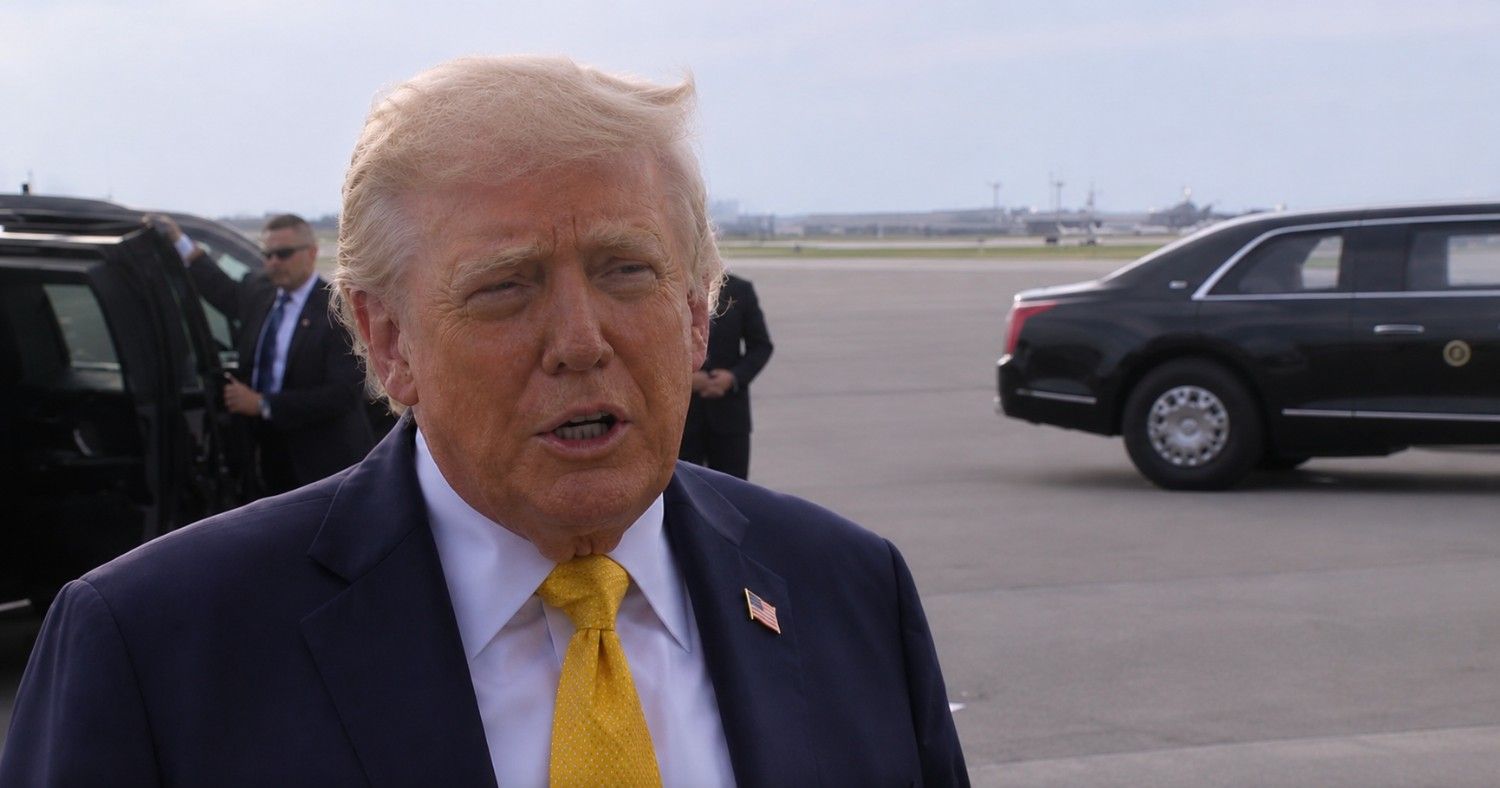
U.S. President Donald Trump has postponed a planned military strike on Iran after urgent appeals from key Gulf allies and renewed signs of diplomatic movement between Washington and Tehran, according to statements from the White House and multiple international reports.
The decision, announced late Monday, temporarily eases fears of an immediate escalation in one of the most volatile confrontations in the Middle East in years. But Trump also warned that the United States remains prepared to launch what he described as a “full, large-scale assault” if negotiations collapse.
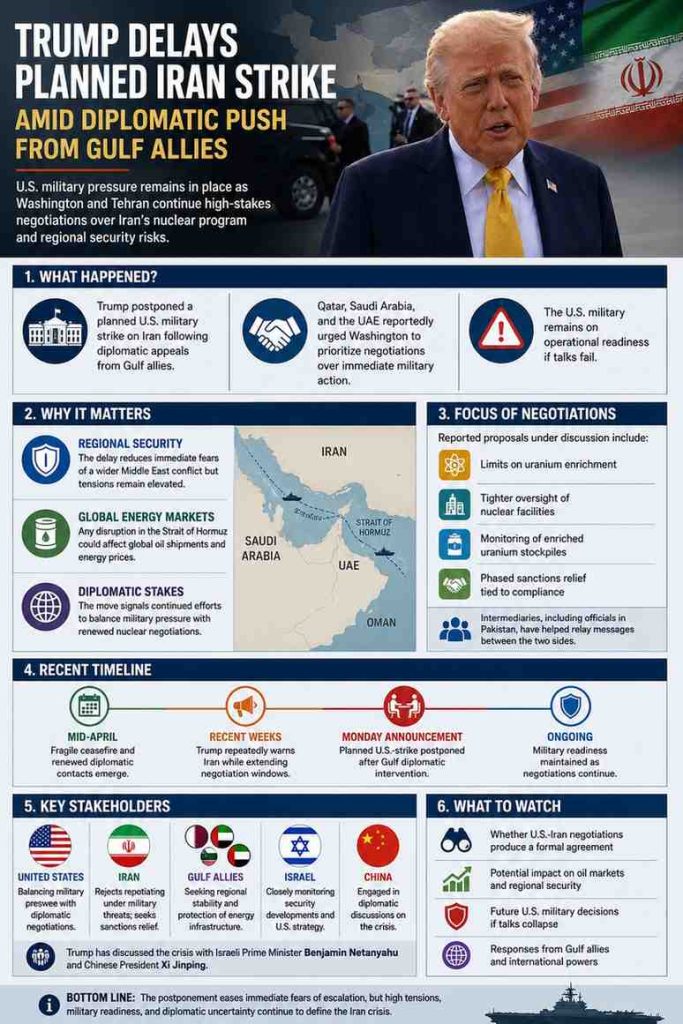
The pause follows weeks of mounting tensions surrounding Iran’s nuclear program, regional military activity, and threats to shipping lanes in the Strait of Hormuz — a critical corridor for global energy supplies.
Gulf Pressure Shapes Washington’s Calculation
According to international reports, leaders from Qatar, Saudi Arabia, and the United Arab Emirates privately urged Trump to delay military action, arguing that negotiations still offered a realistic path toward de-escalation.
The Gulf states, while deeply wary of Iran’s regional influence, also face enormous economic and security risks from a wider conflict. Energy infrastructure, shipping routes, financial markets, and civilian populations across the Gulf could all be exposed to retaliation in the event of direct U.S. strikes.
Oil markets reacted cautiously to news of the postponement, with traders interpreting the delay as a sign that a broader regional war may not be imminent. Analysts have warned for months that any prolonged disruption in the Strait of Hormuz could sharply affect global crude supplies and inflation-sensitive economies worldwide.
Trump Keeps Military Pressure Intact
Despite delaying the operation, Trump maintained a confrontational tone toward Tehran.
In recent days, he warned that “the clock is ticking” for Iran and suggested that military action could resume with little notice if diplomatic efforts fail.
According to reports, U.S. military forces in the region have not been stood down. Pentagon planners were reportedly instructed to maintain readiness for rapid escalation while negotiations continue.
That dual-track approach — combining military pressure with intermittent diplomacy — has increasingly defined Trump’s Iran strategy during the current crisis.
The administration has repeatedly issued hard deadlines, only to extend or soften them as talks resumed behind closed doors. Critics argue the pattern creates uncertainty for allies and markets, while supporters say it keeps maximum pressure on Tehran without immediately triggering a broader war.
Nuclear Negotiations Re-Emerge
At the center of the standoff remains Iran’s nuclear program.
Although Washington has not publicly detailed the latest negotiating framework, several reports indicate the United States is pursuing strict limitations on Iranian enrichment capabilities and seeking tighter international oversight of nuclear facilities.
Some proposals under discussion reportedly include:
- restrictions on uranium enrichment,
- consolidation of nuclear activity at a limited number of facilities,
- transfer or monitoring of enriched uranium stockpiles,
- and phased sanctions relief tied to compliance.
Reports also suggest that intermediaries, including officials in Pakistan, have helped relay messages between the two sides.
Trump has signaled some flexibility compared with earlier positions that demanded a complete dismantling of Iran’s nuclear infrastructure. Reports suggest Washington may now consider a long-term suspension framework rather than permanent elimination, though no formal agreement has been confirmed.
Iranian officials, meanwhile, have publicly insisted that Tehran will not negotiate under direct military threats. Iranian military leaders have warned that any renewed attack would trigger retaliation against U.S. interests and regional allies.
Regional Conflict Has Already Expanded
The latest diplomatic scramble comes against the backdrop of a much broader regional crisis that has unfolded over recent months.
Military exchanges involving Iran, Israel, U.S. forces, and Iran-aligned groups have already intensified across several fronts, including maritime zones and neighboring countries. Recent reports have described drone attacks, missile interceptions, and strikes targeting infrastructure linked to Gulf states.
International analysts have also documented an extensive U.S. military buildup across the Middle East since early 2026, involving naval deployments, missile defense systems, and expanded regional force positioning.
Trump has discussed the crisis with Israeli Prime Minister Benjamin Netanyahu and Chinese President Xi Jinping, reflecting the broader geopolitical stakes attached to the confrontation.
Why the Delay Matters
The postponement does not necessarily indicate a lasting breakthrough. Instead, it highlights how close the region may be to a larger military confrontation — and how strongly regional governments are trying to prevent it.
For Gulf nations, the risks extend beyond security concerns. A sustained conflict could disrupt energy exports, destabilize investment flows, and increase domestic political pressure across the region.
For Washington, the crisis presents competing strategic calculations: projecting strength against Iran while avoiding a prolonged regional war that could carry significant military, political, and economic costs.
For Iran, continued negotiations may offer a pathway to sanctions relief and economic stabilization at a time when the country faces internal strain, international isolation, and mounting pressure on its energy sector.
Whether the current diplomatic opening produces a durable agreement remains uncertain. But for now, the immediate prospect of direct U.S. military action against Iran appears to have been deferred — not abandoned.
Key Highlights
- President Donald Trump postponed a planned U.S. military strike on Iran after Gulf allies, including Qatar, Saudi Arabia, and the UAE, urged Washington to allow more time for diplomacy.
- Despite delaying the operation, Trump warned that the U.S. military remains prepared for rapid action if negotiations with Tehran fail.
- The crisis continues to center on Iran’s nuclear program, with reported proposals involving limits on uranium enrichment, tighter oversight of facilities, and monitored handling of enriched uranium stockpiles.
- Gulf nations are pushing to avoid a wider regional conflict that could threaten energy infrastructure, disrupt global oil markets, and destabilize the Strait of Hormuz shipping corridor.
- U.S. officials have reportedly maintained military readiness in the Middle East, reflecting Washington’s strategy of combining diplomatic engagement with sustained military pressure.
- Iran has rejected negotiating under direct military threats and warned that any renewed attack could trigger retaliation against U.S. interests and regional allies.
- The postponement eases immediate fears of escalation but leaves uncertainty over whether ongoing diplomatic efforts can produce a long-term agreement between Washington and Tehran.
Input & Images: Hindusthan Samachar
Edited by Manten Sasank
Add Digital Herald as preferred source on google – click here
Also read – Modi Pushes India–Sweden Strategic Partnership Around AI, Green Technology and Defence Cooperation
Last Updated on: Tuesday, May 19, 2026 11:00 am by Mantena Sasank | Published by: Mantena Sasank on Tuesday, May 19, 2026 10:54 am | News Categories: News