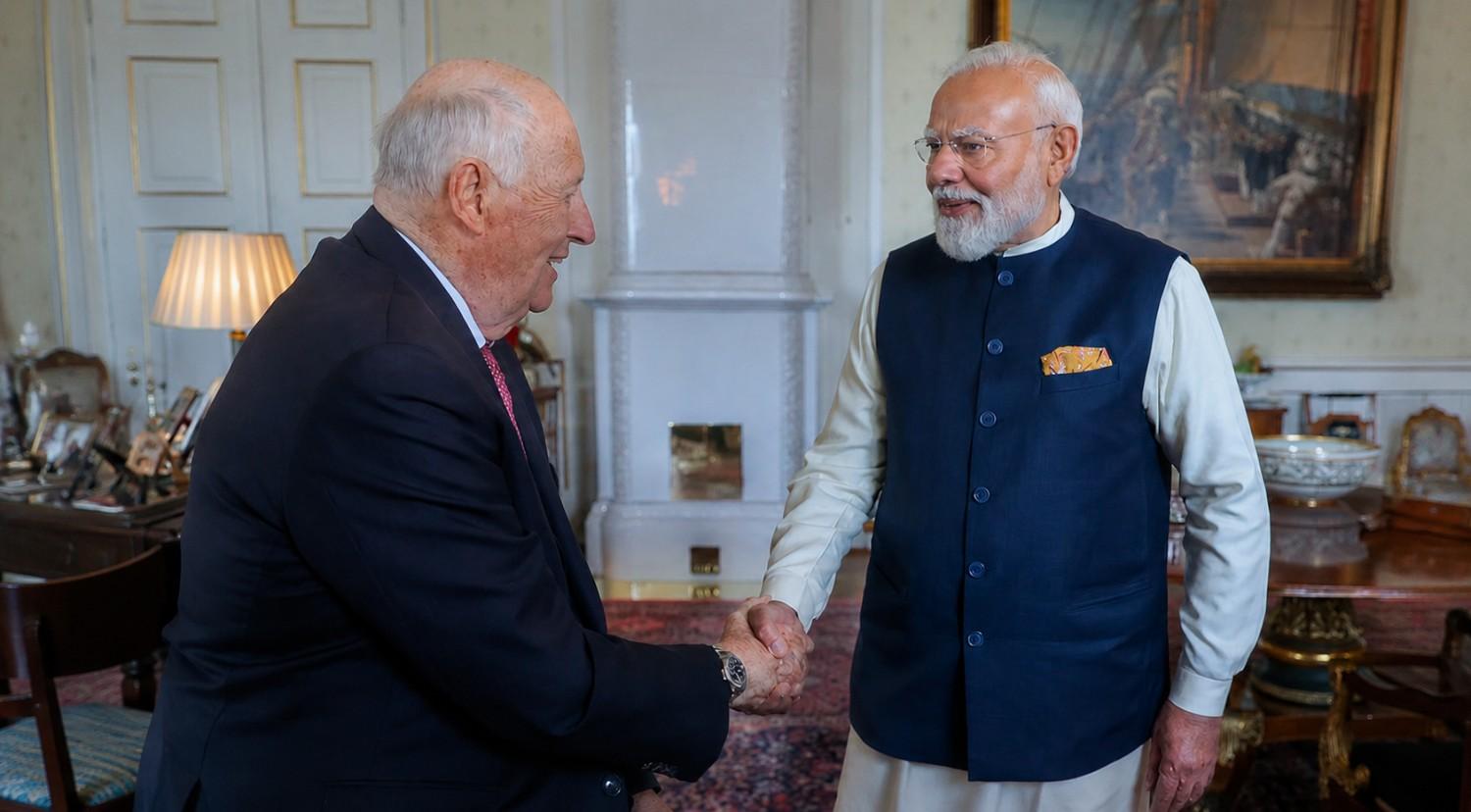
Prime Minister Narendra Modi’s visit to Norway this week marked more than a ceremonial diplomatic engagement. It underscored India’s accelerating effort to deepen ties with strategically important European partners at a time when geopolitical realignments, energy transition goals, and Indo-Pacific security concerns are reshaping global alliances.
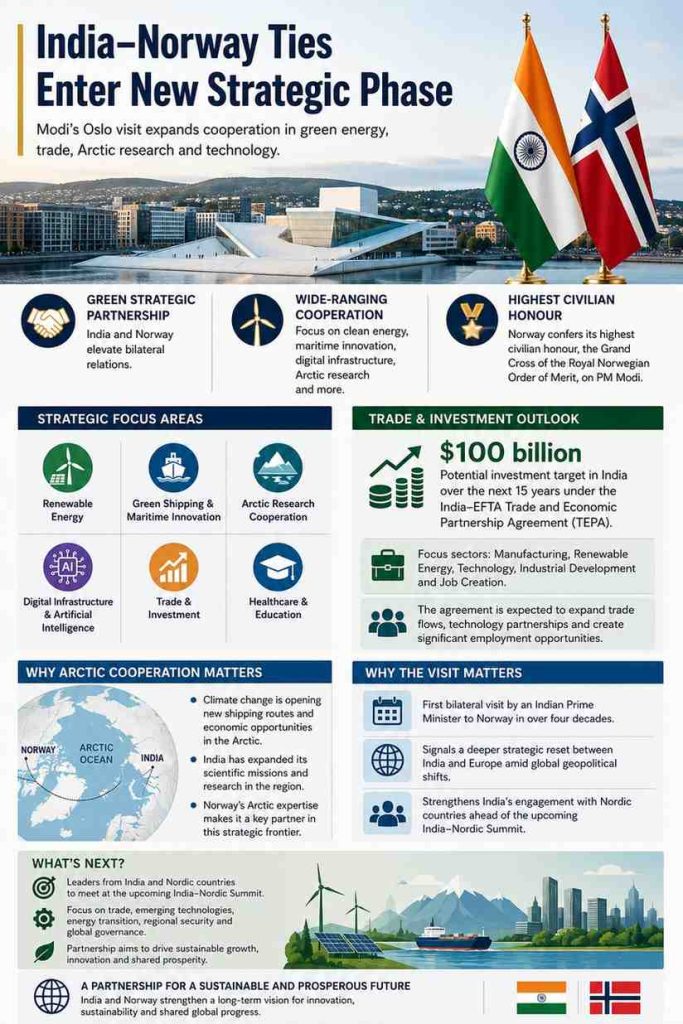
During high-level talks in Oslo with Norwegian Prime Minister Jonas Gahr Store, India and Norway elevated bilateral relations to a “Green Strategic Partnership,” expanding cooperation across clean energy, maritime technologies, climate initiatives, Arctic research, digital infrastructure, and emerging technologies.
The visit also carried symbolic significance. Norway conferred its highest civilian distinction — the Grand Cross of the Royal Norwegian Order of Merit — on Prime Minister Modi, recognizing his role in strengthening India’s international partnerships and advancing bilateral cooperation with Nordic nations.
The award adds to a growing list of international honours received by Modi during his tenure and reflects India’s rising diplomatic profile in Europe amid intensifying competition for economic and strategic partnerships.
A Strategic Reset in India-Europe Relations
The Norway visit comes at a moment when Europe is recalibrating its geopolitical priorities in response to the war in Ukraine, growing tensions in the Indo-Pacific, global supply chain vulnerabilities, and the transition toward green economies.
For India, the outreach to Nordic nations aligns with a broader foreign policy strategy aimed at building deeper engagement with technologically advanced, innovation-driven economies that can support India’s ambitions in manufacturing, sustainability, digital transformation, and energy security.
Speaking alongside Prime Minister Store in Oslo, Modi emphasized that India and Norway share support for a rules-based international order and diplomacy-led conflict resolution.
Without directly naming major powers, Modi referred to ongoing crises in Ukraine and West Asia, arguing that military responses alone cannot provide lasting peace and that sustained dialogue remains essential to global stability.
The comments come as India continues balancing its strategic partnerships with Western nations while maintaining its longstanding policy of strategic autonomy in international affairs.
Green Strategic Partnership Reflects Shared Priorities
At the center of the visit was the formal launch of the India-Norway Green Strategic Partnership — a framework expected to guide long-term cooperation in areas increasingly critical to both economies.
The partnership focuses heavily on:
- renewable and clean energy,
- green shipping and maritime innovation,
- climate adaptation technologies,
- offshore wind and sustainability projects,
- digital infrastructure and artificial intelligence,
- Arctic research cooperation,
- healthcare and advanced education partnerships.
Norway, one of Europe’s largest sovereign wealth holders and a global leader in renewable technologies and maritime expertise, is viewed by Indian policymakers as a valuable long-term partner in India’s energy transition plans.
India, meanwhile, offers Norway access to one of the world’s fastest-growing major economies, a rapidly expanding technology ecosystem, and large-scale infrastructure opportunities.
The emphasis on “green growth” also reflects a wider international trend as governments increasingly tie trade, industrial policy, and diplomacy to climate and sustainability objectives.
Trade and Investment Take Center Stage
Economic cooperation emerged as a major pillar of the discussions in Oslo.
Both leaders highlighted the importance of the India-European Free Trade Association Trade and Economic Partnership Agreement (TEPA), signed earlier between India and the EFTA bloc comprising Norway, Switzerland, Iceland, and Liechtenstein.
The agreement is expected to significantly expand trade flows, technology partnerships, and long-term investments.
Indian officials have previously stated that the agreement could facilitate nearly $100 billion in investment commitments into India over the next 15 years while supporting large-scale job creation across manufacturing, technology, renewable energy, and industrial sectors.
Norwegian Prime Minister Støre described the agreement with India as distinctive in scale and strategic importance, signaling Oslo’s growing confidence in India’s economic trajectory.
At the India-Norway Business and Research Summit held during the visit, Modi invited Norwegian companies to deepen investments in sectors such as:
- green mobility,
- digital technologies,
- healthcare innovation,
- maritime infrastructure,
- sustainable urban development,
- and advanced manufacturing.
The summit also reflected a growing push by both countries to connect research ecosystems, universities, startups, and innovation networks.
Why the Arctic Matters to India
One of the less publicly discussed but strategically important aspects of India-Norway relations is Arctic cooperation.
As climate change reshapes the Arctic region, major economies are increasingly viewing it as a critical zone for future shipping routes, scientific research, energy access, and geopolitical influence.
India has steadily expanded its Arctic engagement over the past decade through scientific missions, climate research programs, and policy initiatives. Norway, with its geographic position and Arctic expertise, has emerged as a key partner in that effort.
Analysts note that cooperation in Arctic science, environmental monitoring, and maritime governance could become an increasingly important dimension of India-Europe relations in the coming years.
Diplomatic Symbolism and Political Messaging
Modi’s meeting with King Harald V at the Royal Palace added ceremonial importance to the visit, but the broader diplomatic messaging extended well beyond protocol.
The visit marked the first bilateral trip by an Indian prime minister to Norway in more than four decades — a reflection of how dramatically India’s engagement with Nordic countries has evolved.
The timing is also significant ahead of the upcoming India-Nordic Summit, where leaders from Norway, Sweden, Denmark, Finland, and Iceland are expected to discuss cooperation on trade, emerging technologies, energy transition, regional security, and global governance issues.
India’s growing outreach to the Nordic region also complements its larger effort to diversify strategic partnerships beyond traditional power centers while strengthening its position in Europe amid shifting geopolitical equations.
A Relationship Moving Beyond Symbolism
While the state honours and ceremonial events drew attention, the deeper significance of Modi’s Norway visit lies in the expanding strategic convergence between India and the Nordic region.
From clean energy and maritime innovation to Arctic policy and digital infrastructure, the relationship is increasingly moving beyond traditional diplomacy toward long-term economic and technological cooperation.
For India, the visit reinforces its effort to position itself as both a major economic partner and a key geopolitical actor in an era of fragmented global alliances.
For Norway and other Nordic nations, closer ties with India offer access to one of the world’s largest growth markets and a critical democratic partner in the Indo-Pacific.
As Europe and Asia navigate economic uncertainty, climate pressures, and geopolitical competition, partnerships such as the India-Norway relationship are likely to gain increasing strategic importance in the years ahead.
Key Highlights
- Prime Minister Narendra Modi and Norwegian Prime Minister Jonas Gahr Støre elevated India-Norway ties to a “Green Strategic Partnership” focused on clean energy, maritime technology, climate cooperation, and digital innovation.
- Norway awarded Modi the Grand Cross of the Royal Norwegian Order of Merit, the country’s highest civilian honour, recognizing his role in strengthening bilateral and global partnerships.
- The visit signals India’s expanding strategic engagement with Nordic and European nations amid shifting geopolitical dynamics, energy transition efforts, and Indo-Pacific security concerns.
- India and Norway agreed to deepen cooperation in sectors including renewable energy, Arctic research, artificial intelligence, green shipping, healthcare, and advanced manufacturing.
- Discussions also highlighted the India-EFTA Trade and Economic Partnership Agreement, which is expected to boost investment, technology collaboration, and long-term trade between India and European partners.
- Arctic cooperation emerged as a key strategic area, with both countries looking to expand collaboration in climate research, maritime governance, and emerging northern trade routes.
- Modi’s Norway visit, the first bilateral trip by an Indian prime minister to the country in over four decades, comes ahead of the India-Nordic Summit focused on regional security, sustainability, and technology partnerships.
Input & Images: Hindusthan Samachar
Edited by Manten Sasank
Add Digital Herald as preferred source on google – click here
Also read – Trump Delays Planned Iran Strike as Gulf Allies Push for Diplomacy
Last Updated on: Tuesday, May 19, 2026 11:34 am by Mantena Sasank | Published by: Mantena Sasank on Tuesday, May 19, 2026 11:29 am | News Categories: News, India