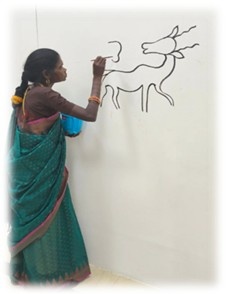
The Tribes Art Fest 2026, organised by the Ministry of Tribal Affairs, celebrated the diversity and vitality of India’s indigenous art traditions at Travancore Palace from March 3 to March 13. The national cultural event brought together more than 75 tribal artists and showcased over 1,000 artworks representing 30 tribal art traditions from across the country.
Held in collaboration with the National Gallery of Modern Art and Federation of Indian Chambers of Commerce and Industry, the festival served as both an exhibition and a platform for dialogue on the preservation and promotion of tribal art. The event allowed visitors to experience traditional storytelling through paintings, crafts, and live demonstrations while providing artists opportunities to engage with new audiences and markets.
Platform for Dialogue and Learning
Beyond the exhibition, the festival hosted panel discussions and workshops focusing on themes such as tribal art revival, sustainable futures, and market linkages for artists. More than 100 tribal students pursuing art participated in curated walkthroughs, mentorship sessions with senior artists, and interactive workshops that offered insights into traditional artistic practices.
Tribal art in India encompasses a wide variety of forms, including paintings, metal crafts, wood carvings, textiles, pottery, and body art, often created using locally available materials such as natural pigments, bamboo, clay, and wood. Many artworks reflect themes of nature, mythology, ancestral spirits, and community life, reflecting the close relationship tribal communities share with their environment.
Warli Painting: A Legacy of Nature and Tradition
One of the highlights of the festival was the work of Madhukar Rambhau Vadu, a veteran artist dedicated to preserving the Warli painting tradition of Maharashtra. Practicing the art since the age of eight, Vadu has spent nearly five decades exploring the connections between ancient cave paintings and Warli art.
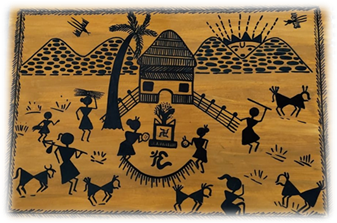
Warli painting, which received a Geographical Indication (GI) tag in 2014, is known for its minimalist style that uses white pigment made from rice paste on earthen backgrounds. The art form uses simple geometric shapes—circles, triangles, and squares—to depict scenes of farming, hunting, rituals, and the famous Tarpa dance, reflecting the everyday life and spiritual beliefs of the Warli tribe.
According to Vadu, festivals like the Tribes Art Fest provide crucial visibility for tribal art. “This is a very important platform provided by the Government of India. It helps people learn about tribal art and encourages young artists who want to pursue it,” he said.
Masks of Myth and Ritual
Another striking attraction was the traditional mask-making craft presented by Shanti Ram Rabha, a 64-year-old artist from West Bengal. His wooden and bamboo masks represent mythological figures, animals, and spirits used in ritual performances among the Rabha tribe of Assam and North Bengal.
Rabha’s journey into the craft began after retiring from the army, transforming what started as a personal interest into a full-fledged artistic pursuit. At the festival, many of his masks were sold on the first day, reflecting growing public interest in tribal storytelling traditions.
Gond and Bhil Art: Stories Through Colour and Pattern
The festival also highlighted Gond art, a distinctive painting tradition originating in Madhya Pradesh. Known for its intricate patterns of dots and lines, Gond paintings depict animals, birds, trees, and folklore narratives rooted in forest life. The art form has also received a GI tag, recognising its unique cultural heritage.
Young artist Japani Shyam Hurley showcased vibrant works inspired by the legacy of her father, the renowned Gond artist Jangarh Singh Shyam. Her paintings at the festival conveyed moral stories about friendship and human values through colourful patterns and symbolic imagery.
Similarly, Bhil painting, one of the oldest tribal art forms in India, drew attention for its distinctive pointillist technique, where compositions are built from thousands of tiny dots representing seeds and elements of nature. Artist Ram Singh Bhavor from Madhya Pradesh shared how the art form, once limited to village walls, is now gaining recognition on national platforms.
Celebrating Living Traditions
The Tribes Art Fest 2026 brought together artists who carry forward traditions that have existed for centuries. Each artwork displayed at the festival reflected not only artistic creativity but also community memory, cultural identity, and ecological knowledge.
For many participants, the festival was more than an exhibition—it was a meeting ground for artists from different regions to exchange stories and learn from one another.
By providing visibility, market access, and opportunities for cultural exchange, the event reaffirmed the importance of safeguarding India’s tribal art traditions while encouraging younger generations to continue these living cultural practices.
Source : PIB
Last Updated on: Monday, March 16, 2026 11:54 am by Digital Herald Team | Published by: Digital Herald Team on Monday, March 16, 2026 11:54 am | News Categories: Kolkata