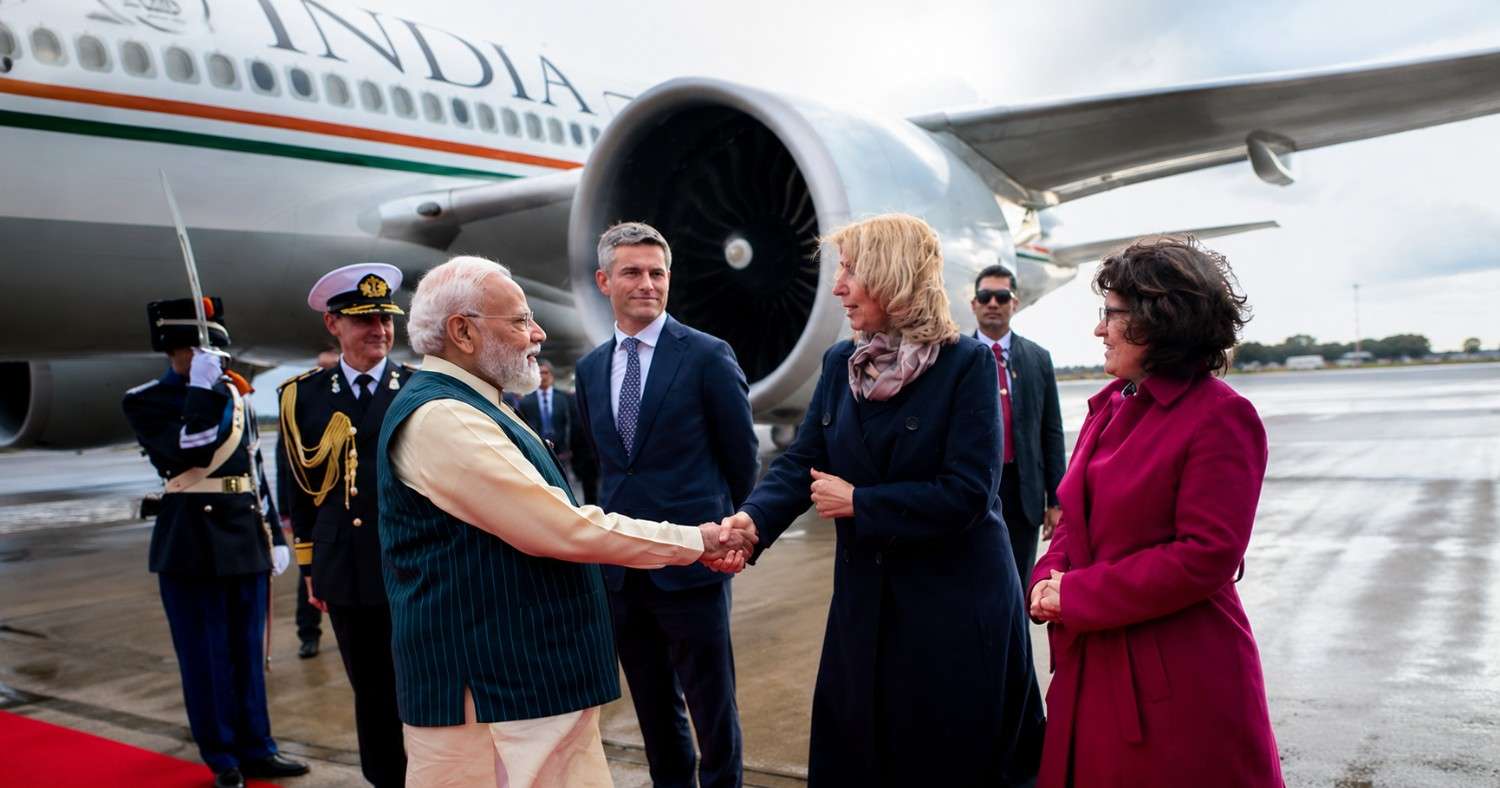
Indian Prime Minister Narendra Modi arrived in the Netherlands for a two-day official visit that is expected to deepen India’s cooperation with the Dutch government across trade, technology, water management, clean energy, and regional security issues.
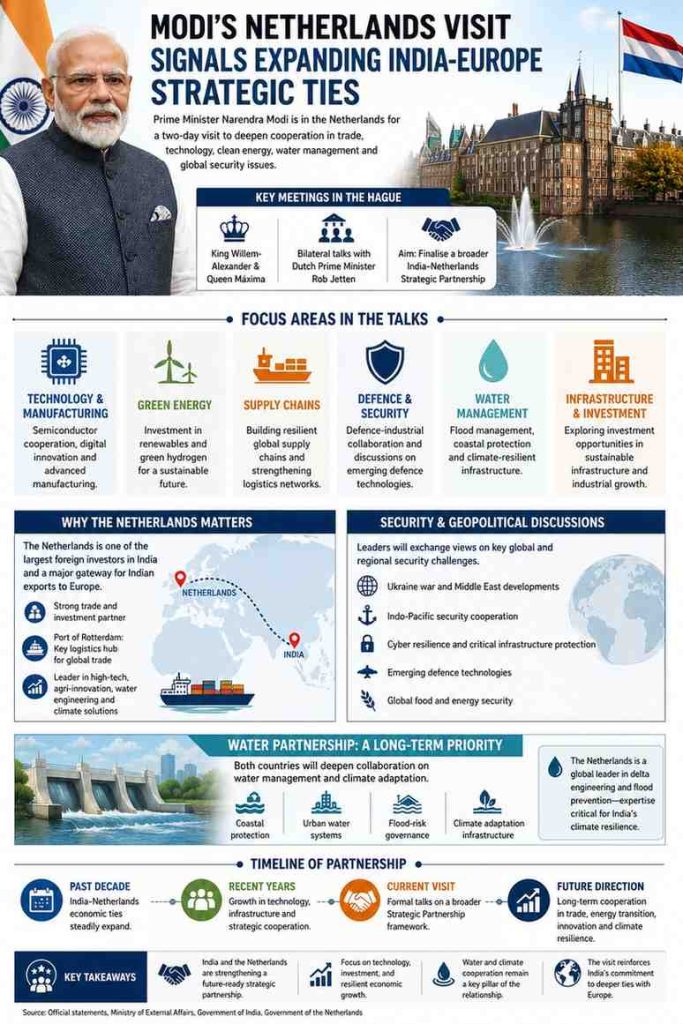
The visit, centered in The Hague, includes meetings with King Willem-Alexander and Queen Máxima, alongside bilateral talks with Dutch Prime Minister Rob Jetten. Officials from both countries are expected to formalize a broader India–Netherlands Strategic Partnership framework during the visit, reflecting expanding political and economic engagement between New Delhi and European partners.
The trip comes at a time when India is intensifying diplomatic outreach across Europe while seeking stronger technology alliances, resilient supply chains, and investment partnerships amid shifting geopolitical and economic dynamics.
Focus on Trade, Technology and Industrial Cooperation
A major component of Modi’s visit involves meetings with Dutch business leaders, technology executives, and trade officials aimed at strengthening commercial ties between the two countries.
India and the Netherlands have steadily expanded economic engagement over the past decade. The Netherlands is among the largest foreign investors in India and serves as a significant European gateway for Indian exports through the Port of Rotterdam, one of the world’s busiest logistics hubs.
Officials familiar with the discussions say the talks are expected to focus on:
- semiconductor and advanced manufacturing cooperation
- green hydrogen and renewable energy investment
- digital technology and innovation ecosystems
- resilient global supply chains
- defence-industrial collaboration
- sustainable infrastructure financing
The Dutch government has increasingly positioned itself as a European leader in high-tech manufacturing, water engineering, agricultural innovation, and climate adaptation — sectors where India is seeking international expertise as it accelerates industrial modernization and infrastructure expansion.
CEO roundtables scheduled during the visit are also expected to explore investment opportunities linked to India’s manufacturing push and its growing role in global technology supply chains.
Strategic Partnership Reflects Wider European Realignment
The planned Strategic Partnership between India and the Netherlands reflects a broader trend in European foreign policy toward deeper engagement with India as geopolitical tensions reshape global alliances.
European governments have been expanding cooperation with India across trade, maritime security, climate policy, and critical technologies while attempting to reduce economic dependencies exposed by supply-chain disruptions and geopolitical instability in recent years.
For New Delhi, stronger ties with European economies offer opportunities to diversify strategic partnerships beyond traditional security frameworks while attracting investment into key sectors such as clean energy, electronics manufacturing, logistics, and digital infrastructure.
Analysts say the Netherlands occupies a particularly important role because of its influence in European trade networks, maritime logistics, and advanced technology industries.
The visit also underscores India’s effort to position itself as a long-term strategic and economic partner for European nations seeking stable Indo-Pacific relationships.
Security and Geopolitical Issues Expected in Talks
Beyond trade and investment, Modi’s discussions with Dutch leaders are expected to cover several international security concerns, including the wars in Ukraine and the Middle East, maritime security, and evolving geopolitical competition.
The Netherlands has been active within European and NATO discussions surrounding security policy, energy resilience, and international sanctions regimes since Russia’s invasion of Ukraine.
India, meanwhile, has attempted to maintain strategic balance in its international relationships, continuing engagement with Western countries while preserving longstanding ties with Russia.
Diplomatic observers say the meetings may also touch on:
- Indo-Pacific security cooperation
- cyber resilience
- critical infrastructure protection
- emerging defence technologies
- global food and energy security
While India and European nations do not always align fully on geopolitical issues, both sides have increasingly emphasized pragmatic cooperation on economic resilience and strategic stability.
Water Management Partnership Remains Central
One of the most significant long-term pillars of India–Netherlands cooperation remains water management and climate resilience.
On the second day of the visit, Modi and Dutch officials are expected to focus on coastal protection, urban water systems, flood-risk governance, and climate adaptation infrastructure — areas where the Netherlands is globally recognized for technical expertise.
India has worked with Dutch institutions for years on river management, smart water systems, port modernization, and sustainable urban planning. As climate-related flooding, rising sea levels, and water stress increasingly affect South Asian cities and coastal regions, such cooperation has taken on greater strategic importance.
Experts note that Dutch expertise in delta engineering and flood prevention is particularly relevant for Indian states vulnerable to coastal erosion and extreme weather events.
Growing India-Europe Engagement
Modi’s Netherlands visit forms part of India’s wider diplomatic strategy of strengthening ties with Europe at a time of increasing geopolitical fragmentation and economic restructuring.
In recent years, India has signed or expanded multiple strategic and technology-focused partnerships with European countries, while negotiations between India and the European Union over a free trade agreement have regained momentum.
For the Netherlands, deeper engagement with India offers access to one of the world’s fastest-growing major economies and an increasingly influential geopolitical actor in the Indo-Pacific region.
The visit also highlights how economic diplomacy, climate cooperation, and strategic technology partnerships are becoming central pillars of modern international relations — often extending well beyond traditional trade agreements alone.
As global competition intensifies around technology, infrastructure, energy transition, and supply chains, both India and the Netherlands appear keen to position their relationship within a broader framework of long-term strategic cooperation.
Key Highlights
- Indian Prime Minister Narendra Modi is visiting the Netherlands for talks focused on trade, technology, climate cooperation, and regional security.
- Modi is scheduled to meet King Willem-Alexander, Queen Máxima, and Dutch Prime Minister Rob Jetten as both countries work toward a broader India–Netherlands Strategic Partnership.
- Discussions are expected to cover semiconductors, renewable energy, advanced manufacturing, digital innovation, and resilient global supply chains.
- The Netherlands remains one of the largest foreign investors in India and serves as a major European trade gateway through the Port of Rotterdam.
- Security discussions are likely to include the Ukraine war, Indo-Pacific stability, cyber resilience, and emerging defence technologies.
- Water management and climate adaptation remain a core area of bilateral cooperation, with both sides focusing on flood-risk governance and coastal infrastructure.
- The visit reflects India’s wider strategy of strengthening strategic and economic ties with European partners amid shifting global geopolitical and supply-chain dynamics.
Input & Images: Hindusthan Samachar
Edited by Manten Sasank
Add Digital Herald as preferred source on google – click here
Also read – Zelensky Signals New Fears Over Belarus Front as NATO Watches Russia’s Military Posture
Last Updated on: Saturday, May 16, 2026 5:05 pm by Mantena Sasank | Published by: Mantena Sasank on Saturday, May 16, 2026 5:03 pm | News Categories: News