
Domestic equity markets declined sharply for the fourth consecutive session on Tuesday, as geopolitical tensions and currency weakness weighed on investor sentiment.
Markets continue downward trend amid global and domestic concerns
Indian stock markets ended in deep red on May 12, with benchmark indices witnessing significant losses due to persistent selling pressure.
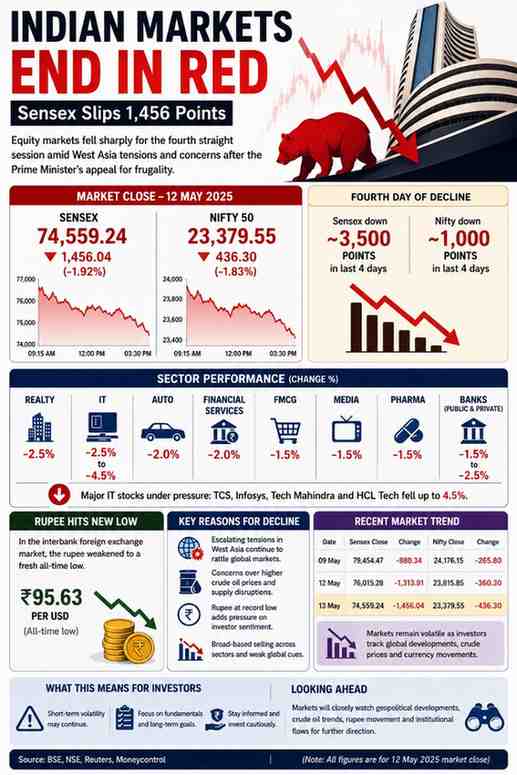
The BSE Sensex dropped 1,456 points to close at 74,559, while the NSE Nifty fell 436 points, settling below the 23,400 mark.
This marks the fourth straight session of decline, with both indices losing substantial ground over the past few days.
Key highlights from the trading session
Broad-based selloff across sectors
Most sectors ended lower, reflecting widespread investor caution.
Realty and IT stocks were among the biggest losers, with major companies such as TCS, Infosys, Tech Mahindra, and HCL Tech declining sharply.
Weakness across key industries
Auto, financial services, FMCG, media, pharmaceutical, and banking stocks also recorded notable losses, indicating a broad market downturn.
Rupee hits record low
The Indian rupee weakened further in the currency market, touching a fresh record low of around ₹95.63 against the US dollar, adding to investor concerns.
What is driving the market decline?
Geopolitical tensions in West Asia
Ongoing instability in West Asia has increased uncertainty in global markets, particularly impacting energy prices and investor confidence.
Rising economic caution
Recent calls for fuel conservation and economic prudence have been interpreted by some investors as signals of potential economic pressure.
Weak global cues and currency pressure
Negative international market trends and a weakening rupee have added to the downward momentum in domestic equities.
Market trend over recent sessions
The continued fall reflects a sustained bearish trend in the market.
Over the past four trading sessions:
- The Sensex has declined by nearly 3,500 points
- The Nifty has lost around 1,000 points
This consistent drop highlights growing risk aversion among investors.
Why this matters for investors
A prolonged market decline can impact:
- Portfolio values
- Investor confidence
- Short-term trading strategies
At the same time, corrections are part of market cycles and may present opportunities for long-term investors, depending on fundamentals.
Broader economic implications
The combination of rising oil prices, geopolitical uncertainty, and currency weakness could:
- Increase inflationary pressures
- Affect import costs
- Impact corporate earnings
- Influence monetary policy decisions
What lies ahead
Market participants are expected to closely track:
- Developments in global geopolitical conditions
- Movement in crude oil prices
- Currency stability
- Institutional investment trends
Conclusion
Tuesday’s sharp fall reinforces the cautious mood in Indian markets, as global uncertainties and domestic signals continue to weigh on sentiment. While volatility may persist in the near term, the market’s direction will depend on how these external and internal factors evolve in the coming days.
Input & Images: Hindusthan Samachar
Edited by Manten Sasank
Add Digital Herald as preferred source on google – click here
Also read – India Builds Energy Cushion With 69 Days of Oil and LNG Reserves, LPG Output Rises: Minister
Last Updated on: Tuesday, May 12, 2026 6:57 pm by Mantena Sasank | Published by: Mantena Sasank on Tuesday, May 12, 2026 6:57 pm | News Categories: Business, News