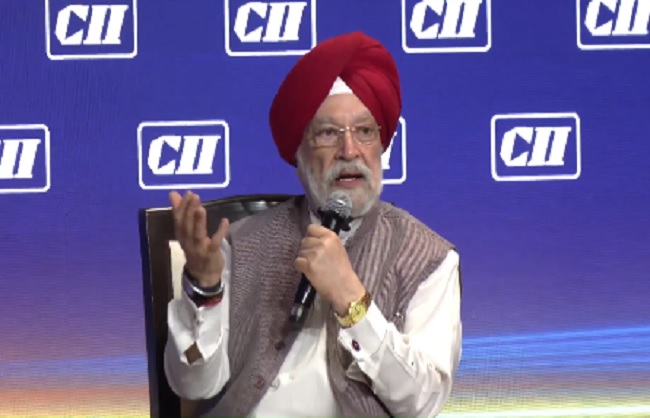
India has strengthened its energy security by expanding fuel reserves and increasing domestic LPG production, amid concerns over supply disruptions linked to geopolitical tensions in West Asia.
Government outlines energy preparedness amid global uncertainty
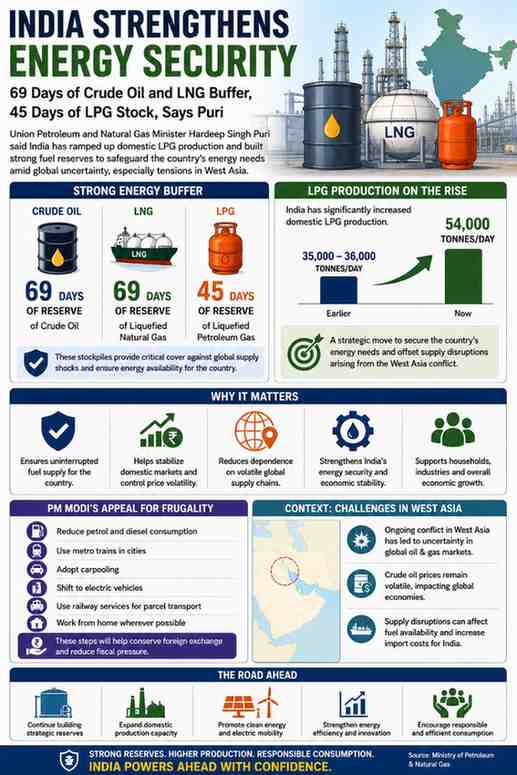
India currently holds energy reserves equivalent to 69 days of crude oil and liquefied natural gas (LNG) and about 45 days of liquefied petroleum gas (LPG), according to Union Petroleum and Natural Gas Minister Hardeep Singh Puri.
Speaking at an industry event in New Delhi, the minister said the government has taken steps to ensure adequate fuel availability as global energy markets face volatility due to ongoing conflicts in West Asia.
Key highlights
Increase in LPG production
India has significantly ramped up domestic LPG output, with daily production rising from approximately 35,000–36,000 tonnes to about 54,000 tonnes.
Strong fuel reserves
The country’s combined reserves of crude oil and LNG now cover more than two months of demand, while LPG stocks are sufficient for around one and a half months.
Focus on supply security
The measures are aimed at safeguarding energy availability and reducing dependence on volatile international supply chains.
Government’s approach to managing risks
Officials have indicated that the increase in production and reserves is part of a broader strategy to handle potential disruptions in global oil and gas supply.
The West Asia region, a key supplier of crude oil, has seen heightened geopolitical tensions, raising concerns over energy flows and price stability.
Call for fuel conservation
Alongside supply-side measures, the government has also emphasized demand-side management.
Prime Minister Narendra Modi has urged citizens to adopt more efficient fuel usage practices, including:
- Using public transport such as metro systems
- Carpooling
- Shifting to electric vehicles
- Reducing unnecessary fuel consumption
- Opting for railways for logistics where possible
- Encouraging remote work to cut travel needs
These steps are intended to reduce fuel demand and ease pressure on foreign exchange reserves.
Why this matters
India is one of the world’s largest energy importers, making it particularly vulnerable to fluctuations in global oil prices and supply disruptions.
Maintaining strategic reserves and increasing domestic production helps:
- Ensure uninterrupted fuel supply
- Stabilize domestic markets
- Reduce exposure to global shocks
- Support economic stability
Background: Energy security strategy
India has been working to strengthen its energy security through a mix of:
- Strategic petroleum reserves
- Diversified import sources
- Expansion of domestic refining and production capacity
- Promotion of alternative fuels and electric mobility
The current measures reflect a continuation of these long-term efforts.
Public impact
For consumers, higher reserves and increased production may:
- Help prevent sudden fuel shortages
- Reduce the risk of sharp price spikes
- Support stable availability of LPG for households
However, global oil price movements may still influence retail fuel costs.
What lies ahead
The government is expected to continue monitoring global developments and adjust its energy strategy accordingly.
Further measures may include expanding reserves, promoting renewable energy, and encouraging efficiency in fuel consumption.
Conclusion
India’s move to boost LPG production and maintain strong energy reserves highlights its focus on preparedness in an uncertain global environment. While challenges remain due to external factors, the current strategy aims to ensure stability in fuel supply and protect the economy from sudden disruptions.
Input & Images: Hindusthan Samachar
Edited by Manten Sasank
Add Digital Herald as preferred source on google – click here
Also read – Indian Stock Market Slumps as Sensex, Nifty Fall Sharply; ₹5.68 Lakh Crore in Market Value Erased
Last Updated on: Tuesday, May 12, 2026 6:47 pm by Mantena Sasank | Published by: Mantena Sasank on Tuesday, May 12, 2026 6:47 pm | News Categories: News, India