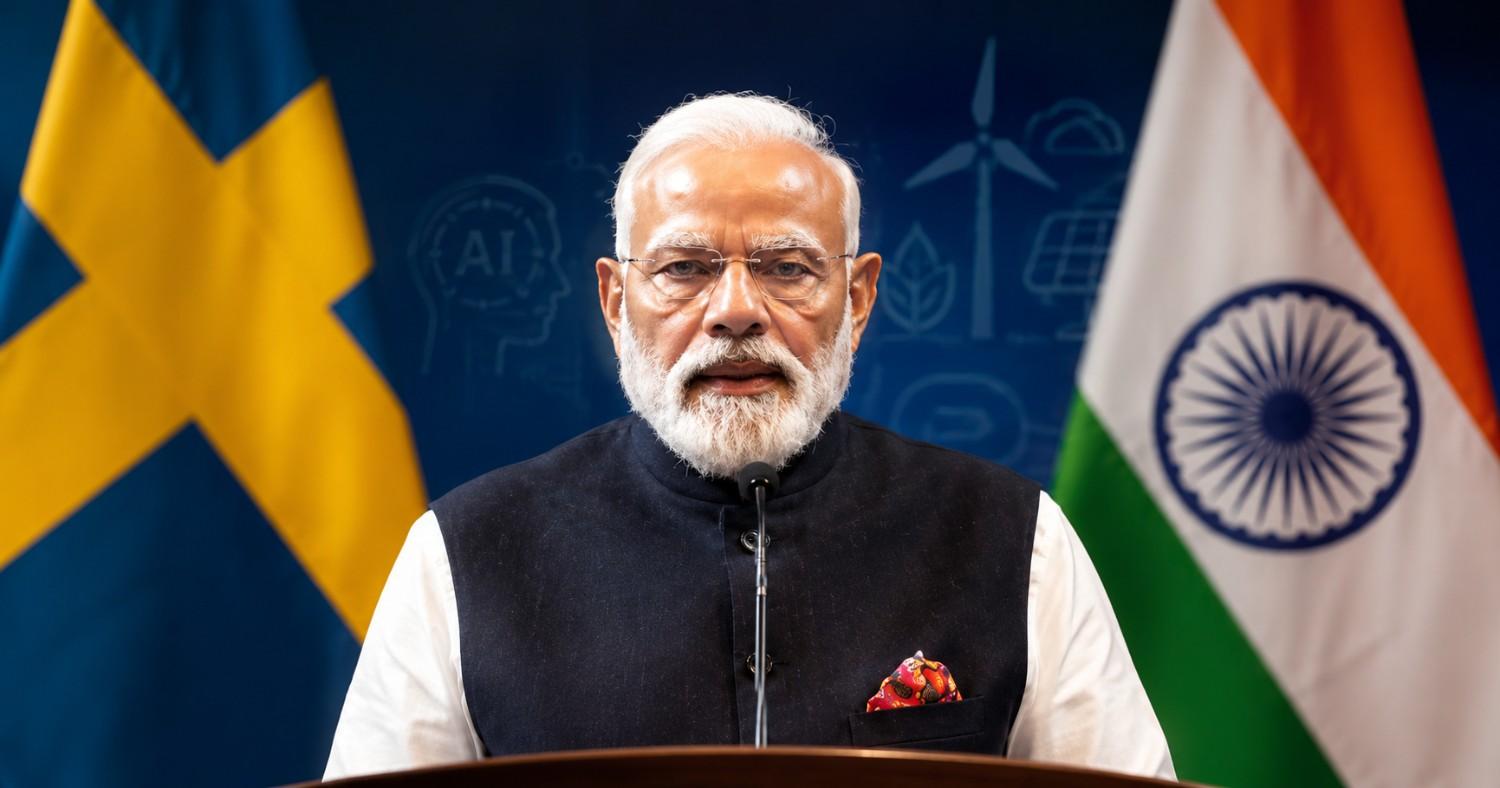
Indian Prime Minister Narendra Modi said India and Sweden are entering a new phase of strategic cooperation focused on technology, green transition, defence manufacturing, and innovation partnerships, as both countries seek closer alignment amid evolving geopolitical and economic challenges.
Speaking at the European Round Table for Industry in Gothenburg, Modi described India–Sweden relations as increasingly shaped by democratic values, technological collaboration, and sustainable development priorities. His remarks came during a broader diplomatic visit aimed at strengthening India’s engagement with Nordic and European partners.
Swedish Prime Minister Ulf Kristersson and European Commission President Ursula von der Leyen attended the event, underscoring the growing importance European leaders attach to strategic partnerships with India.
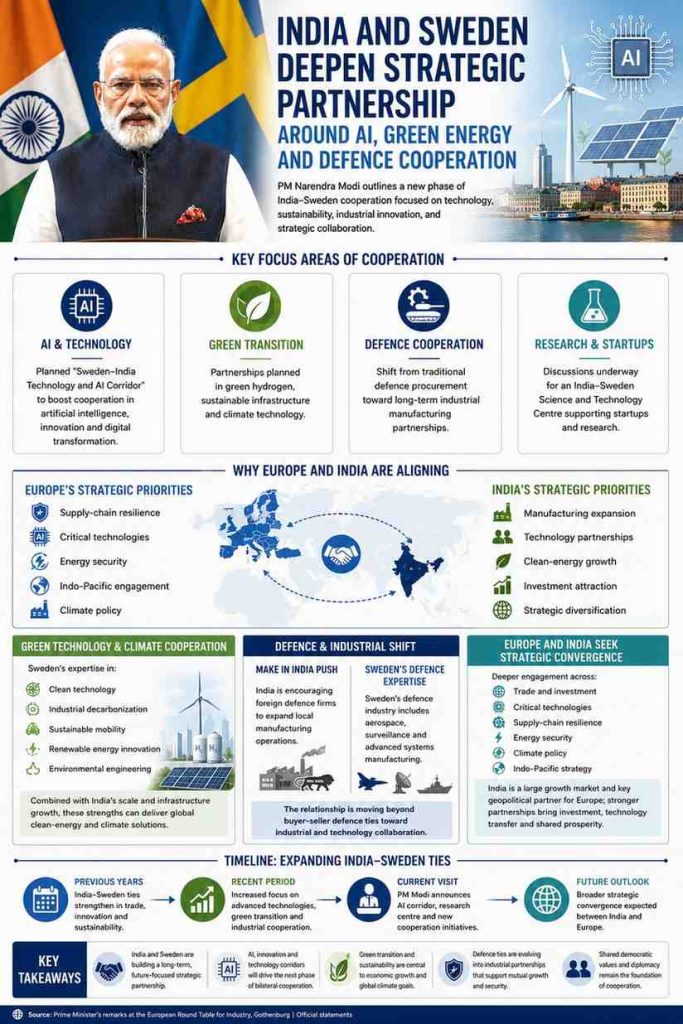
Technology and AI Emerging as Central Pillars
A major focus of Modi’s address was the role of emerging technologies in shaping the next stage of India–Sweden cooperation.
The prime minister announced plans to strengthen a proposed “Sweden–India Technology and AI Corridor,” aimed at expanding collaboration in artificial intelligence, advanced research, innovation ecosystems, and digital transformation initiatives.
He also said discussions are underway to establish an India–Sweden Science and Technology Centre to support joint research, startup collaboration, and academic partnerships.
The emphasis on AI and deep technology reflects wider global competition over technological leadership, supply-chain resilience, and industrial modernization. European governments have increasingly sought partnerships with countries like India to diversify technology ecosystems and reduce vulnerabilities in critical sectors.
India, meanwhile, is positioning itself as a major global digital economy and innovation hub, with policymakers actively pursuing international cooperation in semiconductors, artificial intelligence, advanced manufacturing, and emerging technologies.
Green Transition Cooperation Gains Momentum
Climate and sustainability cooperation featured prominently in the discussions, with Modi highlighting India’s work in green hydrogen, circular economy initiatives, and sustainable infrastructure development.
He said Swedish technological expertise combined with India’s industrial scale and market capacity could contribute to globally relevant clean-energy and climate solutions.
Sweden has developed a strong international reputation in:
- clean technology
- sustainable mobility
- renewable energy innovation
- industrial decarbonization
- environmental engineering
India, one of the world’s fastest-growing major economies, is simultaneously attempting to accelerate energy transition goals while expanding infrastructure and manufacturing capacity.
Analysts say partnerships between European technology-driven economies and India’s large-scale industrial ecosystem are becoming increasingly important as countries race to develop low-carbon supply chains and climate-resilient infrastructure.
Defence Ties Shift Toward Industrial Partnership
Modi also signaled a broader shift in defence relations between India and Sweden, noting that Swedish companies setting up manufacturing operations in India represent movement beyond traditional buyer-seller arrangements.
India has been encouraging foreign defence manufacturers to expand local production under its “Make in India” strategy, which seeks to strengthen domestic manufacturing capacity and reduce long-term dependence on imported military equipment.
Sweden’s defence sector includes globally recognized aerospace, surveillance, and advanced systems manufacturers, making the country a potentially important long-term industrial and technology partner for India.
Defence-industrial cooperation has become a growing component of India’s broader strategic relationships with European countries, particularly as geopolitical uncertainty and regional security competition reshape global defence supply chains.
Europe and India Seek Strategic Convergence
Modi argued that political, economic, and strategic convergence between India and Europe has become increasingly important for global stability.
The comments come at a time when European governments are deepening engagement with India across:
- trade and investment
- critical technologies
- Indo-Pacific strategy
- supply-chain resilience
- energy security
- climate policy
For Europe, India represents both a rapidly growing market and a major geopolitical actor in the Indo-Pacific region. For India, stronger partnerships with European democracies provide opportunities for investment, technology transfer, and diversified strategic engagement.
The presence of European Commission President Ursula von der Leyen at the event also reflected ongoing efforts to expand India-European Union cooperation amid renewed negotiations over trade and economic agreements.
Diplomacy, Democracy and Global Stability
In his remarks, Modi repeatedly emphasized democratic governance, rule of law, and dialogue-based conflict resolution as shared principles between India and Sweden.
Without directly referencing specific global conflicts, he said cooperation among democratic nations has gained importance in the current international environment and reiterated India’s position that disputes should be resolved through diplomacy and dialogue.
The messaging aligns with India’s broader foreign-policy balancing strategy, where New Delhi continues engaging multiple global powers while emphasizing strategic autonomy and multilateral cooperation.
Observers say the growing India–Sweden partnership reflects wider changes in global diplomacy, where innovation policy, climate transition, economic resilience, and technology cooperation increasingly shape bilateral relationships alongside traditional geopolitical considerations.
As Europe seeks trusted long-term partners in a rapidly changing international order, India’s role in the continent’s strategic calculations appears likely to expand further.
Key Highlights
- Indian Prime Minister Narendra Modi said India and Sweden are expanding strategic cooperation in artificial intelligence, green technology, defence manufacturing, and innovation partnerships.
- Speaking at the European Round Table for Industry in Gothenburg, Modi emphasized democratic values, sustainable development, and technology collaboration as core pillars of India–Sweden relations.
- India and Sweden plan to strengthen a proposed “Sweden–India Technology and AI Corridor” and are discussing the creation of a joint Science and Technology Centre for research and startup collaboration.
- Climate and clean-energy cooperation featured prominently, with both countries exploring partnerships in green hydrogen, sustainable infrastructure, and industrial decarbonization.
- Modi said Swedish companies expanding manufacturing operations in India reflect a shift from traditional defence procurement toward long-term industrial cooperation.
- European leaders, including Ulf Kristersson and Ursula von der Leyen, signaled growing interest in deeper strategic and economic engagement with India.
- The discussions reflect broader global efforts to strengthen partnerships around supply-chain resilience, emerging technologies, energy security, and geopolitical stability.
Input & Images: Hindusthan Samachar
Edited by Manten Sasank
Add Digital Herald as preferred source on google – click here
Also read – Sweden Honours PM Modi With Royal Order as India-Nordic Ties Gain Strategic Momentum
Last Updated on: Monday, May 18, 2026 12:28 pm by Mantena Sasank | Published by: Mantena Sasank on Monday, May 18, 2026 12:23 pm | News Categories: News, Technology