
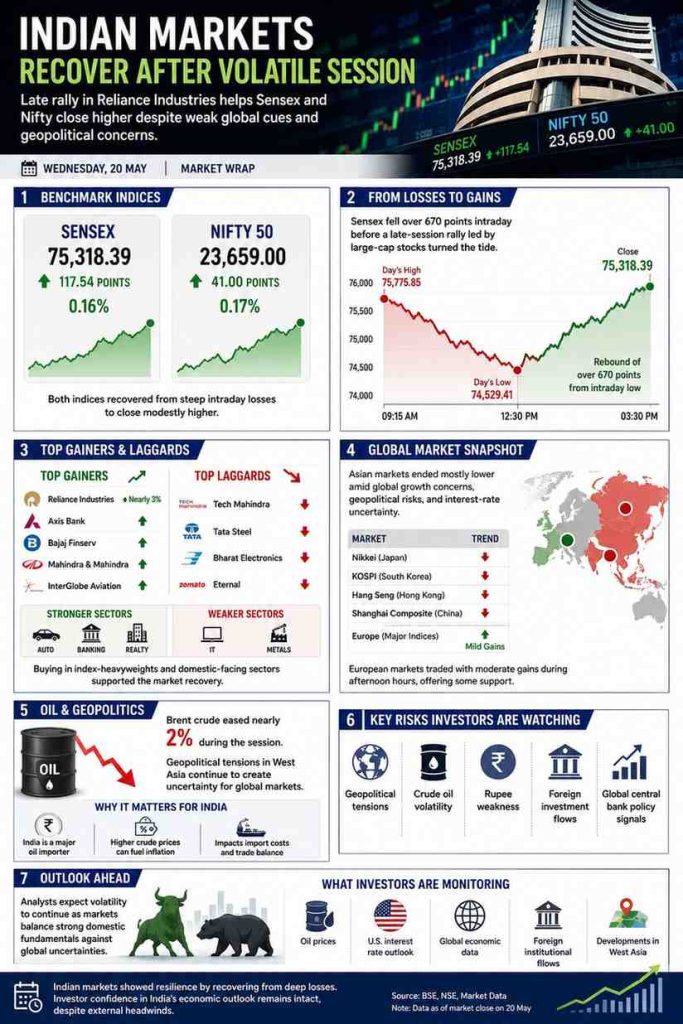
Indian equity markets recovered from steep intraday losses to close modestly higher on Wednesday, supported by late buying in heavyweight stocks led by Reliance Industries, even as investors remained cautious over geopolitical tensions in West Asia and weak global market sentiment.
The benchmark BSE Sensex ended the session up 117.54 points, or 0.16%, at 75,318.39, while the NSE Nifty 50 gained 41 points, or 0.17%, to settle at 23,659. The rebound came after both indices traded sharply lower earlier in the day amid concerns over crude oil volatility, global risk sentiment, and mixed economic signals from overseas markets.
At one stage during intraday trade, the Sensex had fallen more than 670 points before recovering in the final hours of the session.
Reliance Industries Leads Market Recovery
A strong rally in Reliance Industries emerged as the biggest driver of the market’s turnaround.
Shares of the conglomerate climbed nearly 3%, helping offset weakness across several sectors. Analysts said buying in index-heavyweights and renewed interest in domestic-facing sectors helped stabilize sentiment after a volatile start.
Apart from Reliance Industries, gains were also recorded in shares of Bajaj Finserv, Axis Bank, Mahindra & Mahindra, Trent, and InterGlobe Aviation.
The broader market showed selective strength in automobile, banking, and real estate stocks, sectors that have recently benefited from expectations of sustained domestic demand and improving credit conditions.
However, weakness persisted in parts of the technology and metal segments. Bharat Electronics, Tech Mahindra, Tata Steel, and Eternal were among the notable laggards during the session.
Global Cues Continue to Influence Investor Mood
Market sentiment remained fragile as investors monitored developments in the Middle East and fluctuations in global commodity markets.
Brent crude prices declined during the session, easing nearly 2%, although oil remained elevated compared with recent averages. Energy prices continue to be closely watched in India because of their impact on inflation, import costs, and the country’s trade balance.
The recent rise in geopolitical tensions in West Asia has added uncertainty to global financial markets, particularly for energy-importing economies such as India.
Asian markets broadly ended lower on Wednesday. Japan’s Nikkei, South Korea’s KOSPI, Hong Kong’s Hang Seng, and China’s Shanghai Composite all closed in negative territory amid concerns over slowing global growth, geopolitical risks, and uncertainty around interest rate trajectories in major economies.
European markets, however, traded with moderate gains during afternoon hours, offering some support to broader global sentiment.
Domestic Fundamentals Remain Supportive
Despite near-term volatility, analysts say Indian equities continue to draw support from relatively strong domestic macroeconomic indicators.
India remains one of the fastest-growing major economies, with resilient consumption trends, government-led infrastructure spending, and steady corporate earnings continuing to support medium-term investor confidence.
Foreign institutional investment flows, however, have remained sensitive to global developments, particularly movements in crude oil prices, U.S. Treasury yields, and currency fluctuations.
The rupee’s performance also remains under close watch. A weaker rupee can increase imported inflation risks and affect sectors dependent on overseas inputs or dollar-denominated liabilities.
Volatility Likely to Persist
Market experts say volatility may continue in the near term as investors balance positive domestic fundamentals against rising geopolitical and global macroeconomic uncertainties.
The recovery during the final trading hours highlighted the presence of buying interest at lower levels, particularly in large-cap stocks viewed as relatively defensive during periods of uncertainty.
Investors are also expected to closely monitor upcoming global economic data, central bank signals, crude oil movements, and developments in West Asia for further direction.
Wednesday’s recovery follows a weak close in the previous session, when both the Sensex and Nifty had ended lower amid profit-booking and cautious global sentiment.
While the day’s gains were relatively modest, the market’s ability to recover from deep intraday losses suggested that investor confidence in India’s broader economic outlook remains intact despite external headwinds.
Key Highlights
- Indian benchmark indices recovered from sharp intraday losses to close higher, with the Sensex rising 117 points and the Nifty gaining 41 points.
- Reliance Industries led the late-session rebound, with its shares climbing nearly 3% and helping stabilize broader market sentiment.
- Auto, banking, and real estate stocks showed resilience, while technology and metal shares remained under pressure during the session.
- Investor sentiment stayed cautious amid geopolitical tensions in West Asia, fluctuations in crude oil prices, and weak global market cues.
- Brent crude oil prices eased nearly 2%, offering some relief to markets concerned about inflation and India’s import costs.
- Asian markets closed mostly lower due to global growth concerns and uncertainty around interest rates, while European markets traded with modest gains.
- Analysts say India’s strong domestic economic fundamentals continue to support investor confidence, though market volatility may persist due to global uncertainties and energy price movements.
Input & Images: Hindusthan Samachar
Edited by Manten Sasank
Add Digital Herald as preferred source on google – click here
Also read – U.S. Expands Iran Sanctions, Targets Financial Network and Oil Shipping Operations
Last Updated on: Wednesday, May 20, 2026 6:32 pm by Mantena Sasank | Published by: Mantena Sasank on Wednesday, May 20, 2026 6:18 pm | News Categories: Business