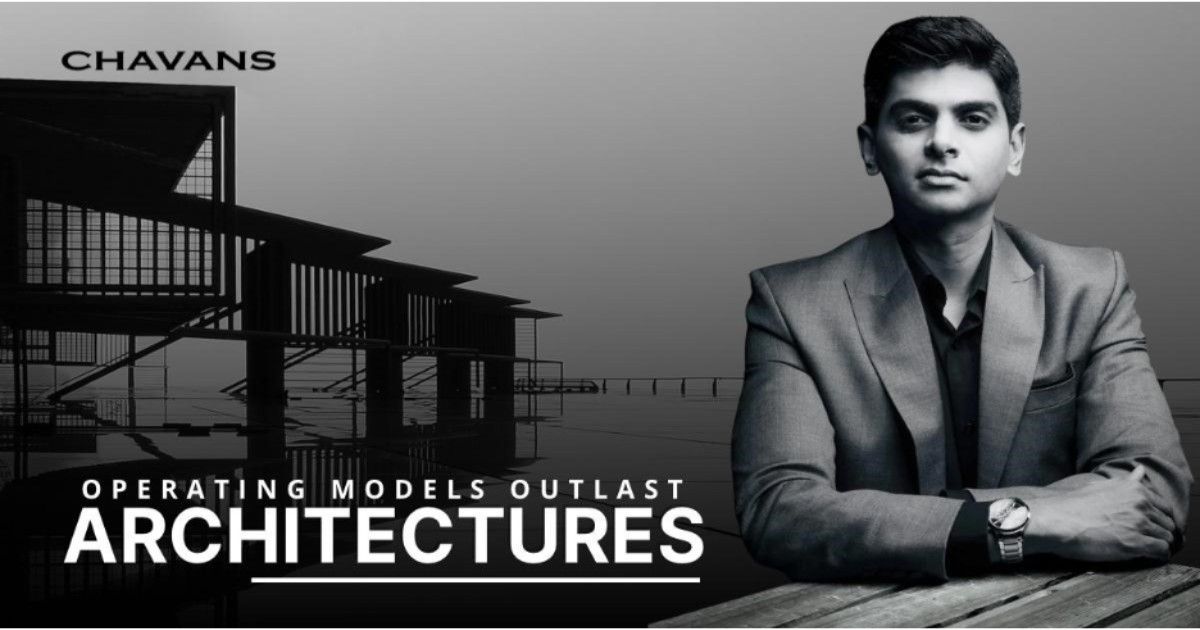
As enterprises continue investing heavily in AI, cloud, cybersecurity, and digital transformation, many organisations are realising that long-term success depends less on architecture decisions alone and more on the operating models that sustain them. According to Chavans Technologies, enterprises often focus extensively on designing future-state systems while underestimating the operational discipline required to make transformation sustainable.
At Chavans Technologies, enterprise transformation is approached through a consulting-led, problem-first methodology that prioritises governance, execution discipline, ownership clarity, and long-term operational resilience. The company believes that while architectures evolve continuously, operating models ultimately determine whether transformation initiatives survive beyond implementation.
Sumanth Chavan, Founder and CEO of Chavans Technologies, observes that enterprises rarely struggle because they lack sophisticated technologies. More often, they struggle because operational structures fail to evolve at the same pace as technology investments.
In many transformation programmes, organisations invest significant effort into selecting platforms, modernising infrastructure, and redesigning system architectures. However, after go-live, businesses frequently encounter a different challenge altogether: sustaining execution consistency across teams, processes, governance structures, and decision-making environments.
This is where operating models become critical.
An operating model defines how decisions are made, how teams collaborate, how accountability is maintained, how systems are governed, and how technology initiatives continue delivering value after deployment. Unlike architecture diagrams, which often represent technical intent, operating models shape daily enterprise behaviour.
This distinction is becoming increasingly important in the AI era.
As organisations accelerate AI adoption, many are discovering that technical implementation is only one layer of transformation. The larger challenge lies in integrating AI into existing operational structures without creating fragmentation, governance gaps, or duplicated decision systems.
In practice, enterprises often underestimate the organisational complexity introduced by AI and cloud initiatives. New tools are implemented, but ownership boundaries remain unclear. Teams adopt platforms independently without shared governance standards. Processes evolve unevenly across departments. Over time, this creates operational sprawl that weakens long-term efficiency.
According to Chavans Technologies, operating discipline is now becoming one of the most important differentiators in enterprise transformation.
Enterprises that build strong operating models are typically better positioned to:
- Maintain governance consistency across business functions
- Scale transformation programmes sustainably
- Reduce operational duplication and rework
- Improve accountability and decision clarity
- Adapt to evolving technology environments without destabilising operations
- Sustain measurable business outcomes after implementation
Conversely, organisations that focus exclusively on architecture modernisation often experience hidden long-term drag. Systems may technically function as intended, but business execution slows due to fragmented ownership, process inconsistency, and governance fatigue.
One of the most common patterns observed in large enterprises is that operating structures remain tied to legacy behaviours even after technology environments change. This creates a disconnect between what systems are designed to enable and how organisations actually operate.
For example, enterprises may adopt cloud-native infrastructure while continuing to manage operations through siloed decision-making models designed for older environments. Similarly, AI initiatives may be deployed across departments without establishing unified governance frameworks, resulting in inconsistent adoption and unclear accountability.
These operational gaps rarely create immediate failure. Instead, they gradually erode transformation ROI over time.
According to Sumanth Chavan, one of the biggest misconceptions in enterprise transformation is the assumption that architecture itself guarantees scalability. In reality, scalability depends on whether organisations can consistently govern, operate, and adapt those systems over time.
This is why enterprises increasingly need to view transformation not as a technology programme, but as an organisational operating challenge.
At Chavans Technologies, the emphasis remains on helping organisations simplify complexity before accelerating transformation initiatives. The company advocates for transformation strategies that align technology decisions with operational maturity, governance readiness, and long-term execution capability.
Another important shift taking place across enterprises is the growing recognition that operating models require continuous evolution. Unlike architecture projects that may have defined timelines, operating discipline must adapt continuously as business priorities, regulatory environments, security requirements, and technology ecosystems evolve.
This requires enterprises to move away from transformation approaches that focus only on deployment milestones. Instead, organisations must build systems capable of supporting sustained operational learning, governance refinement, and long-term accountability.
The future of enterprise transformation will likely belong to organisations that treat operating models as strategic assets rather than administrative structures.
As AI, cloud, and digital systems become more deeply integrated into business operations, architectures will continue changing. New platforms will emerge. Technologies will evolve. Market conditions will shift.
But enterprises with disciplined operating models will remain more resilient because their ability to govern change, align teams, and sustain execution will outlast any individual technology stack.
In an increasingly complex enterprise landscape, operating models are no longer secondary to architecture. They are becoming the foundation that determines whether transformation can endure at scale.
Last Updated on: Monday, May 25, 2026 7:31 pm by Digital Herald Team | Published by: Digital Herald Team on Monday, May 25, 2026 7:25 pm | News Categories: Brand Post