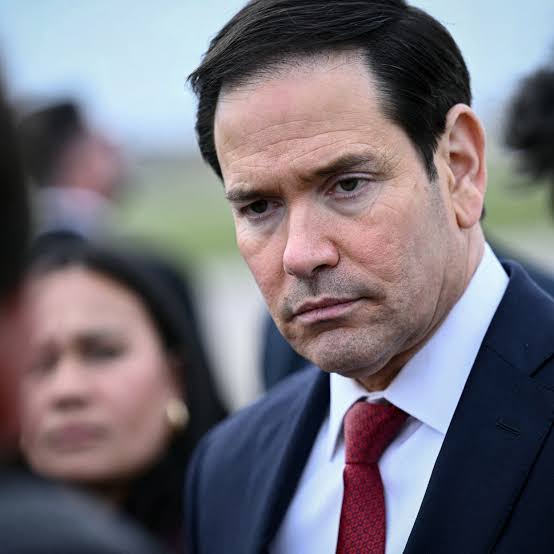
The United States has declared the conclusion of its military campaign against Iran, with senior officials arguing that key strategic objectives have been achieved. Yet despite Washington’s assessment, ongoing attacks, maritime disruptions, and unresolved diplomatic disputes continue to fuel uncertainty across the Middle East.
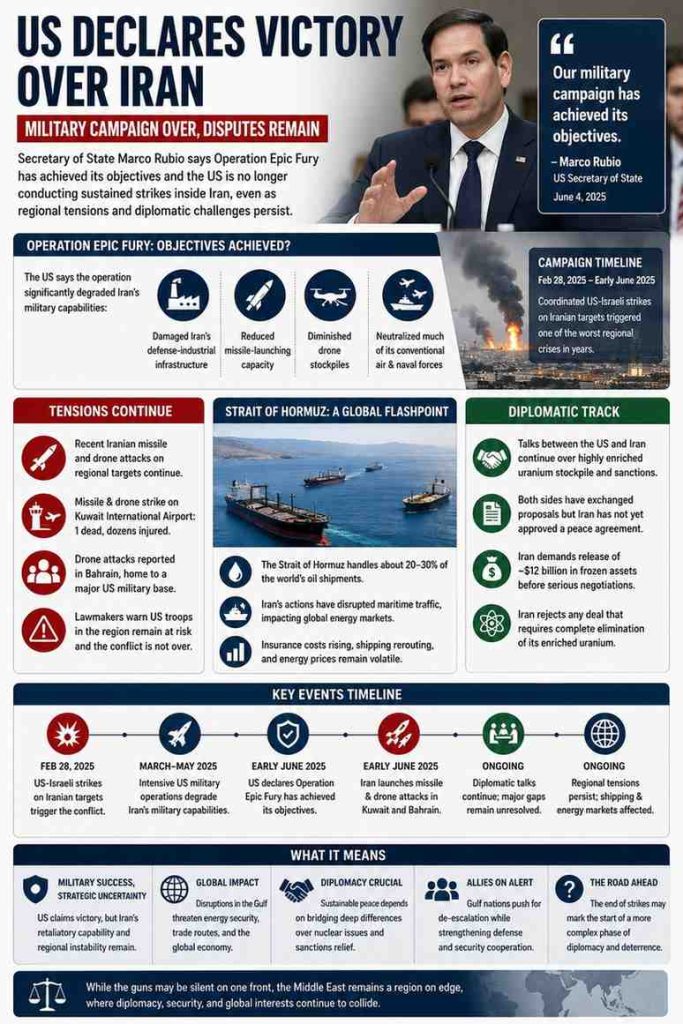
Appearing before lawmakers in Washington, Secretary of State Marco Rubio said the operation, known as Operation Epic Fury, had successfully degraded Iran’s military capabilities and reduced its ability to project conventional force. According to the administration, the campaign targeted critical military infrastructure, missile-launching systems, drone networks, and other strategic assets.
The announcement marks a significant milestone in a conflict that has reshaped regional security calculations since coordinated strikes against Iranian targets earlier this year. However, questions remain over whether military success can translate into lasting stability.
A Military Campaign Ends, but the Crisis Continues
While U.S. officials have characterized the operation as a strategic victory, recent events suggest the broader confrontation is far from over.
Several lawmakers challenged the administration’s claim that the conflict has effectively ended, pointing to continued missile and drone incidents across the Gulf region. Security concerns remain elevated in countries hosting American forces, while regional governments continue to strengthen defensive measures against potential future attacks.
Analysts note that modern conflicts are increasingly defined not only by battlefield outcomes but also by their long-term political, economic, and security consequences. In that context, the end of active military operations does not necessarily mean the underlying crisis has been resolved.
Strait of Hormuz Remains a Global Flashpoint
Among the most pressing concerns is the continued disruption of maritime activity near the Strait of Hormuz.
The narrow waterway serves as one of the world’s most important energy corridors, carrying a substantial share of global oil and liquefied natural gas exports. Any instability affecting navigation through the region can quickly influence energy prices, shipping costs, and international trade flows.
Although international efforts are underway to restore confidence in maritime routes, uncertainty surrounding regional security continues to affect commercial shipping operations.
Energy market observers warn that prolonged disruptions could create ripple effects far beyond the Middle East, particularly for countries heavily dependent on imported energy supplies.
Diplomacy Takes Center Stage
With military operations winding down, attention is increasingly shifting toward diplomacy.
Negotiations between Washington and Tehran continue, though major differences remain unresolved. Discussions have focused on Iran’s nuclear programme, its stockpile of highly enriched uranium, sanctions relief, and broader regional security arrangements.
The United States has maintained that any comprehensive agreement must address concerns over uranium enrichment and guarantee freedom of navigation through key maritime routes. Iranian officials, meanwhile, have signaled that economic considerations, including access to frozen financial assets, remain central to their negotiating position.
Diplomatic experts caution that bridging these differences will require significant political compromise from both sides.
Regional Allies Watch Closely
The conflict has also placed America’s Gulf partners in a difficult position.
Countries across the region have found themselves balancing security cooperation with Washington while attempting to avoid becoming direct participants in a wider confrontation. Recent attacks targeting regional infrastructure have reinforced concerns about the vulnerability of critical facilities and transportation networks.
Governments in the Gulf continue to advocate for de-escalation while strengthening defensive capabilities and maintaining close coordination with international partners.
What Comes Next?
The coming weeks may prove decisive for determining whether the region moves toward stabilization or renewed confrontation.
For Washington, the challenge will be converting military gains into diplomatic progress. For Tehran, the priority remains securing acceptable political and economic terms while preserving strategic interests.
Despite claims that the military campaign has ended, the broader issues that fueled the confrontation—including regional influence, maritime security, and nuclear negotiations—remain unresolved.
As a result, the conclusion of military operations may represent not the end of the crisis, but the beginning of a new and potentially more complex phase defined by diplomacy, deterrence, and geopolitical competition.
For now, global attention remains fixed on whether negotiations can succeed where military force has reached its limits.
Key Highlights
- U.S. Secretary of State Marco Rubio said Washington’s military campaign against Iran, known as Operation Epic Fury, has officially concluded.
- The U.S. administration claims the operation significantly weakened Iran’s missile capabilities, drone stockpiles, military infrastructure, and conventional forces.
- Despite the declaration of success, lawmakers and analysts argue that regional tensions remain high and the broader conflict is not fully resolved.
- Recent missile and drone attacks in the Gulf region have raised concerns about the security of U.S. personnel and allied nations.
- The Strait of Hormuz remains a major flashpoint, with disruptions to maritime traffic continuing to affect global energy and shipping markets.
- Ongoing diplomatic talks between Washington and Tehran are focused on Iran’s enriched uranium stockpile, sanctions relief, and regional security issues.
- The U.S. insists that any future agreement must include restrictions on Iran’s nuclear activities and guarantees for freedom of navigation through key shipping routes.
- Iran has reportedly demanded access to frozen assets and opposed proposals to completely eliminate its enriched uranium reserves.
- Gulf nations continue to push for de-escalation while strengthening security measures amid fears of renewed hostilities.
- Analysts say the conflict may be entering a new phase where diplomacy and negotiations become as important as military actions in shaping regional stability.
Input & Images: Hindusthan Samachar
Edited by Manten Sasank
Add Digital Herald as preferred source on google – click here
Also read – US-Iran Maritime Dispute Deepens as Conflicting Claims Raise Fears of Wider Gulf Crisis
Last Updated on: Thursday, June 4, 2026 12:07 pm by Mantena Sasank | Published by: Mantena Sasank on Thursday, June 4, 2026 12:07 pm | News Categories: News