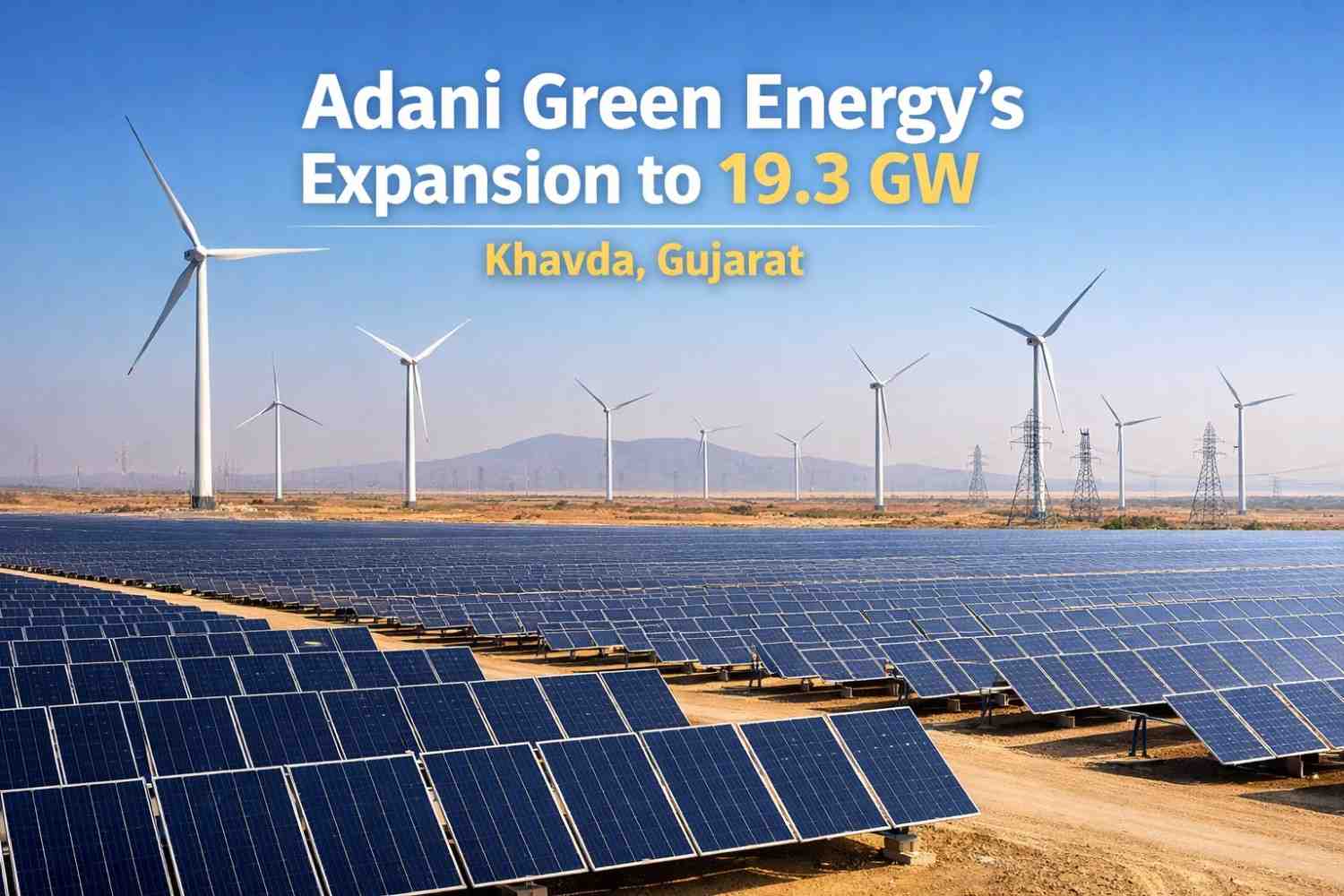
Major capacity addition at Gujarat’s Khavda project positions India among global leaders in renewable energy expansion
Adani Green Energy Limited (AGEL) has added more than 5 gigawatts (GW) of renewable energy capacity during the financial year 2025–26, taking its total operational portfolio to 19.3 GW. A significant portion of this expansion has been carried out at the Khavda renewable energy project in Gujarat, considered one of the largest of its kind globally.
Key Highlights
AGEL commissioned approximately 5,051 megawatts (MW) of new capacity during the year. This includes around 3.4 GW of solar energy, 0.7 GW of wind power, and nearly 1 GW of hybrid capacity combining both sources.
The scale of this addition is among the highest annual greenfield expansions globally, excluding projects in China. Most of the newly added capacity is concentrated at the Khavda site, which is being developed at an accelerated pace.
Project Details and Scale
The expansion is centered around the Khavda Renewable Energy Park, spread across approximately 538 square kilometres. The site is being developed on arid land and is designed to support large-scale solar and wind installations.
Out of a planned 30 GW capacity at Khavda by 2029, AGEL has already installed about 9.4 GW, indicating steady progress toward its long-term targets.
Environmental Impact
The newly added capacity is expected to offset around 10 million tonnes of carbon emissions annually. With the expanded portfolio of 19.3 GW, the company estimates a total annual carbon offset of nearly 36 million tonnes.
Such reductions are significant in the context of India’s climate commitments, particularly its efforts to lower emissions intensity and increase the share of renewable energy in its power mix.
Context and Background
Renewable energy capacity is typically measured in gigawatts, indicating the maximum electricity generation potential. Large-scale additions like this reflect both infrastructure growth and policy support for clean energy.
India has set ambitious renewable energy targets as part of its broader strategy to reduce dependence on fossil fuels and meet international climate goals.
Public and Industry Impact
The expansion is expected to contribute to improved energy availability and support industrial and residential demand through cleaner sources. Large renewable projects also create employment opportunities during construction and operation phases.
For the energy sector, continued investment in solar, wind, and hybrid systems indicates a shift toward more diversified and sustainable power generation.
Conclusion
Adani Green Energy’s capacity addition in FY26 marks a significant step in large-scale renewable energy development. As the Khavda project continues to expand toward its planned capacity, it is likely to play a key role in India’s transition to cleaner energy sources.
The pace of execution and future additions will determine how quickly the project reaches its long-term targets and contributes to the country’s overall energy goals.
Image Credit: AI-generated image for illustrative purposes
Edited by Manten Sasank
Add Digital Herald as preferred source on google – click here
Also read – US–Iran Conflict: Trump Signals Possible End to Hostilities Within Weeks
Last Updated on: Wednesday, April 1, 2026 11:44 am by Mantena Sasank | Published by: Mantena Sasank on Wednesday, April 1, 2026 11:44 am | News Categories: News, India, Technology