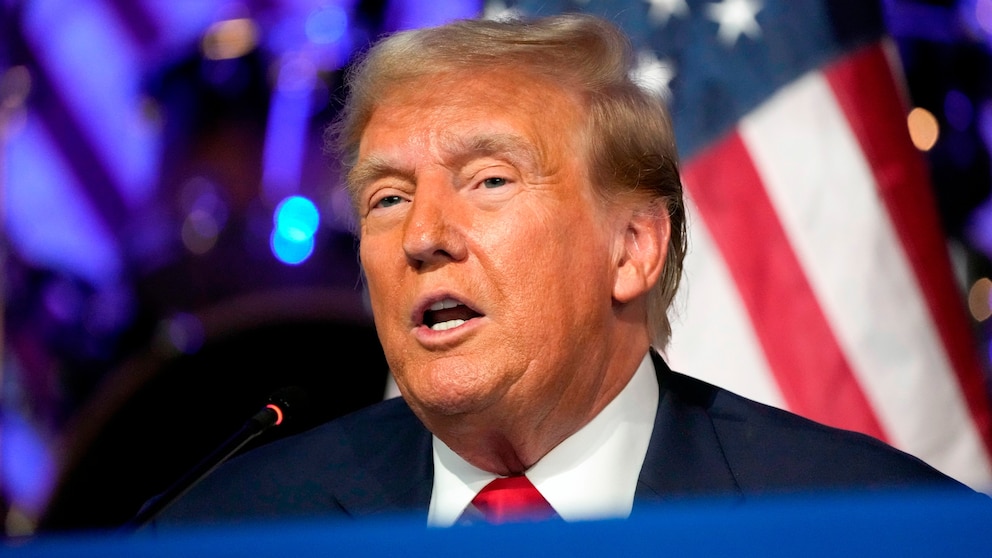
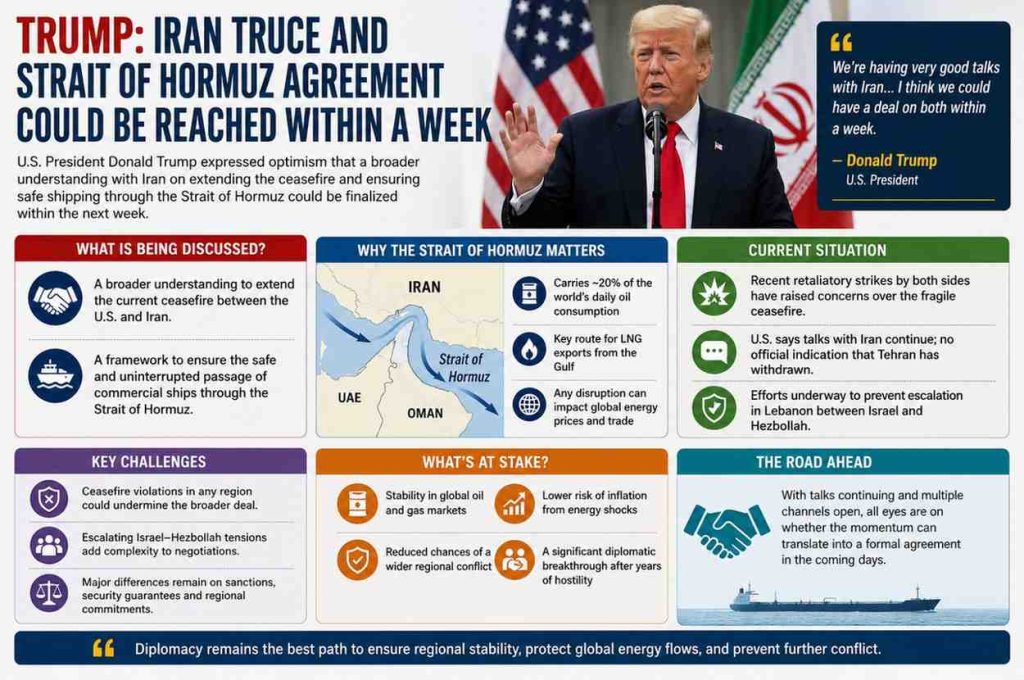
U.S. President Donald Trump has expressed confidence that negotiations with Iran could produce a broader agreement within days, potentially extending a fragile ceasefire and restoring confidence in one of the world’s most critical maritime trade routes.
Speaking amid heightened tensions across the Middle East, Trump said discussions with Tehran were moving forward despite recent military incidents that had raised concerns about the durability of diplomatic efforts. He suggested that negotiators were making progress toward an arrangement that would help ensure the uninterrupted flow of commercial shipping through the Strait of Hormuz, a strategic waterway central to global energy supplies.
The comments come at a pivotal moment for regional stability, as governments and financial markets closely monitor whether diplomacy can overcome a series of recent confrontations involving Iran, the United States, Israel, and allied groups across the region.
Strait of Hormuz Remains Central to Global Concerns
The Strait of Hormuz remains one of the world’s most strategically important maritime corridors, serving as a major transit route for crude oil and liquefied natural gas exports from Gulf producers to international markets.
Any threat to navigation through the narrow passage can trigger immediate concerns over energy security, fuel prices, shipping costs, and broader economic stability.
Recent tensions in the Gulf have renewed attention on the vulnerability of global supply chains to geopolitical disruptions. Analysts note that even the perception of risk around Hormuz can influence commodity markets and investor sentiment worldwide.
A successful agreement guaranteeing safe passage for commercial vessels would therefore carry significance far beyond the immediate region.
Fragile Ceasefire Faces Continued Pressure
Trump’s optimism follows a period of uncertainty surrounding a ceasefire that has helped limit direct confrontation between Washington and Tehran in recent months.
Reports of retaliatory military activity over recent days have fueled concerns that the truce could weaken, complicating ongoing diplomatic efforts. While neither side has formally abandoned dialogue, the incidents have highlighted the challenges facing negotiators attempting to convert temporary de-escalation into a more durable framework.
U.S. officials continue to emphasize diplomacy as the preferred path forward, while Iranian leaders have repeatedly stressed that any agreement must address broader security concerns and regional commitments.
The gap between those positions remains one of the key tests facing negotiators.
Regional Tensions Extend Beyond Iran
The diplomatic effort is unfolding against a wider backdrop of instability across the Middle East.
Recent military activity involving Israel and Hezbollah in Lebanon has increased fears that regional conflicts could intersect and undermine separate negotiation tracks. Diplomatic sources have indicated that multiple governments are attempting to prevent localized confrontations from escalating into broader regional crises.
Trump acknowledged efforts to encourage restraint among regional actors, arguing that preventing additional flashpoints is essential for maintaining momentum in ongoing talks.
Observers note that the interconnected nature of Middle Eastern security issues means progress in one area can be influenced by developments elsewhere.
Why Markets Are Watching Closely
Financial markets are paying close attention to developments surrounding Iran and the Strait of Hormuz because of the potential impact on global energy flows.
Any agreement that reduces the risk of disruption could help stabilize oil markets and ease concerns among energy-importing nations. Conversely, renewed hostilities or a breakdown in negotiations could increase volatility in commodity prices and shipping costs.
For major economies already grappling with inflation, energy affordability remains a critical concern. As a result, diplomatic developments in the Gulf continue to carry global economic implications.
Challenges Remain Despite Optimism
While Trump’s comments reflect growing optimism, analysts caution that complex negotiations rarely move in a straight line.
Key issues involving regional security arrangements, sanctions, military activity, and long-term guarantees remain unresolved. Previous efforts to improve relations between Washington and Tehran have often encountered setbacks despite periods of progress.
Diplomatic experts note that achieving a formal agreement would require sustained political commitment from all parties and mechanisms capable of maintaining trust during periods of tension.
The Week Ahead
With multiple diplomatic channels remaining active, attention is now focused on whether negotiators can transform recent momentum into a formal understanding.
A breakthrough would represent one of the most significant diplomatic developments in the region in recent years, potentially reducing tensions, safeguarding a vital energy corridor, and creating space for broader discussions on regional security.
For now, officials continue to pursue negotiations while balancing the realities of a volatile security environment, leaving the coming days likely to be critical for the future direction of U.S.-Iran relations and stability across the Middle East.
Key Highlights
- U.S. President Donald Trump said a broader agreement with Iran could be reached within a week, potentially extending the current ceasefire and easing regional tensions.
- Discussions reportedly include a framework to ensure uninterrupted shipping through the Strait of Hormuz, a critical route for global oil and LNG exports.
- Trump indicated that negotiations with Tehran remain active despite recent military exchanges and concerns over the stability of the truce.
- The Strait of Hormuz remains a key focus for global markets, as any disruption could impact energy prices, trade flows, and economic stability.
- Diplomatic efforts are also aimed at preventing a wider regional conflict, including reducing tensions involving Israel and Hezbollah in Lebanon.
- Iranian officials have warned that violations of ceasefire understandings elsewhere in the region could undermine broader diplomatic progress.
- Analysts say a successful U.S.-Iran agreement would represent a significant diplomatic breakthrough and could help stabilize both regional security and global energy markets.
- International attention is now focused on whether ongoing talks can produce a formal agreement in the coming days.
Input & Images: Hindusthan Samachar
Edited by Manten Sasank
Add Digital Herald as preferred source on google – click here
Also read – Commercial LPG Prices Rise Across India as Government Cuts Export Duties on Refined Fuels
Last Updated on: Tuesday, June 2, 2026 10:05 am by Mantena Sasank | Published by: Mantena Sasank on Tuesday, June 2, 2026 10:05 am | News Categories: News