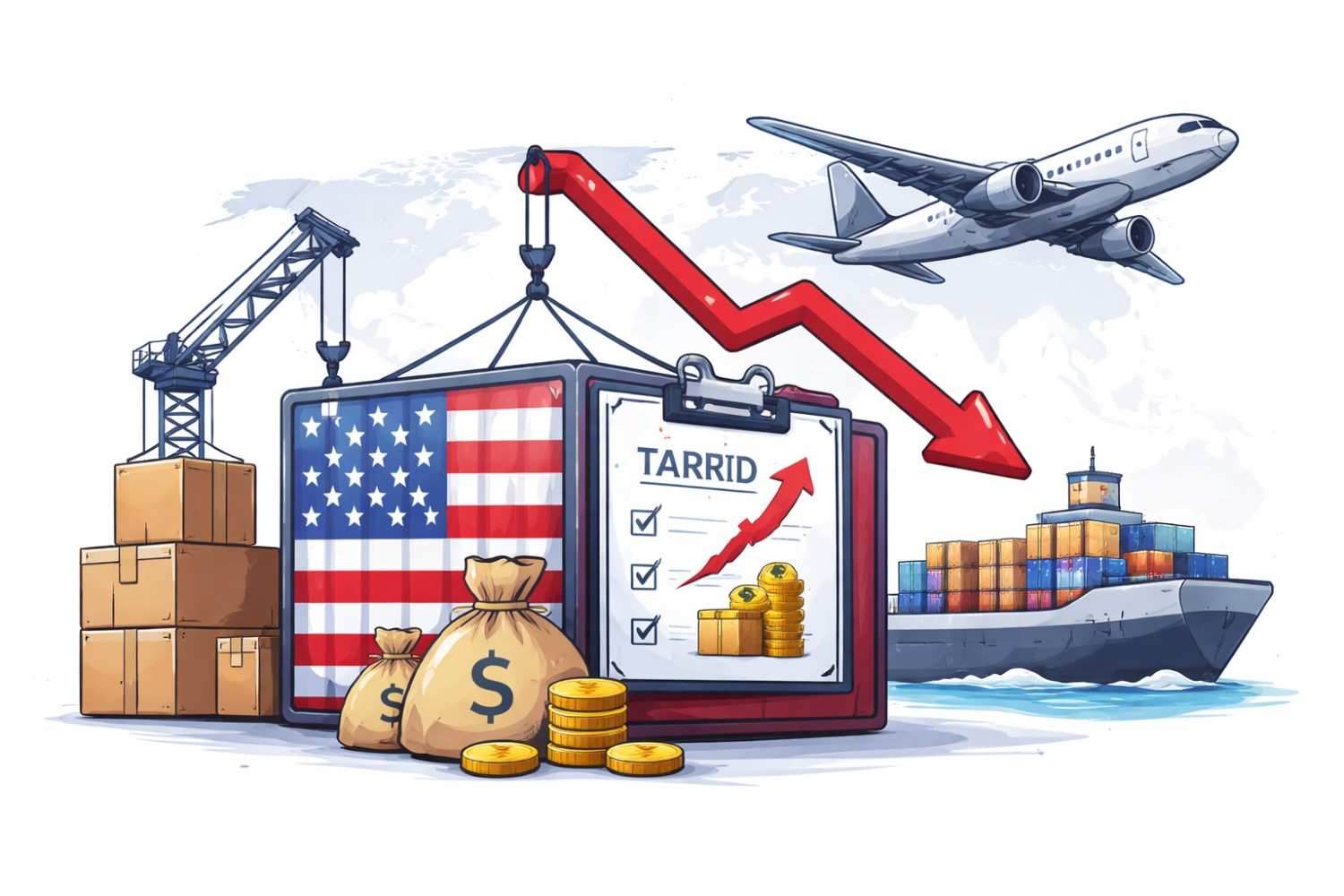
New US tariffs have officially come into effect, marking a fresh phase in global trade policy. The move is expected to impact supply chains, export strategies, and international pricing across sectors. For India and other emerging economies, the development could open both risks and opportunities.
Trade policies from the United States often influence global markets because the US remains one of the world’s largest importers and exporters. When tariffs change, global trade flows tend to shift.
Here is a clear breakdown of what the new US tariffs mean and why they matter.
What Are the New US Tariffs?
The latest US tariffs apply to selected imported goods under trade policy measures announced earlier by American authorities. Tariffs are taxes imposed on imported products. When tariffs increase, imported goods become more expensive in the US market.
These measures are often introduced to:
Protect domestic industries
Address trade imbalances
Respond to national security concerns
Encourage local manufacturing
The new tariffs affect specific product categories. These typically include industrial goods, technology components, and certain manufactured items, depending on the official notification.
Businesses importing affected goods into the US will now have to pay higher duties.
Why the Timing Is Important
The tariffs come at a time when global trade is already adjusting to multiple pressures.
These include:
Geopolitical tensions
Supply chain realignment
Inflation concerns
Slowdown in major economies
Many countries are trying to reduce dependence on single markets. Companies are diversifying production bases and sourcing strategies.
In this context, new US tariffs add another layer of complexity to international trade planning.
Impact on Global Supply Chains
Tariffs directly influence supply chains.
When duties increase, companies often look for alternative suppliers in countries not affected by the new rates. This can shift manufacturing orders from one country to another.
For example, if certain goods from one region become more expensive due to tariffs, US importers may turn to suppliers in Southeast Asia, India, or Latin America.
Such changes do not happen overnight. But over time, trade flows adjust.
This shift is already visible in sectors such as electronics, auto components, and textiles, where global companies are spreading risk across multiple countries.
What It Means for India
For India, new US tariffs could create both opportunities and challenges.
Opportunities
If competing countries face higher tariffs, Indian exporters may gain an advantage in certain product categories.
India has been working to strengthen manufacturing under initiatives such as “Make in India” and production-linked incentive schemes.
If US buyers seek alternative suppliers, Indian manufacturers could benefit.
Sectors that may watch developments closely include:
Engineering goods
Pharmaceutical inputs
Textiles and apparel
Auto components
India is already one of the US’s major trading partners. Any shift in sourcing patterns could increase export volumes in select areas.
Challenges
At the same time, if Indian exports are directly affected by new tariff measures, costs could rise.
Higher duties may reduce competitiveness in the US market. Indian exporters would then need to either absorb costs or pass them on to buyers.
Currency movements also play a role. Exchange rate fluctuations can offset or amplify tariff impact.
Effect on Prices and Inflation
Tariffs often lead to higher consumer prices in the importing country.
When import costs increase, companies may pass those costs to consumers. This can add to inflation pressures.
In the US, inflation has already been a policy concern in recent years. Analysts are closely watching whether new tariffs will influence price levels in affected sectors.
For exporting countries, demand shifts may impact factory output and employment.
Trade Relations and Policy Signals
Tariffs are not only economic tools. They are also policy signals.
They may reflect strategic priorities such as:
Reducing dependency on specific countries
Encouraging domestic production
Strengthening national security
Other countries may respond with their own measures. In some cases, negotiations follow tariff announcements.
The World Trade Organization framework allows countries to challenge certain tariff measures if they believe trade rules are violated.
However, trade disputes often take time to resolve.
Market Reaction
Financial markets typically react quickly to tariff announcements.
Stock markets may see volatility in sectors directly affected by trade rules.
For example:
Export-focused companies may see price movement.
Manufacturing firms dependent on imports may face cost concerns.
Commodity markets may react to changes in demand expectations.
Currency markets also respond to trade policy changes, especially if they influence capital flows.
Investors usually assess whether tariffs are temporary or part of a longer-term shift.
Long-Term Shift in Global Trade
The new US tariffs are part of a broader trend toward trade realignment.
In recent years, many countries have focused on supply chain resilience. The pandemic exposed risks linked to over-dependence on single production hubs.
As a result:
Regional trade agreements are gaining importance.
Companies are setting up multiple manufacturing bases.
Governments are offering incentives for domestic production.
This trend is often described as “friend-shoring” or “near-shoring,” where companies source from politically aligned or geographically closer countries.
India is actively positioning itself in this evolving environment.
How Indian Businesses Can Respond
Indian exporters and manufacturers may consider several strategies.
First, diversification is key. Companies should not depend on a single export market.
Second, value addition can improve competitiveness. Higher-quality products often face less price sensitivity.
Third, monitoring trade policy updates is crucial. Tariff rules can change quickly based on political developments.
Industry associations in India regularly engage with policymakers to assess risks and opportunities from global trade changes.
Role of Bilateral Trade Talks
India and the US maintain ongoing trade dialogue.
While tariff measures are unilateral decisions, broader trade relations are shaped by negotiation and cooperation.
Bilateral trade discussions can address market access issues and tariff concerns.
India remains a strategic partner for the US in areas such as technology, pharmaceuticals, and defense manufacturing.
Therefore, trade dynamics are influenced by both economic and geopolitical factors.
Sectors to Watch Closely
Certain sectors may feel stronger impact from new US tariffs.
Electronics and semiconductors are key focus areas globally.
Steel and aluminum have historically been sensitive sectors in trade disputes.
Green energy equipment may also see policy shifts as countries promote local manufacturing.
Indian companies in these industries should track regulatory changes carefully.
What This Means for Consumers in India
Indian consumers may not see immediate direct impact unless global supply shifts affect product availability or pricing.
However, if global demand changes significantly, export-oriented industries in India could see production adjustments.
Over time, shifts in global trade patterns influence job creation, investment, and industrial growth.
Looking Ahead
The full impact of new US tariffs will unfold over the coming months.
Key questions include:
Will other countries respond with counter-measures?
Will negotiations ease tensions?
Will companies accelerate supply chain diversification?
Trade policy is rarely static. Adjustments are common as governments respond to economic conditions.
For India, the focus will remain on balancing export growth with domestic manufacturing expansion.
Conclusion
The implementation of new US tariffs marks another turning point in global trade dynamics.
The move may reshape supply chains, pricing structures, and export strategies across industries.
For India, the development presents a mixed picture. There may be fresh export opportunities in some sectors, while others may face higher barriers.
As global trade continues to evolve, businesses and policymakers must stay alert.
In a world of shifting trade alliances and strategic economic planning, tariff decisions from major economies like the United States carry wide-reaching impact.
Disclaimer: The information presented in this article is intended for general informational purposes only. While every effort is made to ensure accuracy, completeness, and timeliness, data such as prices, market figures, government notifications, weather updates, holiday announcements, and public advisories are subject to change and may vary based on location and official revisions. Readers are strongly encouraged to verify details from relevant official sources before making financial, investment, career, travel, or personal decisions. This publication does not provide financial, investment, legal, or professional advice and shall not be held liable for any losses, damages, or actions taken in reliance on the information provided.
Edited by mantena sasank
Last Updated on: Friday, February 27, 2026 11:44 am by Digital Herald Team | Published by: Digital Herald Team on Friday, February 27, 2026 11:44 am | News Categories: General