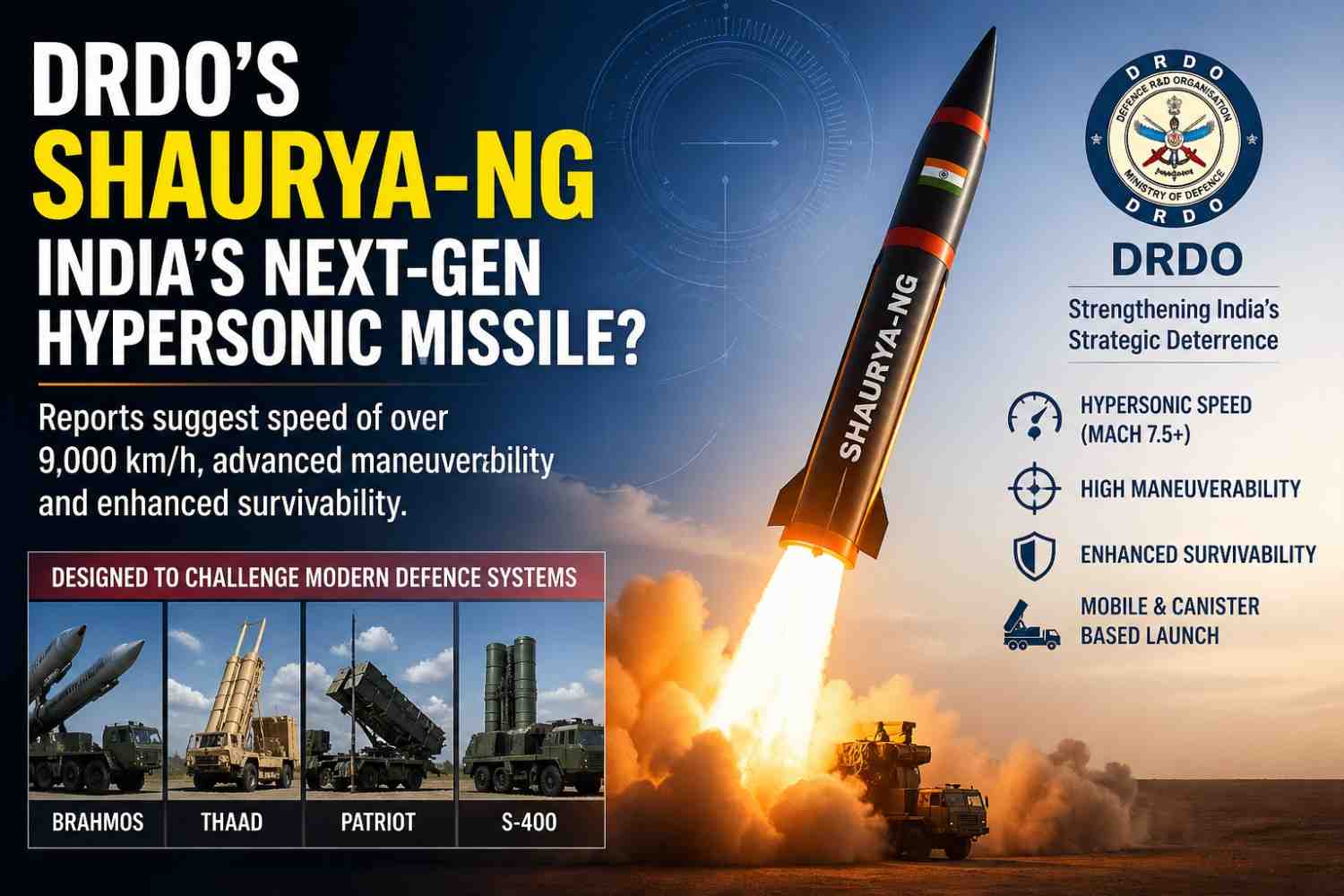
Reports suggest India is preparing to test a next-generation Shaurya missile with hypersonic speed and enhanced maneuverability, though many headline claims remain unverified.
India’s defence research ecosystem is drawing renewed attention following reports that the Defence Research and Development Organisation is preparing to test an upgraded version of its Shaurya missile platform, commonly referred to in media reports as Shaurya-NG. According to defence-focused coverage, the system is being positioned as a high-speed, maneuverable strategic missile aimed at strengthening India’s deterrence capabilities.
While several headlines have described the missile as a “9000 kmph weapon” or “more lethal” than systems such as THAAD, Patriot, or S-400, such comparisons require caution, as these platforms serve different military roles and are not directly comparable.
Key Announcements / Highlights
Reports indicate that Shaurya-NG may build on the existing Shaurya missile platform first tested in 2008, with expected upgrades in speed, survivability, guidance, and launch readiness. Media discussions suggest speeds of Mach 7.5 or higher, equivalent to roughly 9,000 km/h, alongside a quasi-ballistic flight profile designed to complicate interception.
The missile is also described as capable of maneuvering mid-flight within the atmosphere, rather than following a traditional ballistic arc, which could improve its ability to evade missile defence systems.
Some reports further suggest the system may feature indigenous seeker technology, canister-based cold-launch capability, and mobile deployment options, though full official DRDO specifications have not yet been publicly confirmed.
Official Status and Verification
As of now, much of the information surrounding Shaurya-NG appears to be based on defence analysis, media reports, and unofficial projections rather than a comprehensive technical release from DRDO.
This means that performance claims—including range, operational deployment timelines, and superiority over foreign missile systems—should be treated as developmental expectations until validated through official testing and government confirmation.
Context / Background
India has increasingly prioritised indigenous defence manufacturing under its broader self-reliance strategy, with missile systems such as BrahMos, Akash, and strategic deterrence platforms forming a key part of military modernisation.
Hypersonic and quasi-ballistic missile systems are strategically important because their speed and maneuverability can reduce adversaries’ response time and complicate interception efforts.
India’s long-term missile development strategy is also shaped by evolving regional security challenges, including strategic competition in Asia.
Public Impact
If successfully tested and deployed, Shaurya-NG could strengthen India’s domestic defence capabilities and contribute to strategic deterrence.
For the public, such programmes represent both technological progress and a reflection of national security priorities, though they also raise broader questions around defence budgets, arms competition, and regional stability.
Conclusion
Shaurya-NG could mark an important step in India’s effort to advance indigenous high-speed missile systems. However, many of the strongest claims currently associated with the project remain speculative until officially verified.
Future DRDO disclosures and successful test milestones will be critical in determining whether Shaurya-NG becomes a major strategic breakthrough or remains an ambitious developmental platform.
Image credit: Generated using AI for illustrative purposes
Edited by Manten Sasank
Add Digital Herald as preferred source on google – click here
Also read – Sensex, Nifty Extend Losses for Second Day; Investors Lose ₹2.99 Lakh Crore
Last Updated on: Sunday, April 26, 2026 3:02 pm by Mantena Sasank | Published by: Mantena Sasank on Sunday, April 26, 2026 3:02 pm | News Categories: News, Education