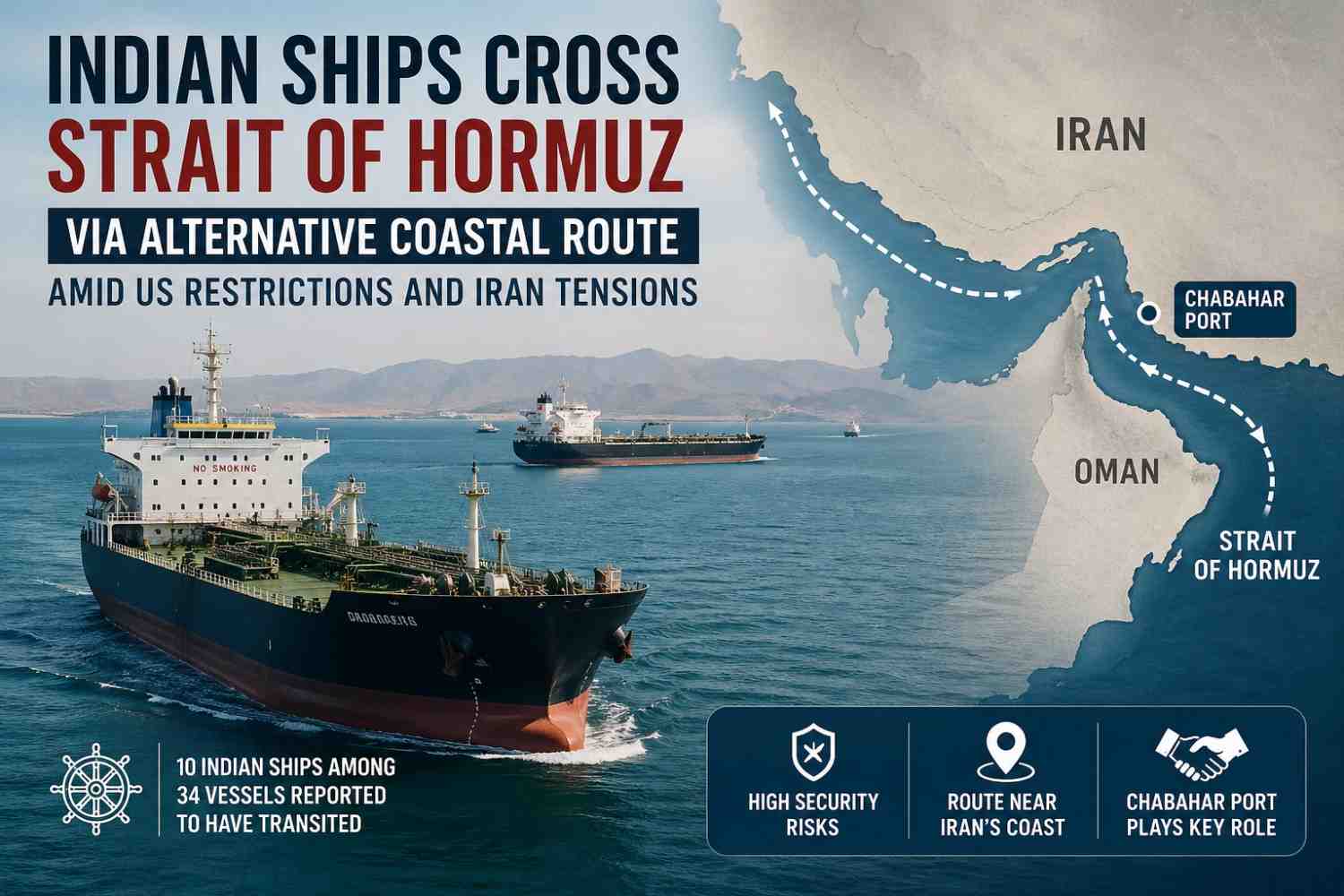
Despite heightened military tensions and reported US restrictions around Iranian maritime zones, Indian-linked vessels are continuing to move through the Strait of Hormuz using alternative coastal navigation routes near Iran, according to multiple media reports.
Indian vessels navigate strategic Gulf waters despite disruption
A growing number of Indian ships have reportedly crossed the Strait of Hormuz in recent weeks even as regional instability, military surveillance, and tighter maritime controls have disrupted one of the world’s most critical oil and trade corridors.
Reports indicate that around 10 Indian vessels were among dozens of ships that successfully transited the region by following routes close to Iran’s southern coastline rather than relying solely on the central shipping lanes traditionally used through Hormuz.
The Strait of Hormuz, located between Iran and Oman, is a vital global shipping chokepoint connecting the Persian Gulf to the Arabian Sea. A significant share of India’s crude oil imports and trade cargo passes through these waters.
Alternative route near Chabahar Port gains significance
According to shipping reports, some vessels have been moving along Iran’s coast toward Chabahar Port before heading south into the Gulf of Oman and onward into international waters.
This route is not an entirely separate passage from Hormuz, but rather a strategic navigation pattern that may reduce exposure to heavily monitored or higher-risk zones.
Chabahar Port, developed with Indian investment, has long held strategic importance for India’s trade connectivity with Iran, Afghanistan, and Central Asia. In the current environment, it is drawing renewed attention for its geographic advantage.
Why the Strait of Hormuz matters
The Strait of Hormuz is among the world’s busiest maritime routes, carrying a large portion of global oil shipments. Any disruption can directly affect:
- Global crude oil prices
- India’s energy security
- Shipping insurance costs
- Regional trade stability
For India, uninterrupted access is especially important because the country depends heavily on energy imports from Gulf nations.
Heightened tensions, but not a full shutdown
While some reports have described the situation as a “blockade,” shipping experts note that maritime traffic has slowed rather than completely stopped.
Vessels continue to operate under increased caution, with route adjustments based on security assessments, naval presence, and diplomatic developments.
This distinction is important because a total closure of Hormuz would have far more severe implications for global supply chains and fuel markets.
Risks remain for commercial shipping
Even with adjusted routes, ships operating in the region continue to face:
- Security threats
- Possible inspections or delays
- Higher operational and insurance expenses
- Geopolitical uncertainty
Maritime analysts caution that these routes are tactical responses, not guaranteed solutions.
Strategic importance for India
India’s commercial and strategic interests in Chabahar could become more significant if instability in Gulf shipping lanes persists. The port has already been central to India’s regional connectivity strategy, and current developments may reinforce its value.
For Indian businesses and policymakers, the movement of cargo through this region is closely tied to fuel costs, trade continuity, and broader economic stability.
What happens next
Shipping patterns in the Strait of Hormuz are expected to remain sensitive to developments between the United States, Iran, and regional powers.
For now, Indian vessels appear to be adapting through selective routing rather than halting operations entirely. However, industry observers say sustained geopolitical escalation could still reshape shipping strategies in the weeks ahead.
As one of the world’s most strategically important waterways faces renewed pressure, India’s maritime planning and energy logistics will remain under close watch.
Image credit: Generated using AI for illustrative purposes
Edited by Manten Sasank
Add Digital Herald as preferred source on google – click here
Also read – DRDO’s Shaurya-NG Missile Project Signals India’s Push Into Advanced Hypersonic Warfare
Last Updated on: Tuesday, April 28, 2026 6:35 pm by Mantena Sasank | Published by: Mantena Sasank on Tuesday, April 28, 2026 6:35 pm | News Categories: News, Politics