
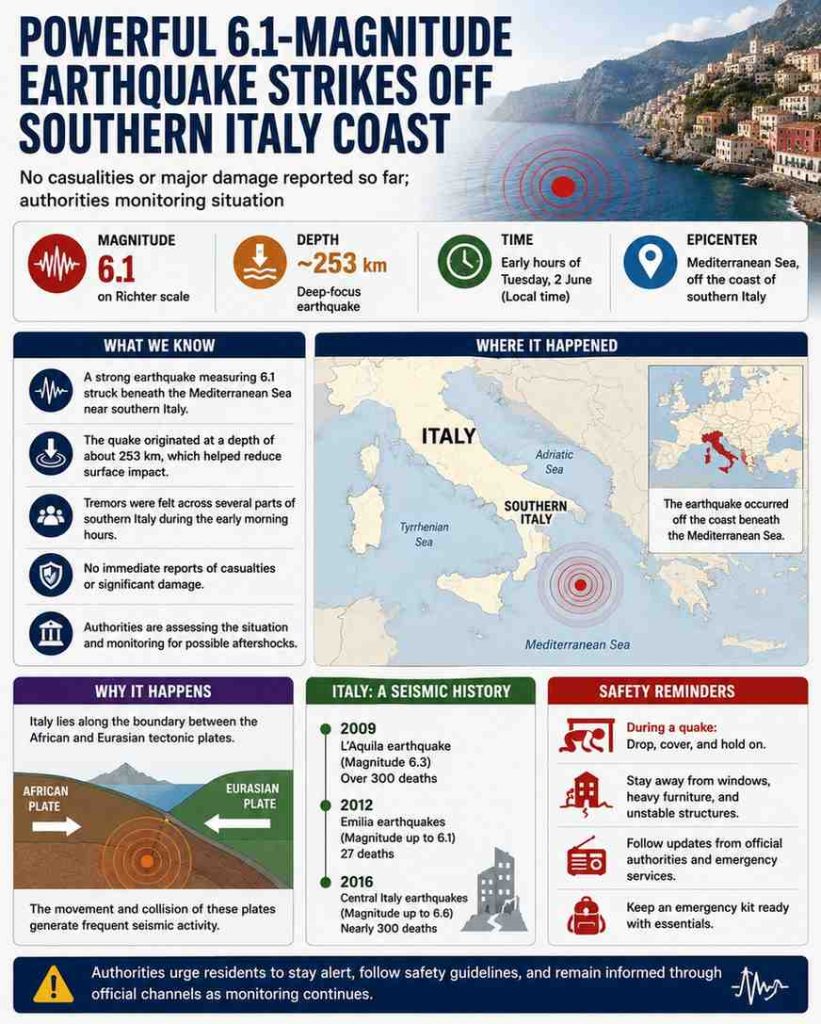
A strong earthquake struck beneath the Mediterranean Sea near southern Italy early Tuesday, sending tremors across parts of the country and prompting authorities to assess potential impacts. Initial reports indicated no casualties or significant structural damage, though officials continued monitoring the region as a precaution.
The earthquake, measured at magnitude 6.1 by seismic monitoring agencies, originated deep below the Earth’s surface. Experts say the considerable depth of the event likely helped limit its destructive potential despite its relatively strong magnitude.
Residents in several southern Italian communities reported feeling the shaking during the early morning hours, while emergency services remained on alert for any delayed reports of damage or infrastructure concerns.
Deep-Focus Quake Reduces Surface Impact
Seismologists noted that the earthquake occurred at a depth of more than 250 kilometers beneath the Mediterranean Sea, classifying it as a deep-focus seismic event.
Unlike shallow earthquakes, which often generate stronger ground shaking near the surface, deep earthquakes tend to disperse energy over a wider area. As a result, they can be felt across large regions while producing comparatively less damage on the ground.
This geological characteristic appears to have played a significant role in limiting the effects of Tuesday’s tremor despite its magnitude.
Experts cautioned, however, that deep earthquakes can still be unsettling for residents and may occasionally be followed by aftershocks, although such events are often less frequent than those associated with shallow quakes.
Why Italy Faces Frequent Earthquakes
Italy remains one of Europe’s most earthquake-prone countries because of its location at the boundary of the African and Eurasian tectonic plates.
The ongoing movement and interaction of these massive geological structures generate significant seismic activity across the Italian peninsula and surrounding Mediterranean region.
Over centuries, Italy has experienced numerous damaging earthquakes that have shaped both its disaster preparedness policies and building regulations.
Among the most notable modern disasters were the 2009 L’Aquila earthquake and the series of powerful earthquakes that struck central Italy in 2016, causing extensive damage and loss of life.
Those events led to renewed efforts to strengthen seismic monitoring networks, improve emergency response capabilities, and enhance building resilience in vulnerable regions.
Authorities Monitor for Aftershocks
Following Tuesday’s earthquake, civil protection agencies and local authorities began reviewing reports from affected areas while monitoring seismic activity for possible aftershocks.
Although no major incidents were immediately reported, infrastructure inspections are expected in locations where residents felt the tremors most strongly.
Emergency officials also reminded citizens to remain informed through official channels and to review earthquake safety procedures, particularly in regions with a history of seismic activity.
Preparedness remains a central component of Italy’s disaster management strategy, especially as scientists continue to emphasize that earthquakes cannot be predicted with precision.
Broader Implications for Seismic Preparedness
While the latest earthquake appears to have passed without serious consequences, it serves as a reminder of the persistent geological risks facing countries across the Mediterranean basin.
Experts frequently stress that resilient infrastructure, public awareness, and rapid emergency response systems remain the most effective tools for reducing the impact of future earthquakes.
As monitoring continues, authorities are expected to provide further updates if additional seismic activity occurs or if inspections reveal previously undetected damage.
For now, the deep offshore location and significant depth of the earthquake appear to have spared southern Italy from the severe consequences often associated with quakes of similar magnitude.
Key Highlights
- A 6.1-magnitude earthquake struck beneath the Mediterranean Sea off the coast of southern Italy.
- The earthquake occurred at a depth of approximately 253 kilometers, making it a deep-focus seismic event.
- No immediate casualties or major damage were reported following the tremor.
- Residents across parts of southern Italy reported feeling the earthquake during the early morning hours.
- Seismologists said the quake’s significant depth likely reduced the risk of severe surface damage.
- Authorities and emergency agencies are monitoring the region for possible aftershocks and conducting precautionary assessments.
- Italy remains one of Europe’s most seismically active countries due to its location between the African and Eurasian tectonic plates.
- The event highlights the ongoing importance of earthquake preparedness, resilient infrastructure, and emergency response planning in earthquake-prone regions.
- Officials have urged residents to stay alert and follow guidance from civil protection authorities as monitoring continues.
Input & Images: Hindusthan Samachar
Edited by Manten Sasank
Add Digital Herald as preferred source on google – click here
Also read – Trump Signals Possible Iran Agreement Within Days as Hormuz Talks Gain Momentum
Last Updated on: Tuesday, June 2, 2026 10:56 am by Mantena Sasank | Published by: Mantena Sasank on Tuesday, June 2, 2026 10:56 am | News Categories: News